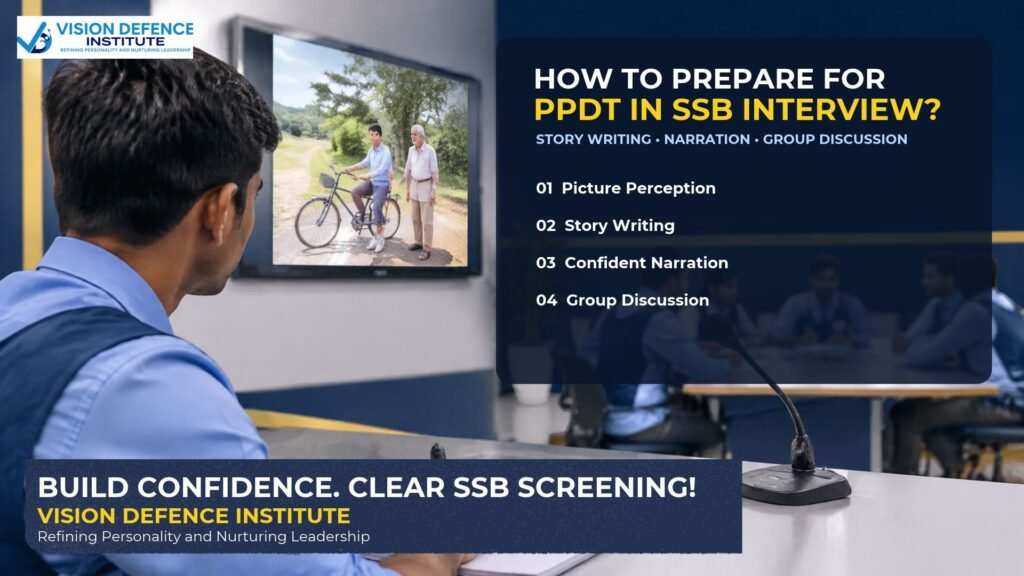
How to Prepare for PPDT in SSB Interview: Story Writing, Narration & Tips
The SSB interview is an important stage in the selection process for candidates aspiring to become officers in the Indian Armed Forces. One of the first challenges candidates face during the screening stage is the Picture Perception and Discussion Test (PPDT).
Many candidates feel nervous because they have to observe a picture, create a meaningful story, narrate it confidently and participate in a group discussion.
However, PPDT is not simply a test of storytelling or English-speaking ability. It gives assessors an opportunity to observe how candidates perceive a situation, organise their thoughts and interact with others.
In this guide, we will explain how to prepare for PPDT in the SSB interview, including story writing, narration, group discussion and common mistakes to avoid.
1. What Is PPDT in the SSB Interview?
PPDT stands for Picture Perception and Discussion Test. It is part of Stage I of the SSB selection process, along with the Officer Intelligence Rating (OIR) test.
Candidates are shown a picture, usually for a short period. They must observe the situation and write a story based on their perception.
After completing the story, candidates narrate it individually to their group. This is followed by a group discussion in which they work towards a common story.
According to the UPSC description of the SSB process, candidates are shortlisted for Stage II based on their combined performance in OIR and PP&DT.
2. Understand the Three Stages of PPDT
PPDT generally involves three important activities.
Stage 1: Picture Perception
A picture is displayed for a limited time. Candidates must observe it carefully and identify:
- Number of visible characters
- Approximate age of the characters
- Gender, where identifiable
- Mood of the characters
- Situation or activity shown in the picture
- Possible central theme
Do not spend time imagining unnecessary details. Focus on what you can reasonably understand from the picture.
Stage 2: Story Writing
After observing the picture, candidates write a short story based on their understanding.
A good story should have:
- A clear main character
- A realistic situation
- A practical problem or objective
- Meaningful action taken by the character
- A logical and positive outcome
Your story should connect naturally with the picture instead of introducing an unrelated situation.
Stage 3: Narration and Group Discussion
Once story writing is complete, candidates narrate their stories individually.
After the narration, the group discusses the picture and tries to develop a common story.
During this activity, candidates should communicate clearly, listen to others and contribute useful ideas.
3. How to Write a Good PPDT Story
Story writing is one of the most important parts of PPDT preparation. You do not need complicated English or dramatic imagination to write a good story.
Focus on creating a simple, logical and realistic sequence of events.
Follow This Simple Story Structure
1. Introduction
Introduce the main character and explain the situation.
2. Problem or Objective
Describe the challenge, responsibility or task faced by the character.
3. Action
Explain how the character takes practical steps to handle the situation.
4. Result
End the story with a realistic and constructive outcome.
Example of a PPDT Story
Picture Situation: A young person standing near a group of people in a village.
Sample Story:
Arun, a 21-year-old college student, noticed that people in his village were facing difficulties because of poor waste management. He discussed the issue with the village residents and organised a cleanliness awareness programme with the support of local volunteers. He divided the volunteers into small teams and arranged waste collection activities. He also encouraged residents to maintain cleanliness around their homes. With everyone’s cooperation, the village became cleaner and the residents developed better waste management habits.
Why is this a useful example?
- The main character has a clear role.
- The situation is realistic.
- The character takes practical action.
- Other people are involved in solving the problem.
- The story has a logical conclusion.
Remember, your story should be based on the actual picture you observe. Do not memorise this example and use it for every picture.
4. PPDT Narration Tips: How to Present Your Story Confidently
After completing the story, you must present it to your group.
Some candidates write good stories but struggle during narration because of nervousness or a lack of speaking practice.
Follow these tips to improve your narration.
1. Speak Clearly
Use simple and understandable sentences. Your aim should be to communicate your story clearly.
2. Maintain a Natural Voice
Speak at a comfortable volume. Avoid speaking too quickly or too softly.
3. Maintain Proper Body Language
Sit comfortably, maintain a natural posture and avoid unnecessary movements.
4. Follow a Logical Sequence
Present your story in the same order in which the events happen.
5. Practise Within the Given Time
Practise narrating short stories within approximately one minute. Follow the actual instructions and time limits provided by the SSB board.
6. Stay Calm If You Make a Mistake
If you forget a sentence, continue naturally. Do not stop your narration because of a small mistake.
5. How to Perform Well in PPDT Group Discussion
The group discussion is another important part of PPDT. After individual narration, candidates discuss their perceptions and try to arrive at a common story.
The aim is not to prove that your story is better than everyone else’s. You should contribute meaningfully while helping the group move towards a common understanding.
Important Group Discussion Tips
1. Listen to Other Candidates
Pay attention to the stories presented by other members. Identify common points and useful ideas.
2. Speak at the Right Time
Look for a suitable opportunity to express your opinion. Avoid interrupting others repeatedly.
3. Present Practical Suggestions
Contribute ideas that are relevant to the picture and help the group develop a logical story.
4. Respect Different Opinions
You may not agree with every suggestion. Respond politely and explain your point of view.
5. Avoid Shouting
Speaking loudly over others does not make your contribution more valuable. Maintain a clear and confident voice.
6. Support the Group’s Progress
If the discussion becomes confusing, help bring it back to the main situation and suggest a common direction.
6. Common PPDT Mistakes Candidates Should Avoid
Many candidates make avoidable mistakes because they focus too much on impressing the assessors.
Here are some common mistakes to avoid:
- Writing a completely imaginary story unrelated to the picture.
- Creating unrealistic situations or dramatic endings.
- Making the main character solve every problem without involving anyone else.
- Writing unnecessarily complicated sentences.
- Speaking too quickly during narration.
- Interrupting other candidates during group discussion.
- Remaining silent throughout the discussion.
- Arguing continuously to prove that your story is correct.
- Memorising prepared stories instead of observing the picture.
- Losing confidence after making a small mistake.
Remember that a simple, relevant and well-organised contribution is more useful than an exaggerated performance.
7. Daily PPDT Preparation Plan for Beginners
Regular practice can help candidates improve their observation, writing and communication skills.
Here is a simple 45-minute daily preparation plan.
| Activity | Time |
|---|---|
| Observe a picture and identify characters | 5 Minutes |
| Write a short story | 10 Minutes |
| Practise story narration | 10 Minutes |
| Group discussion practice | 15 Minutes |
| Review and identify mistakes | 5 Minutes |
| Total | 45 Minutes |
You can practise with friends, fellow defence aspirants or a small study group.
Try different picture situations so that you learn to think independently rather than repeating the same story structure.
8. How to Improve Your Confidence Before PPDT
Confidence develops through regular practice and preparation.
Try these simple activities:
- Read English articles daily to improve vocabulary.
- Speak about everyday situations for one or two minutes.
- Practise explaining your ideas in simple sentences.
- Participate in group discussions.
- Record your narration and review your clarity and speed.
- Observe real-life situations and think about practical solutions.
- Practise listening carefully before responding.
You do not need perfect English to participate effectively. Clear thinking, relevant communication and regular practice are important.
9. How Vision Defence Can Help with SSB Preparation
Preparing for the SSB interview requires an understanding of the selection process, consistent practice and confidence in different assessment activities.
At Vision Defence, aspiring defence candidates can work towards improving their preparation through structured guidance and practice.
With proper preparation, mock activities and regular feedback, candidates can become more familiar with PPDT, narration and group discussion.
If you are preparing for NDA, CDS or AFCAT and aiming to clear the SSB interview, start building your skills with a consistent preparation routine.
Take the next step towards your defence career with Vision Defence.
Frequently Asked Questions (FAQs)
1. What is PPDT in the SSB interview?
PPDT stands for Picture Perception and Discussion Test. It is part of Stage I screening and involves picture observation, story writing, individual narration and group discussion.
2. How much time is given to write a PPDT story?
The exact instructions and timings are communicated during the test. Candidates commonly practise with approximately 30 seconds for picture observation and a few minutes for writing, but should follow the directions given at the SSB centre.
3. How many words should a PPDT story contain?
There is no universal official word limit that candidates must follow. Focus on writing a short, clear and complete story within the time provided.
4. What should a good PPDT story include?
A good story should include a main character, a relevant situation, practical action and a logical outcome.
5. Is English compulsory for PPDT narration?
Candidates should follow the language instructions given by the SSB board. Practising clear and confident communication is important.
6. How long should PPDT narration take?
Candidates commonly practise presenting their story in approximately one minute. Follow the specific instructions given during the test.
7. How can I improve my PPDT group discussion?
Practise listening, expressing ideas clearly, respecting other opinions and contributing relevant suggestions without interrupting or shouting.
8. Is PPDT part of the SSB screening test?
Yes. PPDT is conducted as part of Stage I along with the Officer Intelligence Rating test.
9. Can I use a prepared story in PPDT?
You should not memorise one story and use it for every picture. Your story must be based on the picture shown during the test.
10. How can beginners practise PPDT at home?
Beginners can use sample pictures, practise observing characters, write short stories, narrate them aloud and participate in group discussions with friends.
Conclusion
PPDT is an important part of the SSB screening process. Candidates should prepare for all three activities: picture perception, story writing and group discussion.
Instead of trying to impress others with complicated stories, focus on observing carefully, thinking logically and communicating your ideas clearly.
With regular practice, constructive feedback and a positive approach, you can become more confident when facing the PPDT.
Prepare with purpose. Practise with confidence. Move closer to your dream of joining the Indian Armed Forces.
Vision Defence – Your Pathway to a Defence Career.