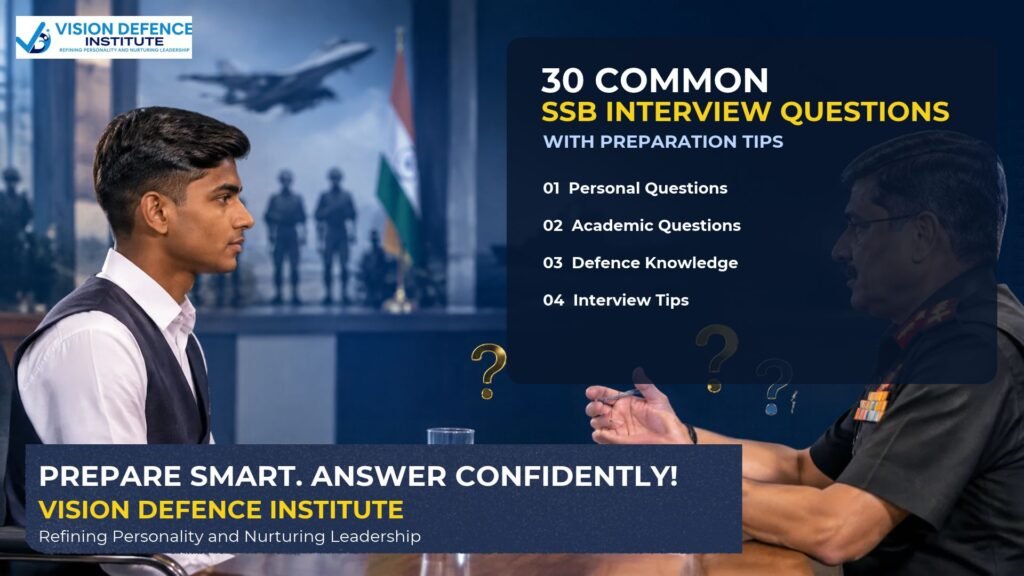
30 Common SSB Interview Questions with Preparation Tips
Preparing for the Services Selection Board (SSB) interview is an important step for candidates who dream of becoming officers in the Indian Armed Forces.
Whether you are appearing through NDA, CDS or AFCAT, the personal interview is an opportunity to present your personality, experiences, interests and motivation to the Interviewing Officer.
Many candidates search for common SSB interview questions because they want to understand what to expect and how to prepare.
The questions may cover your family, education, friends, hobbies, achievements, career goals, general awareness and reasons for choosing a defence career.
However, there is no fixed list of questions asked in every SSB interview. Questions can vary depending on the candidate’s background and the information provided in the Personal Information Questionnaire (PIQ).
In this guide, we cover 30 useful SSB personal interview preparation questions, along with practical tips to help you prepare confidently.
1. What Is the SSB Personal Interview?
The SSB personal interview is a one-to-one interaction between the candidate and the Interviewing Officer (IO).
It is part of Stage II of the SSB selection process. Along with the personal interview, Stage II includes psychological tests, Group Testing Officer (GTO) tasks and the final conference.
The SSB assesses candidates through different activities to understand their personality and potential for becoming officers.
During the personal interview, the Interviewing Officer may ask questions related to:
- Personal and family background
- School and college life
- Academic performance
- Friends and social relationships
- Hobbies and interests
- Sports and extracurricular activities
- Achievements and responsibilities
- Defence knowledge and career motivation
- Current affairs and general awareness
- Personal experiences and decision-making
The questions are not necessarily the same for every candidate. Your own experiences and information can influence the direction of the conversation.
2. 30 Common SSB Interview Questions
Here are 30 practice questions divided into six important categories.
Category 1: Personal Background Questions
These questions help the Interviewing Officer understand your personality, family background and everyday life.
1. Tell me about yourself.
Preparation Tip: Prepare a short introduction covering your education, interests, achievements and important experiences. Avoid giving a memorised speech.
2. Tell me about your family.
Preparation Tip: Know about your family members, their occupations, interests and responsibilities. Explain your relationship with them naturally.
3. What are your strengths and weaknesses?
Preparation Tip: Identify genuine strengths and areas where you need improvement. Support your points with real-life examples.
4. Who is your role model and why?
Preparation Tip: Choose someone who has genuinely influenced you. Explain what you have learned from that person.
5. How do you spend your free time?
Preparation Tip: Be honest about your daily activities, hobbies and interests. Explain how you use your free time productively.
Category 2: Academic and Educational Questions
Your educational background is an important area to prepare because the Interviewing Officer may ask about your academic choices and performance.
6. Which was your favourite subject in school or college? Why?
Preparation Tip: Choose a subject you genuinely enjoy. Be ready to explain its important concepts and why you like it.
7. Why did you choose your particular academic stream or degree?
Preparation Tip: Explain the reasons behind your decision. Connect your choice with your interests, abilities or career goals.
8. How did you perform in your 10th and 12th examinations?
Preparation Tip: Know your marks, percentages and academic performance accurately. Be prepared to explain any major changes in your results.
9. Why did your academic performance improve or decrease in a particular year?
Preparation Tip: Give an honest explanation. Discuss the reasons and what you learned from the experience.
10. Which teacher influenced you the most and why?
Preparation Tip: Think about a teacher who made a genuine difference in your education or personal development. Explain the qualities you admire.
Category 3: Friends, Hobbies and Social Life
These questions explore your interests, relationships and involvement in activities outside academics.
11. Who is your best friend? Tell me about that person.
Preparation Tip: Explain how you know each other, what you appreciate about the person and how you support one another.
12. What qualities do you like and dislike in your friends?
Preparation Tip: Give balanced and realistic observations. Avoid presenting yourself as someone who judges others unnecessarily.
13. What are your hobbies and how regularly do you practise them?
Preparation Tip: Be ready to discuss your hobbies in detail. If you mention reading, sports or music, know enough about that activity to answer follow-up questions.
14. Which sports do you play or follow?
Preparation Tip: Know the basic rules, important players, recent developments and your own participation in the sport you mention.
15. Have you participated in any extracurricular activities?
Preparation Tip: Prepare details about competitions, events, clubs, volunteering or other activities in which you have genuinely participated.
Category 4: Defence Career and Motivation Questions
These questions explore your interest in joining the Armed Forces and your understanding of the responsibilities involved.
16. Why do you want to join the Indian Armed Forces?
Preparation Tip: Explain your genuine motivation. Think about the responsibilities, challenges and opportunities associated with a defence career.
17. Why have you chosen the Army, Navy or Air Force?
Preparation Tip: Understand the role and working environment of the service you have selected. Explain why it matches your interests and career goals.
18. Why do you want to become an officer instead of choosing another career?
Preparation Tip: Discuss your interest in leadership, responsibility, teamwork and serving in the Armed Forces. Avoid giving only general statements.
19. What do you know about the training academy you may join?
Preparation Tip: Research the relevant academy, its location, training structure and role in preparing future officers.
20. What will you do if you are not recommended in the SSB interview?
Preparation Tip: Explain how you would evaluate your performance, learn from the experience and decide your next steps realistically.
Category 5: General Awareness and Defence Knowledge
Candidates should stay informed about important developments in India and understand the basic structure of the Armed Forces.
21. Who are the current heads of the Indian Army, Navy and Air Force?
Preparation Tip: Check the latest official information before your interview. Important appointments can change.
22. What are the major responsibilities of the Indian Armed Forces?
Preparation Tip: Understand the roles of the Army, Navy and Air Force, including national defence and their respective operational responsibilities.
23. Can you name some important defence exercises conducted by India?
Preparation Tip: Learn about major joint and bilateral military exercises, including the participating countries and services.
24. What are some recent developments in India’s defence sector?
Preparation Tip: Follow reliable news sources and official defence announcements. Understand important developments rather than memorising headlines.
25. What is the difference between the Indian Army, Indian Navy and Indian Air Force?
Preparation Tip: Understand the operational roles of each service, their areas of responsibility and how they work together.
Category 6: Situational and Self-Awareness Questions
These questions help candidates reflect on their experiences, decisions and responses to challenging situations.
26. Tell me about a difficult situation you faced and how you handled it.
Preparation Tip: Choose a genuine experience. Explain the situation, your actions and what you learned.
27. Have you ever taken responsibility for leading a team?
Preparation Tip: Discuss a real example from school, college, sports or another activity. Explain your contribution and the outcome.
28. What is one mistake you made, and what did you learn from it?
Preparation Tip: Choose a genuine mistake and show how you took responsibility and improved afterwards.
29. How do you handle pressure or unexpected challenges?
Preparation Tip: Share practical methods you use to stay organised and make decisions. Support your answer with an example.
30. Why should the SSB recommend you?
Preparation Tip: Reflect on your genuine qualities, experiences and potential. Avoid comparing yourself with other candidates or making exaggerated claims.
3. How to Prepare for the SSB Personal Interview
Preparing for these questions requires more than memorising answers. You should understand your own background and be ready to discuss your experiences naturally.
Follow these preparation steps:
1. Prepare Your PIQ Information
Review the details you may provide in your Personal Information Questionnaire.
Be familiar with:
- Your educational qualifications
- School and college details
- Academic marks and achievements
- Family members and their occupations
- Hobbies and interests
- Sports and extracurricular activities
- Positions of responsibility
- Important personal experiences
Every detail you provide may lead to additional questions.
2. Practise Self-Introduction
Prepare to introduce yourself clearly. Include relevant information about your education, interests, achievements and goals.
Do not memorise a long speech. Practise speaking naturally.
3. Improve General Awareness
Read reliable news sources regularly and follow important developments related to:
- National affairs
- International relations
- Defence and security
- Science and technology
- Sports
- Government initiatives
Try to understand the importance of each development instead of simply remembering its headline.
4. Understand Your Hobbies
If you mention a hobby, be prepared to discuss it.
For example, if you enjoy cricket, learn about its rules, major tournaments and recent developments. If you enjoy reading, be ready to discuss books you have actually read.
5. Practise Speaking Clearly
Practise answering questions aloud. Focus on clarity, logical explanations and a natural speaking style.
You can record your practice sessions and review your communication.
6. Be Honest and Consistent
Your answers should reflect your actual experiences and opinions.
Avoid inventing achievements, exaggerating your abilities or giving answers simply because you think they sound impressive.
4. Common Mistakes to Avoid in the SSB Personal Interview
Even well-prepared candidates can make mistakes when they become nervous or try too hard to impress the Interviewing Officer.
Avoid these common mistakes:
- Memorising answers from websites or preparation books.
- Giving false information about achievements or experiences.
- Providing inconsistent details about your education or family.
- Claiming hobbies without understanding them.
- Giving long answers without addressing the question.
- Guessing answers when you do not know the information.
- Speaking negatively about friends, teachers or family members.
- Showing overconfidence or unnecessary attitude.
- Ignoring current affairs and basic defence knowledge.
- Failing to reflect on your strengths and areas for improvement.
Remember, genuine and clear communication is more useful than rehearsed answers.
5. Seven-Day SSB Personal Interview Preparation Plan
If your SSB interview is approaching, use this sample seven-day plan to organise your preparation.
| Day | Preparation Activity |
|---|---|
| Day 1 | Prepare your personal introduction and family details |
| Day 2 | Review academic background and achievements |
| Day 3 | Prepare hobbies, sports and extracurricular activities |
| Day 4 | Understand your motivation for joining the Armed Forces |
| Day 5 | Revise defence knowledge and current affairs |
| Day 6 | Practise situational and self-awareness questions |
| Day 7 | Conduct a complete mock personal interview and review your answers |
You can repeat this plan and spend additional time on areas where you need improvement.
6. How Vision Defence Can Help You Prepare for SSB
Preparing for the SSB interview requires self-awareness, communication skills, general awareness and an understanding of the selection process.
At Vision Defence, aspiring candidates can work towards their defence career goals with structured preparation and guidance.
With regular practice, mock interview activities and constructive feedback, candidates can become more familiar with the personal interview process and improve their confidence.
Whether you are preparing through NDA, CDS or AFCAT, developing the right preparation habits can help you approach the SSB selection process more confidently.
Start your SSB preparation journey with Vision Defence.
Frequently Asked Questions (FAQs)
1. What are the most common SSB interview questions?
Common preparation questions cover personal background, family, education, hobbies, achievements, defence motivation, current affairs and situational experiences.
2. Is there a fixed list of questions asked in the SSB interview?
No. There is no fixed official question list. Questions vary depending on the candidate’s background, PIQ information and the direction of the interview.
3. How many questions are asked in an SSB personal interview?
There is no fixed number. The number of questions depends on the conversation, the candidate’s responses and the time available.
4. Are SSB interview questions the same for NDA, CDS and AFCAT candidates?
The broad purpose of the personal interview is similar across these entries, but questions can vary depending on the candidate’s educational background, experiences and entry.
5. Should I memorise SSB interview answers?
No. Memorising answers can make your responses sound unnatural. Understand your experiences and practise expressing your thoughts clearly.
6. What is a PIQ form in SSB?
PIQ stands for Personal Information Questionnaire. It contains details about a candidate’s background, education, family, interests and achievements.
7. How can I improve my confidence for the SSB interview?
Practise speaking regularly, prepare your personal information, improve general awareness and participate in mock interviews.
8. What happens if I do not know the answer to an SSB interview question?
Do not invent an answer. Be honest about what you know and do not know, and respond calmly.
9. Are current affairs important for the SSB personal interview?
Yes. General awareness can help you discuss national, international and defence-related developments with better understanding.
10. Can beginners prepare for the SSB personal interview at home?
Yes. Beginners can start by reviewing their personal information, practising common questions, reading news and conducting mock interviews.
Conclusion
The SSB personal interview is an opportunity to understand yourself better and communicate your experiences, interests and career motivation.
Practising these 30 common SSB interview questions can help you become familiar with different question categories and prepare your own responses.
Do not focus on memorising perfect answers. Instead, develop self-awareness, stay informed, communicate honestly and learn from your experiences.
Prepare with confidence. Stay genuine. Take the next step towards becoming an officer in the Indian Armed Forces.
Vision Defence – Your Pathway to a Defence Career.