NDA for Girls 2027: Eligibility, Age Limit, Selection Process & Training
NDA for Girls: Eligibility, Age Limit, Selection Process & Training Explained Girls who dream of becoming officers in the Indian Armed Forces can apply for the National Defence Academy (NDA) examination conducted by the Union Public Service Commission (UPSC). Female candidates are eligible to compete for vacancies in the Army, Navy and Air Force wings of the NDA, subject to the prescribed educational, age, medical and other eligibility conditions. The NDA entry gives young women an opportunity to begin their defence careers after Class 12. However, candidates must understand the age limit, required subjects, written examination, SSB interview and training process before applying. In this guide, we explain NDA eligibility for girls, the expected age criteria for NDA 2027, service-wise educational qualifications, selection stages and preparation tips. Can Girls Join NDA After 12th? Yes. Girls can join the National Defence Academy after Class 12 by qualifying in the UPSC NDA and Naval Academy Examination. Female candidates are eligible to apply for notified vacancies in: Indian Army – NDA Army Wing Indian Navy – NDA Naval Wing Indian Air Force – NDA Air Force Wing The available vacancies are announced separately for male and female candidates in each examination notification. Female candidates take the common written examination, but their selection and merit lists are prepared separately according to the notified vacancies. Candidates must select their service preferences carefully while submitting the application form. NDA Eligibility for Girls 2027 Female candidates must satisfy the following eligibility conditions: Eligibility Criteria Requirement Gender Female candidates are eligible Marital status Unmarried Nationality Must satisfy UPSC nationality conditions Educational qualification Class 12 pass or appearing Age limit As specified in the examination notification Medical fitness Must meet prescribed Armed Forces medical standards Candidates should remember that meeting the educational and age requirements does not automatically guarantee admission. Final selection also depends on written examination performance, SSB recommendation, medical fitness and merit. NDA Age Limit for Girls 2027 The NDA examination has a prescribed age range. There is no separate age window for female candidates; the applicable date-of-birth criteria are specified in the UPSC notification. For NDA & NA Examination II, 2026, the official notification permitted unmarried male and female candidates born between 1 January 2008 and 1 January 2011, inclusive. For NDA & NA Examination I, 2027, the detailed notification is scheduled for 2 December 2026. Based on the previous examination cycle, the expected date-of-birth range is 2 July 2008 to 1 July 2011. This is an expected range, not yet an officially confirmed criterion for NDA I 2027. Candidates must check the detailed notification before applying. UPSC accepts the date of birth recorded in the Matriculation or equivalent certificate. Important: Do not rely on an age calculator or an older examination’s date-of-birth range when submitting your application. Always verify the dates in the relevant UPSC notification. Educational Qualification for Girls in NDA The educational qualification depends on the service wing a candidate wishes to join. 1. Army Wing Candidates must have passed Class 12 or an equivalent examination under the 10+2 pattern from a recognised board or university. Students from the following streams can apply: Science Commerce Arts Therefore, girls studying Arts or Commerce can also apply for the NDA Army Wing, provided they meet the other eligibility conditions. 2. Navy Wing Candidates must have passed Class 12 with Physics, Chemistry and Mathematics (PCM). Students without the required PCM subjects are not eligible for this wing through the NDA entry. 3. Air Force Wing Candidates must have passed Class 12 with Physics, Chemistry and Mathematics. The Air Force also has additional service-specific medical and aptitude requirements for relevant roles, including the Flying Branch. Quick Comparison NDA Wing Class 12 Requirement Army Any stream Navy Physics, Chemistry and Mathematics Air Force Physics, Chemistry and Mathematics Can Class 12 students apply? Yes. Students appearing in their Class 12 examination can apply, subject to the conditions and deadline for submitting proof of passing prescribed in the notification. Candidates studying in Class 11 are not eligible. NDA Selection Process for Girls The NDA selection process consists of multiple stages. Female candidates must qualify at each required stage to be considered for final admission. Stage 1: UPSC Written Examination The first stage is the written examination conducted by UPSC. It contains two papers: Subject Maximum Marks Duration Mathematics 300 2.5 hours General Ability Test (GAT) 600 2.5 hours Total 900 5 hours The Mathematics paper tests mathematical understanding and problem-solving skills. The General Ability Test includes: English Physics Chemistry General Science History Geography Current Affairs Both papers contain objective-type questions. Negative marking applies to incorrect answers. Candidates must achieve the prescribed qualifying marks to progress to the SSB interview. Stage 2: SSB Interview Candidates who qualify in the written examination are called for the Services Selection Board (SSB) interview. The SSB process evaluates a candidate’s personality, leadership potential, decision-making ability, communication skills and suitability for a career as an officer. The SSB selection procedure has two stages. Stage I: Screening Test This includes: Officer Intelligence Rating (OIR) tests Picture Perception and Description Test (PP&DT) Candidates are shortlisted based on their performance in the screening process. Stage II: Psychological and Personality Assessment Candidates who clear Stage I proceed to the remaining assessment, which includes: Psychological tests Group Testing Officer (GTO) tasks Personal interview Conference The assessors evaluate candidates holistically rather than judging them on one activity alone. Stage 3: Medical Examination Candidates recommended by the SSB undergo a medical examination conducted by the Armed Forces medical authorities. The medical assessment checks whether the candidate meets the prescribed physical and medical standards. It may include: General physical examination Vision and eyesight assessment Hearing assessment Dental examination Evaluation of overall health Other prescribed medical investigations Medical standards can vary according to the service and role. Candidates should refer to the official medical guidelines rather than relying on general fitness advice. Stage 4: Final Merit List The final selection depends on: Written examination marks SSB interview marks Medical fitness Available vacancies Eligibility and
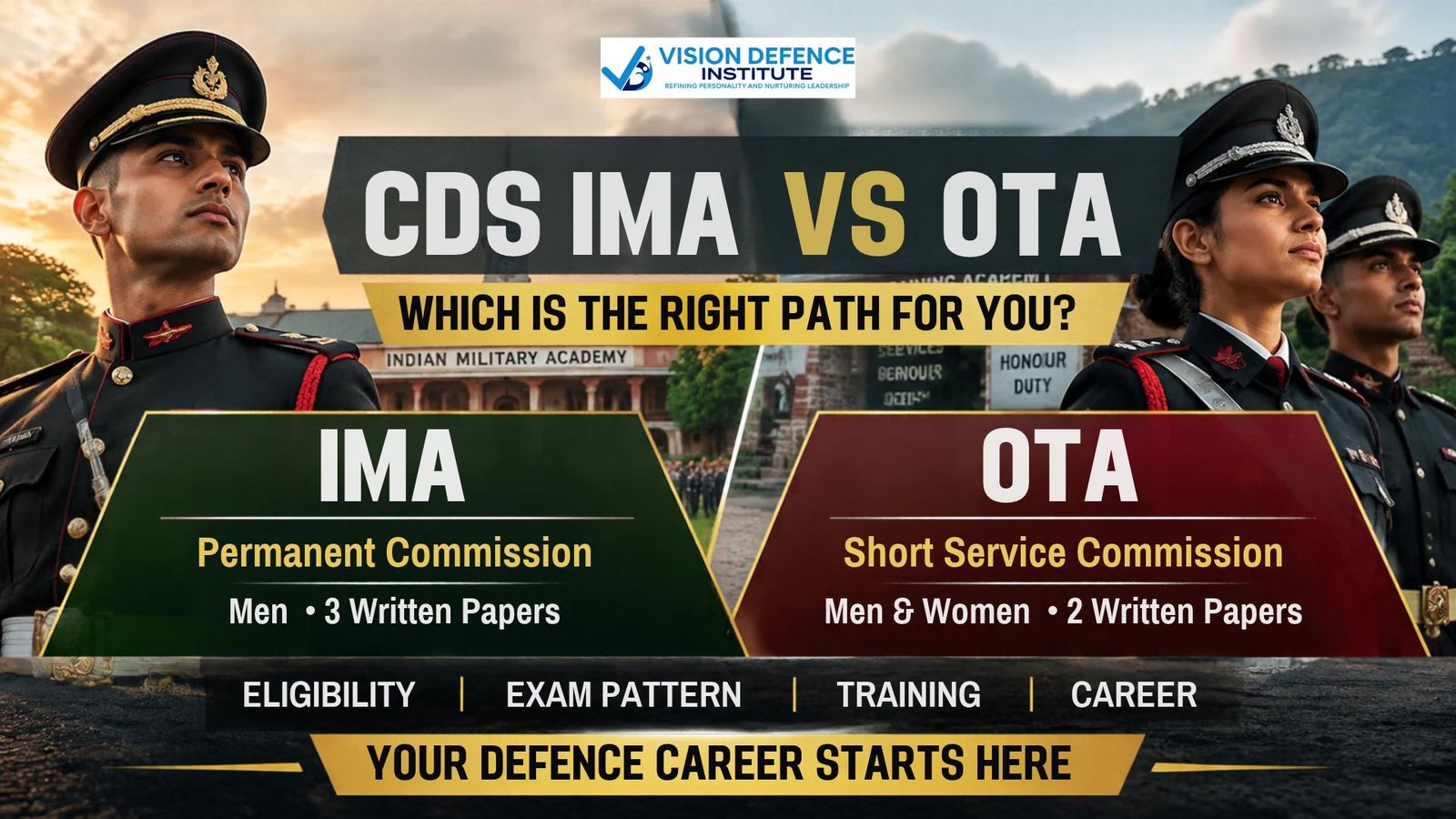
CDS IMA vs OTA: Eligibility, Exam Pattern & Differences
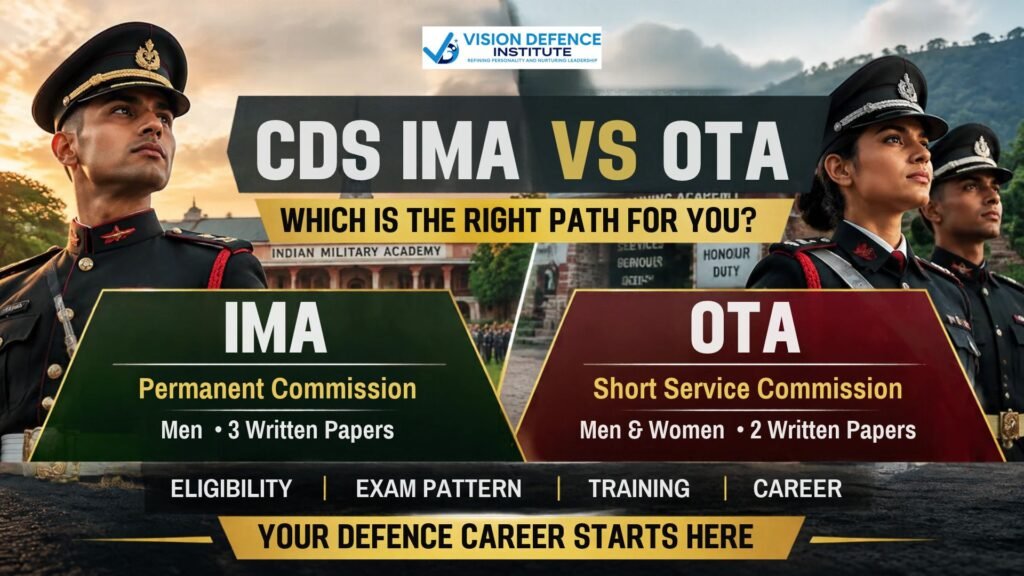
CDS IMA vs OTA: Eligibility, Exam Pattern, Training & Career Differences Are you preparing for the Combined Defence Services (CDS) examination and confused about choosing between the Indian Military Academy (IMA) and Officers Training Academy (OTA)? Both academies provide opportunities to become an officer in the Indian Army. However, they differ in eligibility conditions, written examination pattern, training duration and type of commission. For example, IMA offers Permanent Commission through the CDS entry, while OTA offers Short Service Commission. The written examination for IMA includes Mathematics, but OTA candidates do not have a Mathematics paper. Understanding these differences can help you select the right entry according to your educational background, eligibility and long-term career goals. In this guide, we will compare CDS IMA vs OTA in detail, covering eligibility, examination pattern, training and career opportunities. 1. What Is IMA in CDS? The Indian Military Academy (IMA) is located in Dehradun, Uttarakhand. It trains selected candidates to become officers in the Indian Army. Through the CDS examination, eligible male graduates can apply for admission to IMA. After successfully completing the prescribed training, cadets are granted Permanent Commission in the Indian Army, subject to the applicable conditions. Important details about IMA: Academy: Indian Military Academy Location: Dehradun, Uttarakhand Entry: CDS examination Eligible candidates through CDS: Men Commission: Permanent Commission Training duration: Approximately 18 months 2. What Is OTA in CDS? The Officers Training Academy (OTA) is located in Chennai, Tamil Nadu. It trains candidates selected for Short Service Commission in the Indian Army. Through CDS, eligible male and female graduates can apply for the respective OTA courses. After successfully completing training, candidates are granted Short Service Commission, subject to the applicable conditions. Important details about OTA: Academy: Officers Training Academy Location: Chennai, Tamil Nadu Entry: CDS examination Eligible candidates through CDS: Men and women Commission: Short Service Commission Training duration: Approximately 49 weeks 3. CDS IMA vs OTA: Key Differences Here is a quick comparison of the two academies. Particulars IMA OTA Full Form Indian Military Academy Officers Training Academy Location Dehradun Chennai Entry CDS CDS Eligible Candidates Men Men and Women Commission Permanent Commission Short Service Commission Graduation Requirement Recognised degree Recognised degree Written Exam Subjects English, GK, Mathematics English, GK Written Exam Marks 300 200 SSB Marks 300 200 Training Duration Approx. 18 months Approx. 49 weeks Both academies prepare candidates for leadership responsibilities in the Indian Army, but the commission and career structures are different. 4. CDS IMA Eligibility Criteria Candidates applying for IMA through CDS must satisfy the prescribed educational, age, nationality and marital status conditions. Educational Qualification Candidates must hold a degree from a recognised university or an equivalent qualification. Final-year degree students may also apply if they meet the conditions mentioned in the UPSC notification. Graduates from different streams, including BA, BSc, BCom and Engineering, can apply if they satisfy the other requirements. Age Limit For CDS II 2026, the IMA age requirement is 19–24 years. The notification specifies the eligible date-of-birth range as 1 July 2003 to 1 July 2008, inclusive. Gender and Marital Status Only unmarried male candidates are eligible for IMA through CDS. Candidates must satisfy the marital status conditions mentioned in the notification. Nationality Candidates must meet the nationality requirements specified by UPSC, including the applicable provisions for Indian citizens and other eligible categories. 5. CDS OTA Eligibility Criteria OTA provides opportunities for eligible male and female graduates to join the Indian Army through Short Service Commission. Educational Qualification Candidates must hold a degree from a recognised university or an equivalent qualification. Final-year students may apply subject to the conditions in the relevant notification. There is no compulsory Mathematics requirement at Class 12 level for the OTA graduate entry. Age Limit For CDS II 2026, the OTA age requirement is 19–25 years. The specified date-of-birth range is 1 July 2002 to 1 July 2008, inclusive. Gender and Marital Status For OTA Men: Eligible candidates are unmarried male candidates who satisfy the prescribed conditions. For OTA Women: Unmarried women may apply. Issueless widows who have not remarried may apply. Issueless divorcees who possess the required divorce documents and have not remarried may apply. Candidates must carefully read the applicable notification for complete conditions. 6. CDS IMA vs OTA: Written Exam Pattern One of the biggest differences between IMA and OTA is the written examination. IMA candidates must appear for three papers, whereas OTA candidates appear for only two. IMA Written Examination Pattern Subject Duration Marks English 2 Hours 100 General Knowledge 2 Hours 100 Elementary Mathematics 2 Hours 100 Total 6 Hours 300 OTA Written Examination Pattern Subject Duration Marks English 2 Hours 100 General Knowledge 2 Hours 100 Total 4 Hours 200 Important Exam Details All written papers contain objective-type questions. Negative marking applies for incorrect answers. English, General Knowledge and Mathematics are conducted as separate papers. The General Knowledge and Mathematics papers are bilingual in Hindi and English. The standard of Elementary Mathematics is approximately at the matriculation level. Key Difference: IMA includes a Mathematics paper worth 100 marks, while OTA does not include Mathematics in its written examination. 7. CDS Syllabus: IMA vs OTA Both IMA and OTA candidates must prepare for English and General Knowledge. However, IMA candidates must additionally prepare for Elementary Mathematics. English Important topics include: Grammar Vocabulary Synonyms and Antonyms Sentence Improvement Spotting Errors Reading Comprehension Sentence Arrangement General Knowledge Important areas include: Indian History Geography General Science Current Affairs Indian Polity Economics Defence-related developments Elementary Mathematics – IMA Only Important topics include: Arithmetic Algebra Trigonometry Geometry Mensuration Statistics Candidates choosing IMA should allocate sufficient preparation time to Mathematics. OTA candidates can use the additional preparation time to strengthen English and General Knowledge. 8. SSB Interview Process for IMA and OTA After qualifying in the CDS written examination, shortlisted candidates are called for the Services Selection Board (SSB) interview. The SSB process assesses candidates through different activities. Stage I: Screening Test This includes: Officer Intelligence Rating (OIR) Tests Picture Perception and Discussion Test (PP&DT) Candidates
AFCAT Eligibility for BA, BSc, BCom & Engineering Graduates
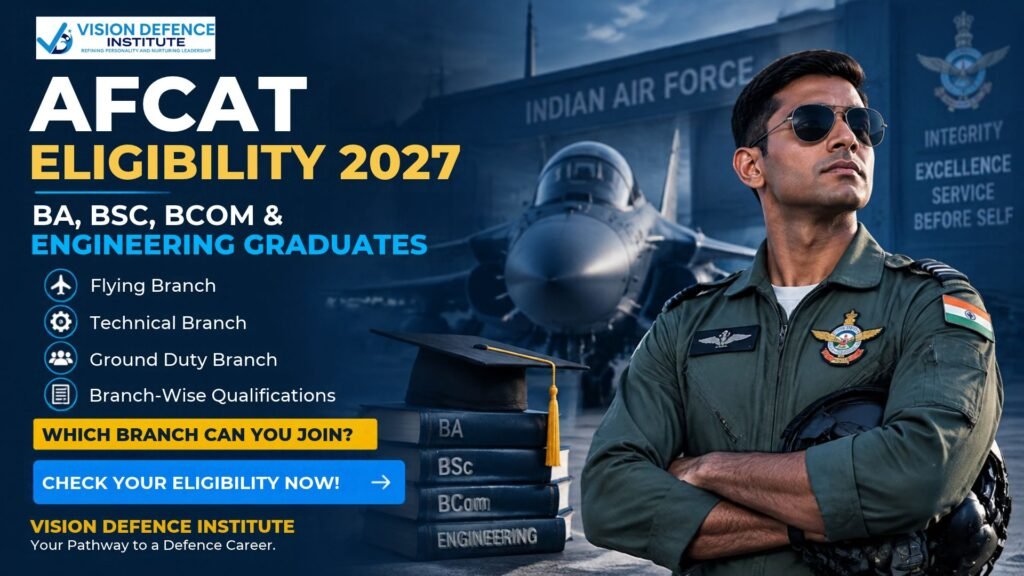
AFCAT Eligibility for BA, BSc, BCom & Engineering Graduates: Branch-Wise Guide Are you a BA, BSc, BCom or Engineering graduate dreaming of joining the Indian Air Force as an officer? The Air Force Common Admission Test (AFCAT) provides opportunities for eligible graduates to apply for Flying and Ground Duty branches of the Indian Air Force. However, not every graduation degree qualifies you for every branch. Your educational background, Class 12 subjects, age and other eligibility conditions determine which branches you can apply for. For example, a BA graduate may be eligible for certain Ground Duty branches, while an Engineering graduate may qualify for Technical branches depending on their engineering discipline. In this guide, we explain AFCAT eligibility for BA, BSc, BCom and Engineering graduates, including branch-wise educational qualifications and important requirements based on the AFCAT 01/2027 notification. 1. What Is AFCAT? AFCAT stands for Air Force Common Admission Test. It is conducted by the Indian Air Force to recruit eligible candidates for officer-level positions in different branches. Through AFCAT, candidates can apply for: Flying Branch Ground Duty (Technical) Ground Duty (Non-Technical) The Ground Duty Non-Technical category includes branches such as Administration, Logistics, Accounts, Education, Meteorology and Weapon Systems, subject to the applicable entry requirements. Both men and women can apply for eligible branches, depending on the vacancies and conditions mentioned in the notification. 2. AFCAT Eligibility Criteria 2027: Basic Requirements Before checking your graduation eligibility, understand the basic requirements. Nationality Candidates must be Indian citizens as specified in the Indian Citizenship Act, 1955. Age Limit For AFCAT 01/2027, the age limits are calculated as of 1 January 2028. Branch Age Limit Flying Branch 20–24 years Flying Branch with valid DGCA Commercial Pilot Licence Up to 26 years Ground Duty Technical 20–26 years Ground Duty Non-Technical 20–26 years Date of Birth Range for AFCAT 01/2027: Flying Branch: 2 January 2004 to 1 January 2008. Flying Branch with eligible Commercial Pilot Licence: 2 January 2002 to 1 January 2008. Ground Duty Branches: 2 January 2002 to 1 January 2008. Both starting and ending dates are inclusive. Marital Status Candidates must be unmarried at the commencement of the course. Marriage is not permitted during training under the notification conditions. Educational Qualification Candidates must possess the educational qualifications specified for their preferred branch. A recognised university and the required degree duration are important considerations. 3. AFCAT Eligibility for BA Graduates If you have completed a Bachelor of Arts (BA), you may have opportunities in the Ground Duty Non-Technical branches. A BA degree does not automatically qualify you for every AFCAT branch. Check the specific requirements below. Branches Available for BA Graduates 1. Administration Branch Passed Class 12. Completed a minimum three-year graduation degree in any discipline from a recognised university. A BA graduate can meet the degree-stream requirement for this branch. 2. Logistics Branch Passed Class 12. Completed a minimum three-year graduation degree in any discipline from a recognised university. BA graduates can also meet the degree-stream requirement for Logistics. 3. Education Branch Passed Class 12. Completed graduation in any discipline. Completed postgraduation in any discipline, subject to the notification’s conditions. A BA graduate may consider this branch after completing the required postgraduate qualification. 4. Flying Branch A BA graduate may be eligible for the Flying Branch if they have: Passed Class 12 with Mathematics and Physics. Completed a minimum three-year graduation degree in any discipline from a recognised university. Therefore, a BA degree alone is not sufficient. Your Class 12 Mathematics and Physics subjects are also important. 5. Weapon Systems Branch A BA graduate may meet the degree requirement if they have: Passed Class 12 with Mathematics and Physics. Completed a minimum three-year graduation degree in any discipline from a recognised university. The Class 12 subject requirement is compulsory. 4. AFCAT Eligibility for BSc Graduates BSc graduates may have opportunities in several AFCAT branches depending on their specialisation and Class 12 subjects. Branches Available for BSc Graduates 1. Administration and Logistics Passed Class 12. Completed a minimum three-year graduation degree in any discipline from a recognised university. General BSc graduates can meet the degree-stream requirement. 2. Flying Branch Passed Class 12 with Mathematics and Physics. Completed a minimum three-year graduation degree in any discipline. BSc graduates can apply if they satisfy both requirements. 3. Weapon Systems Branch Passed Class 12 with Mathematics and Physics. Completed a minimum three-year graduation degree in any discipline. The required Class 12 subjects must be present. 4. Accounts Branch Candidates with BSc in Finance may meet the specified educational qualification for the Accounts Branch. A general BSc degree without the required Finance specialisation does not automatically qualify. 5. Meteorology Branch Candidates may be eligible through either of the following routes: BSc with Physics and Mathematics. A four-year Engineering or Technology degree in one of the disciplines specified in the notification. Meteorology eligibility depends on the exact subjects or engineering discipline. 6. Education Branch Candidates with BSc graduation may consider this branch after completing the required postgraduate qualification in any discipline, subject to the notification conditions. 5. AFCAT Eligibility for BCom Graduates BCom graduates can explore opportunities in Ground Duty Non-Technical branches. Branches Available for BCom Graduates 1. Accounts Branch BCom graduates can meet the specified degree requirement if they have completed a minimum three-year BCom degree from a recognised university. This is one of the directly relevant AFCAT branches for Commerce graduates. 2. Administration Branch Passed Class 12. Completed a minimum three-year graduation degree in any discipline. BCom graduates can meet this educational requirement. 3. Logistics Branch Passed Class 12. Completed a minimum three-year graduation degree in any discipline. BCom graduates can also consider this branch. 4. Education Branch BCom graduates may be eligible after completing the required postgraduate qualification in any discipline, along with the graduation requirement. 5. Flying Branch BCom graduates may be eligible if they have passed Class 12 with Mathematics and Physics and completed a qualifying graduation degree. 6. Weapon Systems Branch BCom graduates may meet the degree requirement if they also passed
SSB Conference Day: Process, Questions & Final Results
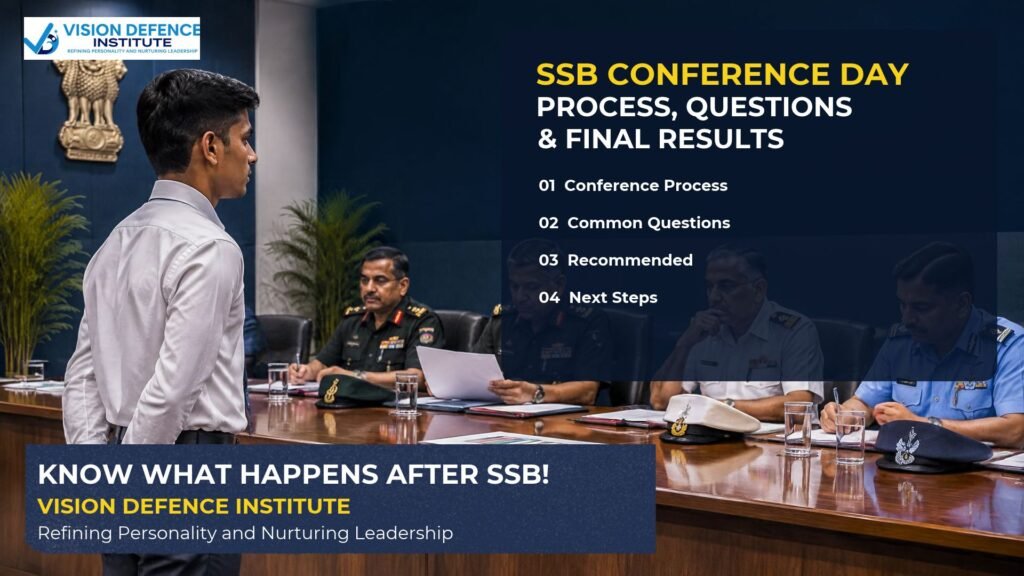
SSB Conference Day: What to Expect, Questions & Final Results After completing the psychological tests, GTO tasks and personal interview, candidates reach the final stage of the SSB selection process: Conference Day. For many defence aspirants, this is one of the most anticipated days because the board finalises its recommendation decision. Candidates often have questions such as: What happens inside the SSB conference room? Who are the officers present during the conference? What questions might the board ask? How is the final result announced? What happens after getting recommended? Understanding the SSB Conference Day process can help candidates approach the final interaction with confidence. In this guide, we explain what happens during the conference, common practice questions, preparation tips and the next steps after the result. 1. What Is SSB Conference Day? SSB Conference Day is the final stage of the SSB assessment process. It generally takes place on the fifth day of the selection procedure. During the conference, the assessors come together to review the candidate’s overall performance throughout the SSB. The three main assessors are: Interviewing Officer (IO): Assesses the candidate through the personal interview. Group Testing Officer (GTO): Observes the candidate during group activities and outdoor tasks. Psychologist: Evaluates responses in psychological tests. The board considers the observations from different assessment activities before reaching its final recommendation decision. The conference is not simply another written or physical examination. It brings together the observations collected throughout the selection process. 2. What Happens on SSB Conference Day? Candidates generally follow the instructions provided by their respective selection centres. The process usually includes the following activities. Step 1: Morning Reporting and Preparation Candidates report according to the schedule given by the selection centre. They should: Wear the prescribed formal dress. Follow the reporting instructions. Keep their chest number and required documents ready. Maintain discipline while waiting for their turn. Step 2: Candidates Are Called Individually Candidates are generally called into the conference room one by one. The board members are present during this interaction. The candidate enters, greets the board and follows the instructions given. Step 3: Short Conference Interaction The board may ask a few questions about the candidate’s SSB experience, performance or personal observations. Some candidates may have a very short interaction, while others may be asked additional questions. The duration and questions can vary between candidates and selection boards. Step 4: Final Board Discussion After the individual interactions, the board considers the assessors’ observations and finalises the recommendation decisions. Step 5: Result Announcement Once the conference process is completed, the selection centre announces the result according to its schedule. Candidates are informed whether they have been recommended or not recommended. 3. Who Is Present During the SSB Conference? The conference brings together the officers involved in assessing candidates during the selection process. The main participants include: Board Member Main Responsibility President or Deputy President Leads the conference Interviewing Officer Reviews personal interview observations Group Testing Officer Reviews GTO task performance Psychologist Reviews psychological assessment Other board members, where applicable Participate in the board’s assessment process Each assessor contributes observations from a different assessment perspective. The final decision considers the candidate’s overall performance rather than relying on just one activity. 4. 15 Common SSB Conference Questions There is no fixed official list of questions asked during the SSB conference. However, candidates can practise questions related to their experience, performance and future plans. Here are 15 useful practice questions. Questions About Your SSB Experience 1. How was your overall experience at the SSB centre? Preparation Tip: Share your genuine experience in a balanced and respectful manner. 2. Which activity did you enjoy the most during the SSB? Preparation Tip: Explain why you enjoyed that activity and what you learned from it. 3. Which task did you find the most challenging? Preparation Tip: Describe the challenge honestly and explain how you approached it. 4. What did you learn about yourself during these five days? Preparation Tip: Think about your strengths, areas for improvement and experiences during the assessment. 5. Do you have any suggestions regarding the facilities or arrangements? Preparation Tip: If you have a genuine suggestion, explain it politely and constructively. Questions About Your Performance 6. Which GTO task do you think you performed well in? Preparation Tip: Mention a task where you made a genuine contribution and explain your role. 7. Which activity would you like to improve if you had another opportunity? Preparation Tip: Identify a real area for improvement rather than claiming that everything went perfectly. 8. Do you think you contributed effectively during group discussions? Preparation Tip: Reflect on your participation, listening skills and communication. 9. What was your biggest learning experience during the SSB? Preparation Tip: Explain one meaningful lesson from your experience. 10. Is there anything about your performance that you would like to explain? Preparation Tip: Answer directly and honestly. Avoid making excuses or blaming other candidates. Questions About Your Future Plans 11. What will you do if you are not recommended? Preparation Tip: Explain how you would accept the outcome, review your preparation and decide your next steps. 12. Will you appear for the SSB again if you get another opportunity? Preparation Tip: Give an honest answer based on your career goals and eligibility. 13. Why do you still want to join the Armed Forces? Preparation Tip: Explain your genuine motivation and understanding of the responsibilities involved. 14. What have you learned from interacting with other candidates? Preparation Tip: Share a real observation about teamwork, communication or different perspectives. 15. Would you like to tell the board anything else? Preparation Tip: If you have something relevant to add, communicate it briefly. Do not feel that you must give a long speech. Remember, these are preparation questions, not guaranteed conference questions. 5. How to Prepare for SSB Conference Day Although most assessment activities are completed before the conference, candidates should remain attentive and composed. Follow these simple tips. 1. Review Your Overall SSB Experience Think about the different activities you participated
30 Common SSB Interview Questions with Preparation Tips
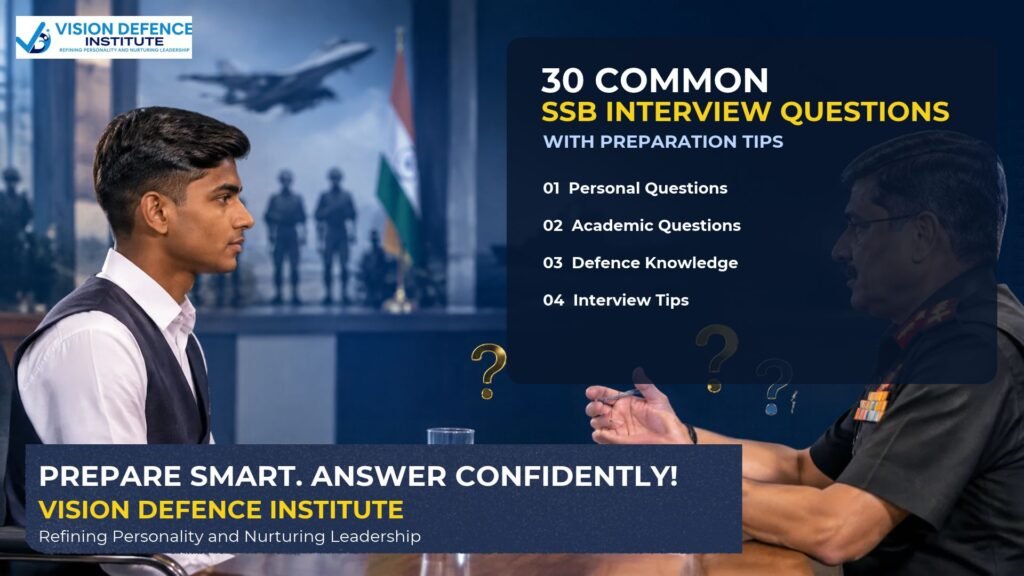
30 Common SSB Interview Questions with Preparation Tips Preparing for the Services Selection Board (SSB) interview is an important step for candidates who dream of becoming officers in the Indian Armed Forces. Whether you are appearing through NDA, CDS or AFCAT, the personal interview is an opportunity to present your personality, experiences, interests and motivation to the Interviewing Officer. Many candidates search for common SSB interview questions because they want to understand what to expect and how to prepare. The questions may cover your family, education, friends, hobbies, achievements, career goals, general awareness and reasons for choosing a defence career. However, there is no fixed list of questions asked in every SSB interview. Questions can vary depending on the candidate’s background and the information provided in the Personal Information Questionnaire (PIQ). In this guide, we cover 30 useful SSB personal interview preparation questions, along with practical tips to help you prepare confidently. 1. What Is the SSB Personal Interview? The SSB personal interview is a one-to-one interaction between the candidate and the Interviewing Officer (IO). It is part of Stage II of the SSB selection process. Along with the personal interview, Stage II includes psychological tests, Group Testing Officer (GTO) tasks and the final conference. The SSB assesses candidates through different activities to understand their personality and potential for becoming officers. During the personal interview, the Interviewing Officer may ask questions related to: Personal and family background School and college life Academic performance Friends and social relationships Hobbies and interests Sports and extracurricular activities Achievements and responsibilities Defence knowledge and career motivation Current affairs and general awareness Personal experiences and decision-making The questions are not necessarily the same for every candidate. Your own experiences and information can influence the direction of the conversation. 2. 30 Common SSB Interview Questions Here are 30 practice questions divided into six important categories. Category 1: Personal Background Questions These questions help the Interviewing Officer understand your personality, family background and everyday life. 1. Tell me about yourself. Preparation Tip: Prepare a short introduction covering your education, interests, achievements and important experiences. Avoid giving a memorised speech. 2. Tell me about your family. Preparation Tip: Know about your family members, their occupations, interests and responsibilities. Explain your relationship with them naturally. 3. What are your strengths and weaknesses? Preparation Tip: Identify genuine strengths and areas where you need improvement. Support your points with real-life examples. 4. Who is your role model and why? Preparation Tip: Choose someone who has genuinely influenced you. Explain what you have learned from that person. 5. How do you spend your free time? Preparation Tip: Be honest about your daily activities, hobbies and interests. Explain how you use your free time productively. Category 2: Academic and Educational Questions Your educational background is an important area to prepare because the Interviewing Officer may ask about your academic choices and performance. 6. Which was your favourite subject in school or college? Why? Preparation Tip: Choose a subject you genuinely enjoy. Be ready to explain its important concepts and why you like it. 7. Why did you choose your particular academic stream or degree? Preparation Tip: Explain the reasons behind your decision. Connect your choice with your interests, abilities or career goals. 8. How did you perform in your 10th and 12th examinations? Preparation Tip: Know your marks, percentages and academic performance accurately. Be prepared to explain any major changes in your results. 9. Why did your academic performance improve or decrease in a particular year? Preparation Tip: Give an honest explanation. Discuss the reasons and what you learned from the experience. 10. Which teacher influenced you the most and why? Preparation Tip: Think about a teacher who made a genuine difference in your education or personal development. Explain the qualities you admire. Category 3: Friends, Hobbies and Social Life These questions explore your interests, relationships and involvement in activities outside academics. 11. Who is your best friend? Tell me about that person. Preparation Tip: Explain how you know each other, what you appreciate about the person and how you support one another. 12. What qualities do you like and dislike in your friends? Preparation Tip: Give balanced and realistic observations. Avoid presenting yourself as someone who judges others unnecessarily. 13. What are your hobbies and how regularly do you practise them? Preparation Tip: Be ready to discuss your hobbies in detail. If you mention reading, sports or music, know enough about that activity to answer follow-up questions. 14. Which sports do you play or follow? Preparation Tip: Know the basic rules, important players, recent developments and your own participation in the sport you mention. 15. Have you participated in any extracurricular activities? Preparation Tip: Prepare details about competitions, events, clubs, volunteering or other activities in which you have genuinely participated. Category 4: Defence Career and Motivation Questions These questions explore your interest in joining the Armed Forces and your understanding of the responsibilities involved. 16. Why do you want to join the Indian Armed Forces? Preparation Tip: Explain your genuine motivation. Think about the responsibilities, challenges and opportunities associated with a defence career. 17. Why have you chosen the Army, Navy or Air Force? Preparation Tip: Understand the role and working environment of the service you have selected. Explain why it matches your interests and career goals. 18. Why do you want to become an officer instead of choosing another career? Preparation Tip: Discuss your interest in leadership, responsibility, teamwork and serving in the Armed Forces. Avoid giving only general statements. 19. What do you know about the training academy you may join? Preparation Tip: Research the relevant academy, its location, training structure and role in preparing future officers. 20. What will you do if you are not recommended in the SSB interview? Preparation Tip: Explain how you would evaluate your performance, learn from the experience and decide your next steps realistically. Category 5: General Awareness and Defence Knowledge Candidates should stay informed about important developments in India and understand the
How to Prepare for PPDT in SSB Interview: Story Writing & Tips
How to Prepare for PPDT in SSB Interview: Story Writing, Narration & Tips The SSB interview is an important stage in the selection process for candidates aspiring to become officers in the Indian Armed Forces. One of the first challenges candidates face during the screening stage is the Picture Perception and Discussion Test (PPDT). Many candidates feel nervous because they have to observe a picture, create a meaningful story, narrate it confidently and participate in a group discussion. However, PPDT is not simply a test of storytelling or English-speaking ability. It gives assessors an opportunity to observe how candidates perceive a situation, organise their thoughts and interact with others. In this guide, we will explain how to prepare for PPDT in the SSB interview, including story writing, narration, group discussion and common mistakes to avoid. 1. What Is PPDT in the SSB Interview? PPDT stands for Picture Perception and Discussion Test. It is part of Stage I of the SSB selection process, along with the Officer Intelligence Rating (OIR) test. Candidates are shown a picture, usually for a short period. They must observe the situation and write a story based on their perception. After completing the story, candidates narrate it individually to their group. This is followed by a group discussion in which they work towards a common story. According to the UPSC description of the SSB process, candidates are shortlisted for Stage II based on their combined performance in OIR and PP&DT. 2. Understand the Three Stages of PPDT PPDT generally involves three important activities. Stage 1: Picture Perception A picture is displayed for a limited time. Candidates must observe it carefully and identify: Number of visible characters Approximate age of the characters Gender, where identifiable Mood of the characters Situation or activity shown in the picture Possible central theme Do not spend time imagining unnecessary details. Focus on what you can reasonably understand from the picture. Stage 2: Story Writing After observing the picture, candidates write a short story based on their understanding. A good story should have: A clear main character A realistic situation A practical problem or objective Meaningful action taken by the character A logical and positive outcome Your story should connect naturally with the picture instead of introducing an unrelated situation. Stage 3: Narration and Group Discussion Once story writing is complete, candidates narrate their stories individually. After the narration, the group discusses the picture and tries to develop a common story. During this activity, candidates should communicate clearly, listen to others and contribute useful ideas. 3. How to Write a Good PPDT Story Story writing is one of the most important parts of PPDT preparation. You do not need complicated English or dramatic imagination to write a good story. Focus on creating a simple, logical and realistic sequence of events. Follow This Simple Story Structure 1. Introduction Introduce the main character and explain the situation. 2. Problem or Objective Describe the challenge, responsibility or task faced by the character. 3. Action Explain how the character takes practical steps to handle the situation. 4. Result End the story with a realistic and constructive outcome. Example of a PPDT Story Picture Situation: A young person standing near a group of people in a village. Sample Story: Arun, a 21-year-old college student, noticed that people in his village were facing difficulties because of poor waste management. He discussed the issue with the village residents and organised a cleanliness awareness programme with the support of local volunteers. He divided the volunteers into small teams and arranged waste collection activities. He also encouraged residents to maintain cleanliness around their homes. With everyone’s cooperation, the village became cleaner and the residents developed better waste management habits. Why is this a useful example? The main character has a clear role. The situation is realistic. The character takes practical action. Other people are involved in solving the problem. The story has a logical conclusion. Remember, your story should be based on the actual picture you observe. Do not memorise this example and use it for every picture. 4. PPDT Narration Tips: How to Present Your Story Confidently After completing the story, you must present it to your group. Some candidates write good stories but struggle during narration because of nervousness or a lack of speaking practice. Follow these tips to improve your narration. 1. Speak Clearly Use simple and understandable sentences. Your aim should be to communicate your story clearly. 2. Maintain a Natural Voice Speak at a comfortable volume. Avoid speaking too quickly or too softly. 3. Maintain Proper Body Language Sit comfortably, maintain a natural posture and avoid unnecessary movements. 4. Follow a Logical Sequence Present your story in the same order in which the events happen. 5. Practise Within the Given Time Practise narrating short stories within approximately one minute. Follow the actual instructions and time limits provided by the SSB board. 6. Stay Calm If You Make a Mistake If you forget a sentence, continue naturally. Do not stop your narration because of a small mistake. 5. How to Perform Well in PPDT Group Discussion The group discussion is another important part of PPDT. After individual narration, candidates discuss their perceptions and try to arrive at a common story. The aim is not to prove that your story is better than everyone else’s. You should contribute meaningfully while helping the group move towards a common understanding. Important Group Discussion Tips 1. Listen to Other Candidates Pay attention to the stories presented by other members. Identify common points and useful ideas. 2. Speak at the Right Time Look for a suitable opportunity to express your opinion. Avoid interrupting others repeatedly. 3. Present Practical Suggestions Contribute ideas that are relevant to the picture and help the group develop a logical story. 4. Respect Different Opinions You may not agree with every suggestion. Respond politely and explain your point of view. 5. Avoid Shouting Speaking loudly over others does not make your contribution more valuable. Maintain a clear and
NDA GAT Preparation Strategy: English, Science & GK Tips
NDA GAT Preparation Strategy: English, Science & GK Study Plan Preparing for the NDA exam requires more than just studying textbooks. Candidates must develop strong language skills, understand basic science concepts and stay updated with general knowledge. The General Ability Test (GAT) is an important part of the NDA written examination. It covers English, Physics, Chemistry, General Science, History, Geography and Current Affairs. Many students find it challenging to prepare for all these subjects together. The key is to follow a structured study plan, understand the syllabus and practise questions regularly. In this guide, we will explain how to prepare for NDA GAT with subject-wise strategies and useful preparation tips. 1. Understand the NDA GAT Exam Pattern Before starting your preparation, understand the examination pattern. Section Maximum Marks English 200 General Knowledge 400 Total GAT Marks 600 Total questions: 150 Examination duration: 2 hours and 30 minutes Question type: Multiple-choice questions Negative marking: Applicable for incorrect answers The English section tests language ability, while the General Knowledge section covers science, social studies and current events. Always check the latest UPSC NDA notification for the applicable exam pattern and marking details. 2. NDA English Preparation Strategy English carries 200 marks in the GAT paper. Improving vocabulary, grammar and reading comprehension can help candidates perform better. Important English Topics Spotting Errors Sentence Improvement Synonyms and Antonyms Idioms and Phrases Fill in the Blanks Reading Comprehension Ordering of Words Sentence Arrangement Parts of Speech Active and Passive Voice How to Prepare for NDA English 1. Improve Your Vocabulary Learn 5–10 new English words every day. Understand their meanings and practise using them in sentences. 2. Understand Formulas Prepare a separate formula notebook. Write important formulas along with their meanings and applications. 3. Practise Numerical Questions Solve basic numerical problems to improve your understanding of formulas and concepts. 4. Connect Concepts with Daily Life Try to understand how Physics works in everyday situations, such as electricity, sound, light and motion. 5. Revise Important Topics Regularly revise definitions, laws, units, measurements and important scientific principles. 4. NDA Chemistry Preparation Strategy Chemistry is another important part of the GAT syllabus. Students should concentrate on basic concepts, common chemical reactions and everyday applications of chemistry. Important Chemistry Topics Elements and Compounds Atoms and Molecules Chemical Reactions Acids, Bases and Salts Metals and Non-Metals Periodic Table Oxidation and Reduction Physical and Chemical Changes Carbon and Its Compounds Everyday Chemistry How to Prepare for NDA Chemistry How to Prepare for NDA Chemistry 1. Learn Basic Concepts Understand atoms, molecules, elements, compounds and chemical reactions before moving to advanced topics. 2. Study the Periodic Table Learn the basic arrangement of elements, their symbols and important properties. 3. Understand Chemical Reactions Practise identifying common reactions and understanding how different substances react. 4. Focus on Everyday Chemistry Learn about common chemicals, household substances, fuels, metals and materials used in daily life. 5. Practise MCQs Solve topic-wise multiple-choice questions after completing each chapter. 5. NDA General Knowledge Preparation Strategy General Knowledge is a broad section that requires consistent preparation. It includes General Science, Social Studies and Current Affairs. Important General Knowledge Areas History Ancient Indian History Medieval Indian History Modern Indian History Indian Freedom Movement Important Historical Events Geography Physical Geography Indian Geography Rivers and Mountains Climate and Natural Resources World Geography General Science Biology Fundamentals Human Body Systems Plants and Animals Environment and Ecology Scientific Discoveries Current Affairs National and International News Defence Exercises Important Government Initiatives Awards and Honours Sports Events Important Appointments Science and Technology Developments How to Prepare for NDA General Knowledge 1. Read Current Affairs Daily Spend 15–20 minutes reading reliable news sources. Focus on important national, international and defence-related developments. 2. Prepare Short Notes Write important facts, dates, events and definitions in a notebook for quick revision. 3. Study NCERT Textbooks Use NCERT textbooks to understand basic History, Geography and Science concepts. 4. Revise Regularly Revise previously studied topics every week. Regular revision helps improve memory and confidence. 5. Solve Previous-Year Questions Practise questions from previous NDA examinations to identify frequently tested concepts and improve your preparation. 6. Daily Study Plan for NDA GAT A consistent timetable can help candidates cover all GAT subjects without feeling overwhelmed. Here is a sample three-hour daily study plan: Subject Daily Time English 45 Minutes Physics 35 Minutes Chemistry 35 Minutes General Knowledge 40 Minutes MCQ Practice and Revision 25 Minutes Total 3 Hours You can adjust this timetable based on your current preparation level and available study time. 7. Best Study Materials for NDA GAT Preparation Choosing the right study materials can make preparation easier. Recommended resources include: NCERT Books: For Physics, Chemistry, History, Geography and General Science fundamentals. English Grammar Books: For grammar, vocabulary and comprehension practice. Previous-Year NDA Question Papers: To understand the examination pattern and question difficulty. Current Affairs Sources: For important national, international and defence-related updates. Mock Tests: To improve speed, accuracy and time management. Avoid collecting too many books. Focus on understanding concepts, practising questions and revising consistently. 8. Common Mistakes to Avoid During NDA GAT Preparation Many candidates spend time studying but do not follow an effective preparation strategy. Avoid these common mistakes: Ignoring English because it seems easier than other subjects. Memorising Physics and Chemistry without understanding concepts. Studying Current Affairs only a few days before the examination. Skipping previous-year question papers. Using too many study materials at the same time. Avoiding mock tests and timed practice. Not revising completed topics regularly. A balanced approach to all subjects is essential for effective GAT preparation. 9. How Vision Defence Can Help You Prepare for NDA Preparing for the NDA examination requires proper guidance, regular practice and a disciplined study routine. At Vision Defence, students can work towards their defence career goals with structured NDA preparation and guidance. With consistent learning, subject-wise practice and regular assessment, candidates can build the confidence needed for the NDA written examination and the next stages of selection. If you are planning to appear for the NDA examination, start
How to Prepare for NDA Maths: Tips, Syllabus & Study Plan for Beginners
How to Prepare for NDA Maths: Step-by-Step Study Plan for Beginners Mathematics is one of the most important subjects in the National Defence Academy (NDA) entrance examination. For many students, especially those who find Mathematics difficult, preparing for this examination can feel challenging. Some aspirants struggle with basic calculations, while others find topics such as Trigonometry, Calculus and Algebra difficult to understand. But does that mean you cannot clear the NDA Mathematics paper if you are weak in Maths? Absolutely not! With the right preparation strategy, regular practice and a clear understanding of fundamental concepts, beginners can gradually improve their mathematical skills and prepare effectively for the NDA examination. Whether you are a Class 11 student, Class 12 student or a beginner starting your NDA preparation, this guide will help you understand the syllabus, identify important topics and create a practical study plan. 1. Understand the NDA Mathematics Exam Pattern Before starting your preparation, understand how the NDA Mathematics examination is structured. The Union Public Service Commission (UPSC) conducts the NDA examination twice a year. The written examination consists of two papers: Subject Maximum Marks Duration Mathematics 300 2½ Hours General Ability Test (GAT) 600 2½ Hours Total 900 5 Hours The Mathematics paper consists of objective-type multiple-choice questions. Candidates must solve mathematical problems within the allotted time. Therefore, understanding concepts alone is not enough. You must also develop calculation speed and accuracy. Important: There is negative marking for incorrect answers. Under the prescribed marking scheme, one-third of the marks assigned to a question are deducted for a wrong answer. No marks are deducted for unanswered questions. This makes accuracy and careful question selection important parts of NDA Maths preparation. 2. Understand the Complete NDA Maths Syllabus The next step is to understand the topics included in the official NDA Mathematics syllabus. According to the UPSC examination syllabus, Mathematics covers several important areas from higher secondary-level Mathematics. A. Algebra Algebra is an important foundation for solving different types of mathematical problems. Important topics include: Sets and operations on sets Venn diagrams Real numbers Complex numbers Quadratic equations Arithmetic, Geometric and Harmonic Progressions Permutations and Combinations Binomial Theorem Logarithms Preparation tip: Start with basic algebraic operations, formulas and equations before moving to advanced problems. B. Matrices and Determinants This section tests your understanding of matrices and their mathematical applications. Important topics include: Types of matrices Matrix operations Determinants Properties of determinants Adjoint and inverse of matrices Solving systems of linear equations Preparation tip: Practise matrix multiplication, determinants and inverse calculations regularly. C. Trigonometry Trigonometry is another important area of the NDA Mathematics syllabus. Important topics include: Trigonometric ratios Trigonometric identities Inverse trigonometric functions Angles and their measurements Heights and distances Properties of triangles Preparation tip: Learn basic trigonometric ratios and standard identities first. Understand how to apply them rather than simply memorising formulas. D. Analytical Geometry This section focuses on coordinate geometry in two and three dimensions. Important topics include: Cartesian coordinate systems Straight lines Circles Conic sections Parabola Ellipse Hyperbola Three-dimensional geometry Preparation tip: Practise coordinate-based problems and understand the basic equations of lines and curves. E. Differential Calculus Differential Calculus deals with functions, limits and derivatives. Important topics include: Functions Domain and range Graphs of functions Limits Continuity Derivatives Applications of derivatives Preparation tip: Build a strong understanding of functions and limits before starting differentiation. F. Integral Calculus and Differential Equations This section tests your understanding of integration and differential equations. Important topics include: Integration Standard integrals Integration by substitution Integration by parts Definite integrals Differential equations Applications of integration Preparation tip: Practise standard integration formulas and understand the steps involved in solving different types of problems. G. Vector Algebra Vector Algebra involves mathematical quantities that have both magnitude and direction. Important topics include: Vectors in two and three dimensions Magnitude and direction Unit vectors Addition of vectors Scalar multiplication Dot product Cross product Preparation tip: Start with basic vector operations before learning applications involving dot and cross products. H. Statistics and Probability This section tests your ability to understand data and calculate probabilities. Important topics include: Statistics: Mean, Median and Mode Frequency Distribution Histograms Pie Charts Variance Standard Deviation Correlation and Regression Probability: Random Experiments Sample Space Events Conditional Probability Bayes’ Theorem Probability Distributions Preparation tip: Understand the basic concepts and practise numerical problems using the correct formulas. 3. How to Start NDA Maths Preparation from Basics If you are weak in Mathematics, do not immediately start solving difficult NDA-level questions. First, strengthen your fundamentals. Follow these steps: Step 1: Improve Basic Mathematical Skills Start by revising important school-level concepts. Focus on: Addition, subtraction, multiplication and division Fractions and decimals Percentages Ratio and proportion Squares and square roots Basic algebra Simple equations Exponents and powers These concepts will help you understand more advanced mathematical topics. Step 2: Learn One Topic at a Time Avoid studying several difficult topics simultaneously. Choose one topic, understand its concepts, learn the formulas and solve basic examples. Once you become comfortable with the fundamentals, gradually move to NDA-level questions. Step 3: Maintain a Formula Notebook Formula revision is important for competitive examinations. Maintain a separate notebook containing: Algebra formulas Trigonometric identities Geometry formulas Differentiation rules Integration formulas Probability formulas Revise this notebook regularly to improve memory and calculation speed. Step 4: Practise Mathematics Every Day Mathematics requires continuous practice. Even if you can spend only one hour daily, use that time effectively. Try solving problems independently before checking the answers. Step 5: Analyse Your Mistakes Whenever you solve a question incorrectly, identify the reason. Ask yourself: Did I misunderstand the concept? Did I use the wrong formula? Was there a calculation error? Did I spend too much time on the question? Understanding your mistakes will help you avoid repeating them. 4. Important NDA Maths Topics to Prioritise Beginners often ask which Mathematics topics they should study first. Instead of randomly selecting chapters, follow a logical learning order. Priority Topic What to focus on 1 Algebra Equations, progressions and logarithms 2 Trigonometry Ratios,
NDA Physical Fitness Requirements 2026: Height, Weight, Running & Medical Standards
NDA Physical Fitness Requirements: Height, Weight, Running & Medical Standards Do you dream of becoming an officer in the Indian Army, Navy or Air Force? Preparing for the National Defence Academy (NDA) examination requires more than academic knowledge. Physical fitness and medical suitability are also important parts of the selection process. Many NDA aspirants have questions such as: What is the minimum height required for NDA? What should be the ideal weight for NDA candidates? Is running compulsory for NDA selection? What are the eyesight requirements? What happens during the NDA medical examination? Understanding these requirements before applying can help students prepare with confidence and avoid unexpected problems during the selection process. In this guide, we will explain the NDA physical fitness requirements, height and weight standards, running preparation, eyesight criteria and important medical conditions that candidates should understand. 1. What Are the NDA Physical Fitness Requirements? NDA candidates must meet the prescribed physical and medical standards to become eligible for admission to the National Defence Academy. The medical examination evaluates whether a candidate is physically and mentally fit for military training and future service responsibilities. The major areas assessed include: Height and weight Body proportion and physical development Eyesight and vision Hearing ability General physical health Bone and joint condition Cardiovascular and respiratory health Overall medical fitness Candidates who clear the written examination and SSB selection process must also satisfy the prescribed medical standards. Important: Clearing the NDA written examination does not automatically guarantee medical fitness or final selection. 2. NDA Height Requirements for Male and Female Candidates Height is one of the important physical measurements considered during the NDA medical examination. The minimum height requirement depends on the applicable service standards, branch and permitted regional or category-based relaxations. As a general reference, the commonly prescribed minimum entry heights are: Candidate category General minimum height Male candidates 157 cm Female candidates 152 cm Certain candidates from specified geographical regions may receive height relaxations under the applicable rules. For example, eligible candidates from Gorkha communities and certain Himalayan and North-Eastern regions may receive relaxations. Height Requirements for Indian Air Force Aspirants Candidates interested in Air Force flying duties must satisfy additional anthropometric requirements. These can include: Minimum height Sitting height Leg length Thigh length The Air Force has separate standards for different duties and branches. Therefore, meeting the general height requirement does not automatically mean that a candidate qualifies for every Air Force role. Note: These figures are general reference points, not a substitute for the exact NDA examination notification and service-specific medical standards. 3. NDA Weight Requirements: How Much Should You Weigh? Weight is assessed in relation to height, age and body development. There is no single weight requirement applicable to every NDA candidate. The prescribed height-and-weight charts help medical authorities assess whether a candidate’s weight is within the acceptable range. Factors Considered During Weight Assessment Candidate’s height Candidate’s age Body composition Physical development Overall medical condition For example, a candidate who is 165 cm tall may have a different acceptable weight range from someone who is 175 cm tall. Both underweight and overweight conditions may require medical assessment. How to Maintain a Healthy Weight for NDA Students preparing for NDA should focus on maintaining a healthy lifestyle. Some useful habits include: Eat a balanced diet with sufficient protein. Include fruits and vegetables in daily meals. Drink enough water. Exercise regularly. Maintain a consistent sleep schedule. Avoid unhealthy crash diets and excessive weight-gain methods. Do not try to reach a particular weight through unsafe dieting or extreme exercise. 4. NDA Running Requirements: How Much Should You Run? Running is an important fitness activity for students preparing for military training. However, candidates should understand an important distinction: The NDA selection process does not prescribe one universal running distance and time as a separate qualifying test for every candidate in the same way that some recruitment physical tests do. Running should be considered part of general physical preparation rather than a guaranteed standalone NDA selection requirement. Why Is Running Important for NDA Aspirants? Regular running helps develop: Cardiovascular endurance Stamina Leg strength Breathing control Physical discipline Overall fitness These qualities can help students adapt to the demands of military training. Suggested Running Preparation Beginners should start gradually and increase their running distance according to their fitness level. Preparation level Suggested activity Beginner 10–15 minutes of brisk walking Intermediate 10–15 minutes of light jogging Improving stamina 15–20 minutes of continuous jogging Advanced 20–30 minutes of running, according to fitness These are suggested training activities, not official NDA qualifying timings. Tips to Improve Running Performance Start with a warm-up before running. Maintain a comfortable running pace. Increase distance gradually. Practise proper breathing. Include recovery days. Wear suitable running shoes. Avoid training through pain or injury. Students who are new to exercise should begin with walking and light jogging before attempting longer distances. 5. NDA Eyesight Requirements and Vision Standards Eyesight is another important part of the NDA medical examination. Vision standards vary depending on the service and branch a candidate wants to join. Different standards may apply to: Army Wing Naval Wing Air Force Flying Branch Air Force Ground Duty Branches Important Vision Parameters Medical authorities may assess: 1. Distance Vision The candidate’s ability to see objects clearly at a distance. 2. Near Vision The ability to read and identify objects at a closer distance. 3. Colour Perception The ability to distinguish different colours. 4. Myopia and Hypermetropia Medical assessment of short-sightedness and long-sightedness. 5. Binocular Vision The ability of both eyes to work together effectively. Can Candidates Wearing Spectacles Apply for NDA? Having spectacles does not automatically mean that a candidate is disqualified from NDA. However, the permitted degree of refractive error and corrected vision requirements depend on the service and branch. Air Force flying duties have particularly specific visual and anthropometric standards. Candidates should undergo an eye examination with a qualified ophthalmologist and compare the results with the latest official medical standards. 6. NDA Medical Examination: What Do Doctors Check?
Can You Join NDA After 10th? Eligibility, Age Limit & Career Path
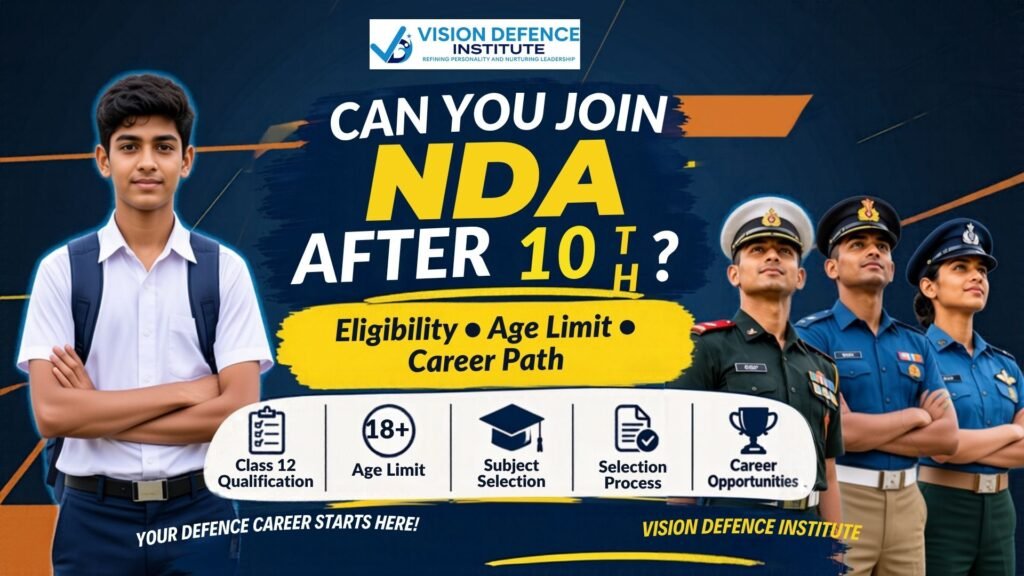
Can You Join NDA After 10th? Eligibility, Age Limit & Complete Career Path Have you completed Class 10 and dream of becoming an officer in the Indian Army, Navy or Air Force? If so, you may already be thinking about joining the National Defence Academy (NDA). Many students have one common question: Can I join NDA immediately after completing Class 10? The answer is no. You cannot directly apply for the NDA entrance examination after Class 10. However, you can start preparing for your NDA journey immediately after completing your 10th standard. The NDA examination, conducted by the Union Public Service Commission (UPSC), provides an opportunity for eligible students to enter the officer training pathway after Class 12. In this guide, we will explain NDA eligibility after 10th, age requirements, subject selection, the examination process, career opportunities and how to begin your preparation. 1. Can You Join NDA After 10th? No, students cannot directly join the National Defence Academy after Class 10. To become eligible for the NDA examination, candidates must meet the prescribed Class 12 educational qualification. However, completing Class 10 is an excellent time to begin your preparation. Students can use Classes 11 and 12 to: Strengthen their Mathematics fundamentals. Improve English grammar and communication. Develop general knowledge and awareness. Build physical fitness and discipline. Develop confidence and leadership qualities. Important: Class 11 students are not eligible to apply for NDA. Candidates appearing in their Class 12 examination can apply, subject to the conditions in the relevant UPSC notification. 2. NDA Eligibility Criteria After 10th Although students cannot apply immediately after Class 10, understanding the eligibility requirements early can help them plan their education. The main eligibility conditions include educational qualification, age, nationality and marital status. Educational Qualification The educational qualification depends on the wing a candidate wants to join. NDA Wing Educational Qualification Army Class 12 pass or equivalent from a recognised board Navy Class 12 with Physics, Chemistry and Mathematics (PCM) Air Force Class 12 with Physics, Chemistry and Mathematics (PCM) Candidates appearing in Class 12 can also apply, provided they satisfy the conditions and deadlines mentioned in the UPSC notification. Students interested in the Navy or Air Force should plan to take Physics, Chemistry and Mathematics in Class 11. Age Limit Generally, NDA candidates must be approximately 16½ to 19½ years old. However, UPSC specifies an exact date-of-birth range in every examination notification. For example, the NDA & NA Examination (II), 2026 notification permitted candidates born between 1 January 2008 and 1 January 2011. Do not calculate your eligibility using your age alone. Always check the exact date-of-birth range in the notification for the examination you intend to take. Nationality Candidates must satisfy the nationality conditions specified by UPSC. These include Indian citizens and certain other eligible categories mentioned in the official notification. Marital Status Only unmarried male and female candidates are eligible under the prescribed conditions. Candidates must also agree to remain unmarried during the training period as required by the rules. 3. Which Subject Should You Choose After Class 10 for NDA? Choosing the right stream after Class 10 is an important decision for NDA aspirants. Your subject selection should depend on the service you want to join. Science Stream with PCM If your dream is to join the Indian Navy or Indian Air Force through NDA, choosing Physics, Chemistry and Mathematics is essential. PCM is also suitable for students interested in the Army. Commerce Stream Commerce students can apply for the Army Wing of NDA if they satisfy the other eligibility requirements. However, they will need to prepare separately for the Mathematics paper in the NDA written examination. Arts or Humanities Stream Students from Arts or Humanities backgrounds can also apply for the Army Wing of NDA. They should pay particular attention to Mathematics preparation and the General Ability Test. Our suggestion: If you are still deciding on your stream and want to keep all three NDA wings open, PCM is a practical choice. 4. How to Start NDA Preparation After 10th Starting early gives students enough time to build a strong foundation instead of rushing through the syllabus during Class 12. Here are some important steps to follow. Step 1: Build Strong Mathematics Fundamentals Mathematics is an important part of the NDA written examination. Start by understanding: Algebra Trigonometry Geometry Mensuration Statistics Basic arithmetic Practise mathematical problems regularly instead of memorising formulas without understanding them. Step 2: Improve English Communication English is an important component of the General Ability Test. Focus on: Grammar Vocabulary Reading comprehension Sentence correction Synonyms and antonyms Reading newspapers and English articles regularly can also improve your language skills. Step 3: Develop General Knowledge Develop a habit of following national and international news. Study important subjects such as: Indian History Geography Indian Polity Physics Chemistry General Science Current Affairs Step 4: Develop Physical Fitness NDA preparation is not limited to written examinations. Build a healthy fitness routine that includes: Running and jogging Basic strength exercises Stretching Outdoor sports Regular physical activity Increase your exercise gradually and maintain proper rest and nutrition. Step 5: Develop Officer-Like Qualities The Services Selection Board (SSB) evaluates qualities beyond academic knowledge. Students should work on: Leadership Teamwork Communication Decision-making Confidence Responsibility Problem-solving Participating in sports, group activities and public speaking can help develop these qualities. 5. NDA Selection Process: From Written Exam to Training The NDA selection process involves multiple stages. Candidates must successfully clear the required stages to secure admission. Stage 1: UPSC Written Examination The written examination consists of two papers. Paper Maximum Marks Mathematics 300 General Ability Test (GAT) 600 Total 900 The Mathematics paper tests mathematical knowledge and problem-solving ability. The GAT paper covers English and General Knowledge, including subjects such as Physics, Chemistry, General Science, History, Geography and Current Affairs. Stage 2: SSB Interview Candidates who qualify in the written examination are called for the Services Selection Board interview, subject to the prescribed shortlisting process. The SSB interview carries 900 marks and includes two stages. Stage