Introduction
Picture this. You walk into the SSB centre on Day 0. You look around and see 80–100 other candidates. All of them have cleared the written exam just like you. All of them want to serve the nation. By the end of Day 1, nearly 40–60% of them will be sent home. By Day 5, only a handful will walk out with a “Recommended.”
Who survives? Who gets through?
The answer isn’t about being the smartest or the most physically fit. It’s about understanding the SSB selection process inside out. The Services Selection Board is not a university exam. It is a five-day personality assessment designed to evaluate whether you have what it takes to be an officer in the Indian Armed Forces.
At Vision Defence Institute in Madurai, we’ve guided hundreds of aspirants through this exact journey. We’ve seen what works and what doesn’t. In this complete guide, we’ll walk you through every single day of the SSB selection process — from reporting and documentation to the final conference and medical examination.
Whether you’re preparing for NDA coaching Madurai, CDS coaching Madurai, AFCAT coaching Madurai, or looking for the best defence academy in Tamil Nadu, understanding the SSB selection process is your first step toward success.
What is SSB?
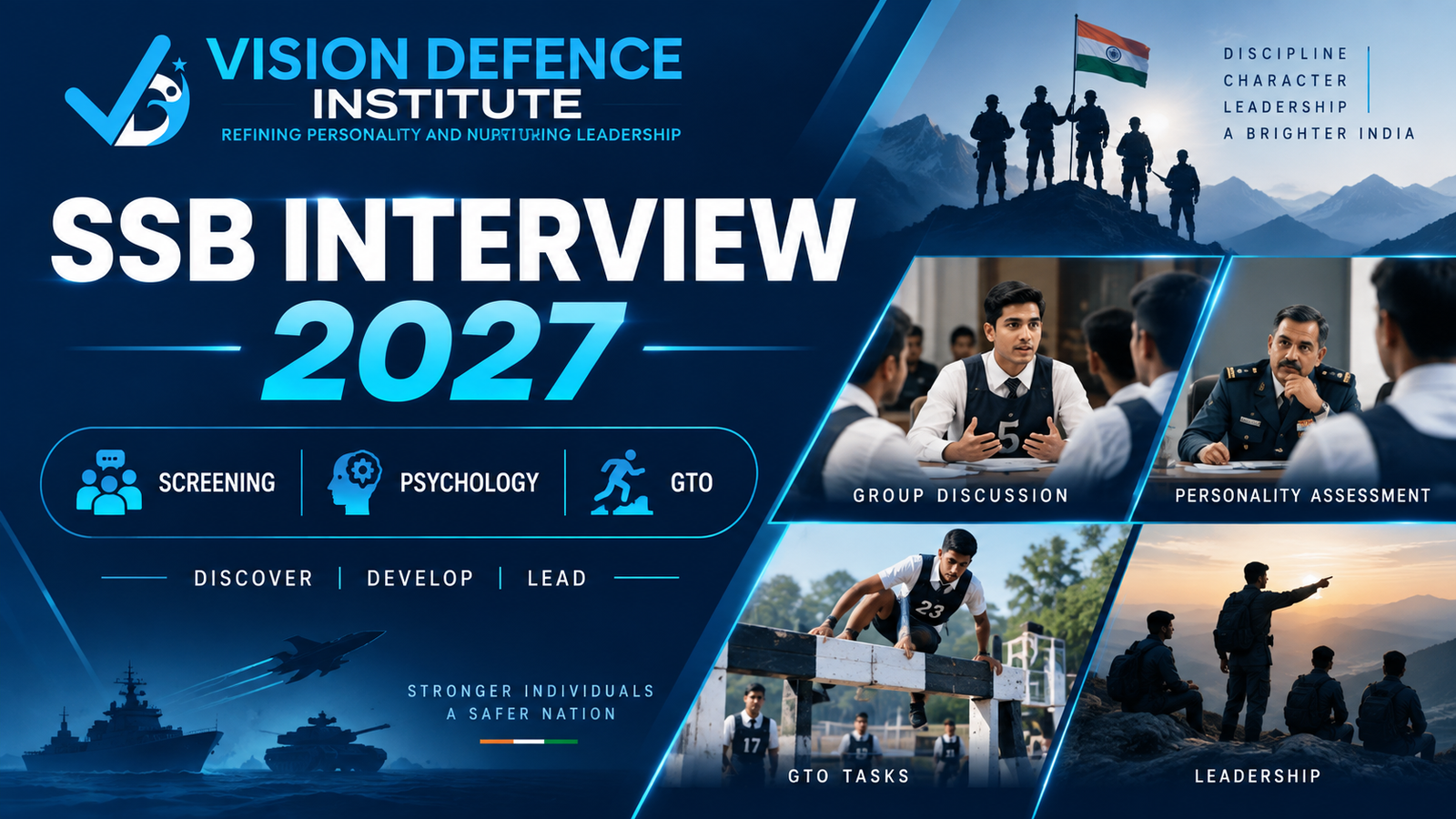
The Services Selection Board (SSB) is a five-day personality assessment procedure conducted for officer-level selection for the Army, Navy, Air Force, and the Coast Guard. It is a two-stage selection system: Stage 1 is held on the day of arrival, and Stage 2 spans the remaining four days.
The Core Philosophy
The SSB is deliberately designed so that the same set of underlying traits — called Officer Like Qualities (OLQs) — are assessed repeatedly through different tests. Three different assessors — the Psychologist, the Group Testing Officer (GTO), and the Interviewing Officer — evaluate the candidate independently.
| Assessor | Role |
|---|---|
| Psychologist | Evaluates subconscious personality through TAT, WAT, SRT, SDT |
| GTO | Assesses group behavior, leadership, and physical tasks |
| Interviewing Officer | Conducts personal interview to verify real-life personality |
A recommendation generally requires their assessments to align — which is why genuine, consistent behaviour matters more than a rehearsed performance.
5-Day SSB Selection Process Overview
| Day | Stage | Key Focus |
|---|---|---|
| Day 0 | Reporting & Documentation | Verification, briefing, PIQ filling |
| Day 1 | Screening Test | OIR + PPDT — Elimination round |
| Day 2 | Psychological Tests | TAT, WAT, SRT, SDT — Personality assessment |
| Day 3 | GTO Tasks (Part 1) | GD, GPE, PGT, HGT — Teamwork & leadership |
| Day 4 | GTO Tasks (Part 2) + Interview | Individual Obstacles, Command Task, Lecturette, PI |
| Day 5 | Conference | Final assessment and result |
Day 0: Reporting and Documentation
Most SSB centres require candidates to report the evening before Day 1. This is your first interaction with the selection centre.
What Happens on Day 0
1. Arrival at the Selection Centre
You report to one of the Selection Centres — Allahabad, Bhopal, Bangalore, Gandhinagar, or others.
2. Document Verification
Your original documents along with photocopies are verified — admit card, certificates, ID proof.
3. Chest Number Allocation
You are allotted a chest number for identification throughout the 5-day process.
4. PIQ (Personal Information Questionnaire) Filling
You fill out the PIQ form, which becomes the foundation of your Personal Interview. Fill it carefully, honestly, and specifically. Avoid vague entries — everything you write becomes material for your Interviewing Officer.
5. Briefing Session
A Duty Officer conducts a short briefing about the schedule and rules. An officer of the board gives an ‘Opening Address’ explaining your stay for the next 5 days.
How to Prepare for Day 0
-
Carry all original documents and multiple photocopies
-
Dress formally and professionally
-
Listen carefully during the briefing
-
Fill the PIQ with complete honesty — no exaggerations
-
Get a good night’s sleep — the next day is intense
Day 1: Screening Test (The Elimination Round)
Day 1 is the most critical day for many candidates — 40–60% are screened out and sent home. This is the first stage of the SSB selection process, and it consists of two parts.
Part 1: Officer Intelligence Rating (OIR) Test
What it is: Two sets of written tests — verbal and non-verbal reasoning.
Format:
-
Two papers of approximately 40 questions each
-
Approximately 17 minutes per paper
-
Verbal: Analogies, Number Series, Coding-Decoding, Syllogisms
-
Non-Verbal: Figure Series, Pattern Matching, Mirror Images, Paper Folding
What it assesses:
-
Logical and analytical ability
-
Reasoning ability, pattern recognition, analytical thinking
-
Speed and accuracy
OIR Ratings: Range from OIR-1 (Outstanding) to OIR-5 (Below Average)
Part 2: Picture Perception and Description Test (PPDT)
What it is: A blurred picture is shown for 30 seconds.
The Process:
-
Observe the picture for 30 seconds
-
Write a story in 4 minutes describing:
-
Number of characters
-
Their mood and age
-
What is happening
-
Past, present, and future actions
-
-
Narrate your story individually in a group
-
Group Discussion — the group creates a common story together
What assessors look for:
-
Clarity of thought
-
Positive story with a constructive outcome
-
Initiative and communication clarity
-
How you interact in a group
Pro Tip: Write clear and logical stories. Speak confidently in the group discussion. Listen to others and build on their ideas.
Result of Day 1
Based on OIR + PPDT performance, assessors shortlist candidates. Selected candidates proceed to Stage 2; others are sent back home the same day.
How to Prepare for Day 1
-
Practice OIR tests extensively beforehand
-
Practice writing stories from random images — time yourself to 4 minutes
-
Develop the habit of positive, action-oriented thinking
-
Practice group discussions with friends
Day 2: Psychological Tests
For screened-in candidates, Day 2 is entirely psychology tests conducted by a trained Psychologist. These tests evaluate your subconscious personality, mindset, emotional balance, and leadership potential.
The Four Psychological Tests
1. Thematic Apperception Test (TAT)
Format: 11 blurred or ambiguous pictures + 1 blank slide. Write a story for each in 4 minutes.
What it assesses:
-
Imagination and personality traits
-
Initiative, leadership, problem-solving, empathy
-
Your thought patterns, values, and personality traits
Key Rule: Use hero-centric, positive-ending stories. Every story must have a protagonist who identifies a problem, takes initiative, uses available resources, and arrives at a constructive solution.
2. Word Association Test (WAT)
Format: 60 words flashed one at a time — 15 seconds per word. Write the first word or phrase that comes to your mind.
What it assesses:
-
Spontaneous quality of your thinking
-
Your values, fears, biases, and social attitudes
-
Underlying mindset
Key Rule: Be natural and honest. Avoid memorized responses. Focus on positive and practical thinking.
3. Situation Reaction Test (SRT)
Format: 60 real-life situations — write how you would react. 30 seconds per situation.
What it assesses:
-
Presence of mind
-
Decision-making ability and resourcefulness
-
Sense of responsibility in challenging circumstances
-
Practical judgment and initiative
4. Self-Description Test (SDT)
Format: Write about what your parents, teachers, friends, yourself, and your ideal self think about you.
What it assesses:
-
Self-awareness and emotional maturity
-
Consistency with what you project throughout the SSB
-
Self-awareness and consistency with other tests
Common Mistakes in Psychology Tests
1. Trying to Give “Ideal” Answers
The SSB psychologist is a trained professional who can immediately identify fabricated or inconsistent responses.
2. Negativity
Stories that end in failure, WAT responses that reflect fear or hopelessness, and SRT answers that show panic — all work against you.
3. Inconsistency
When your TAT stories don’t match your WAT sentences, or your SRT reactions don’t align with your Self Description, you lose credibility.
How to Prepare for Psychology Tests
-
Practice writing TAT stories daily from random images — time yourself strictly
-
Develop a positive, action-oriented mindset
-
Be honest — the SSB is looking for a real person, not a perfect one
-
The Personal Interview often starts on Day 2 in the afternoon or evening
Day 3: GTO Tasks (Part 1)
The Group Testing Officer (GTO) takes over for two days of outdoor and indoor group tasks. Day 3 focuses on teamwork, leadership, and group dynamics.
Day 3 GTO Tasks
1. Group Discussion (GD)
Format: Two rounds — one current affairs topic, one general topic. 10–15 minutes each. No designated leader.
What assessors look for:
-
Initiative
-
Logical contribution
-
Listening skills
-
Communication and reasoning
Key Rule: Don’t dominate — contribute meaningfully. Listen to others and build on their ideas.
2. Group Planning Exercise (GPE)
Format: A model terrain (map) is shown with a complex scenario. The group must:
-
Individual plan → group discussion → common solution
What assessors look for:
-
Planning ability
-
Logical thinking
-
Cooperation and coordination
3. Progressive Group Task (PGT)
Format: Group of 8–10 candidates crosses 4 progressively difficult obstacles using limited resources (plank, rope, baulk).
Rules:
-
Colour rule: Red areas are out of bounds — you cannot touch them
-
Group rule: The group cannot be split during the task
What assessors look for:
-
Leadership and cooperation
-
Initiative and problem-solving
-
How you involve every member
4. Half Group Task (HGT)
Format: Same as PGT but with half the group (5–7 candidates).
Why it matters: Each candidate gets more visibility. This is your chance to shine individually within a group setting.
How to Prepare for Day 3 GTO Tasks
-
Be active and participate in every task
-
Support your team members
-
Show leadership without dominating
-
Stay calm and think clearly under pressure
Day 4: GTO Tasks (Part 2) + Personal Interview
Day 4 completes the GTO series and includes the Personal Interview.
Day 4 GTO Tasks
1. Individual Obstacles (IO)
Format: 10 obstacles in 3 minutes individually. Max 55 points.
What assessors look for:
-
Guts, fitness, confidence
-
Courage and determination
-
Stamina and risk-taking ability
Key Rule: The number of obstacles completed matters less than your determination. Keep trying until the 3 minutes are over.
2. Command Task (CT)
Format: You are the commander; given 2–3 subordinates to complete one obstacle.
What assessors look for:
-
Natural leadership
-
Communication skills
-
Decision-making under pressure
-
How you guide without dominating
3. Lecturette
Format: Choose one of four topics → 3 minutes to prepare → 3-minute speech in front of the group.
What assessors look for:
-
Self-confidence
-
Public speaking ability
-
Knowledge and clarity of thought
4. Final Group Task (FGT)
Format: Full group together, one obstacle. GTO finalizes observations.
Personal Interview (PI)
The Personal Interview is a 1-on-1 conversation with the Interviewing Officer, lasting 20–60 minutes.
What is covered:
-
Your PIQ — everything you wrote on Day 0
-
Academics and family background
-
Current affairs and general awareness
-
Motivation to join the forces
-
Life, leadership, logic, family, failures, purpose
Key Rule: Be honest and confident. The IO is trained to spot inconsistencies and rehearsed answers.
How to Prepare for Day 4
-
Practice public speaking for the Lecturette
-
Build physical fitness for Individual Obstacles
-
Know your PIQ inside out — every detail is fair game
-
Be consistent across all tasks
Day 5: Conference (The Final Day)
Conference Day is the final day of the 5-day SSB selection process when all three assessors — the Interviewing Officer, Psychologist, and GTO — sit together, discuss each candidate, and take the final recommend / not-recommend decision.
What Happens on Conference Day
1. Morning Preparation
Candidates dress formally and wait to be called one by one before the full board of assessors and the Presiding Officer.
2. Short Interaction
Every candidate is called before the board for a short conversation — usually 2–5 minutes. The board has already reviewed your performance across psychology, GTO, and the interview.
3. Common Conference Questions
-
How were your five days at the SSB? Any suggestions for improvement?
-
How was the food, accommodation, and administration?
-
What did you learn about yourself during the SSB?
-
Which task did you enjoy the most, and why?
-
If not recommended, what will you do next?
4. Results Announcement
After all candidates are seen, results are announced.
Why Candidates Are Rejected on Conference Day
The conference only confirms what the assessors observed over the previous days. Candidates are usually not recommended because of:
| Reason | Explanation |
|---|---|
| Inconsistency | Showing confidence in the interview but poor participation in group tasks |
| Rehearsed Personality | Trying to fake OLQs instead of being genuine |
| Poor Communication | Inability to express ideas clearly |
| Lack of Officer-Like Qualities | Not displaying the 15 OLQs consistently |
| Dishonesty | Spotted in the PIQ and interview |
Important: A single weak task rarely causes rejection — a pattern does.
Conference Day Do’s and Don’ts
Do:
-
Dress formally
-
Sit and stand with good posture
-
Greet the board confidently
-
Give honest and balanced feedback
-
Keep answers brief and positive
Don’t:
-
Argue with the board
-
Over-praise or over-criticise the SSB
-
Fidget or show nervousness
-
Give rehearsed answers
Recommended: Medical Examination
If you receive a “Recommended”, you stay back for the SSB medical examination.
Medical Examination Process
The medical examination is conducted by a Board of Service Medical Officers. It is a detailed medical fitness test for defence services.
Key Points:
-
Medical results do not contribute numerically to the merit — they serve as a qualifying filter
-
Only medically fit candidates with verified eligibility proceed
-
Being medically fit is mandatory to receive an invitation letter for joining the academy
Common Medical Rejections
-
Vision problems
-
Hearing issues
-
Flat feet
-
Weight issues
-
Heart conditions
-
Any chronic illness
Merit List and Joining Process
After the medical examination, a final merit list is prepared.
How the Merit List Works
| Factor | Contribution |
|---|---|
| Written Exam Marks | Combined with SSB performance |
| SSB Performance | Combined with written exam marks |
| Medical Fitness | Qualifying — pass/fail |
The merit list doesn’t consider the medical results, but to get an invitation letter for joining the academy based on the number of vacancies available, being medically fit is extremely mandatory.
Training Begins
Selected candidates join the academy for training:
-
NDA — National Defence Academy, Khadakwasla, Pune
-
Army — Indian Military Academy, Dehradun
-
Navy — Indian Naval Academy, Ezhimala
-
Air Force — Air Force Academy, Hyderabad
Your final commissioning depends entirely on your medical fitness and your standing in the final merit list relative to available vacancies.
How to Prepare for Each Stage
Stage-by-Stage Preparation
| Stage | How to Prepare |
|---|---|
| Day 0 | Carry all documents. Fill PIQ honestly. Listen to briefing carefully. |
| Day 1 | Practice OIR tests. Write stories from random images. Practice group discussions. |
| Day 2 | Practice TAT stories daily. Develop positive thinking. Be honest in WAT and SRT. Know yourself for SDT. |
| Day 3 | Build teamwork skills. Practice group discussions. Stay active and participative. |
| Day 4 | Build physical fitness. Practice public speaking. Know your PIQ inside out. |
| Day 5 | Stay calm and confident. Be honest and positive. Don’t argue. |
| Medical | Maintain physical fitness. Get regular health checkups. |
Why Choose Vision Defence Institute for Your SSB Preparation?
At Vision Defence Institute, located at 2ND STOP, S ALANGULAM, Kulamangalam Main Rd, Madurai, Tamil Nadu 625017, we don’t just teach you the theory — we prepare you for every single day of the SSB selection process.
What We Offer
-
Day-wise SSB simulation training
-
Psychological test practice sessions — TAT, WAT, SRT, SDT
-
GTO ground training — PGT, HGT, Individual Obstacles, Command Task
-
Mock interviews with expert feedback
-
Personality development focused on the 15 OLQs
-
Expert mentorship from retired officers who have sat on the other side of the table
Whether you’re looking for NDA coaching Madurai, CDS coaching Madurai, AFCAT coaching Madurai, or SSB interview coaching, we’ve got you covered.
Contact Us:
📞 WhatsApp: +91 81222 87718
📧 Email: visiondefencemduofficial@gmail.com
📱 Facebook: Vision Defence
📸 Instagram: @vision_defence_mdu
▶️ YouTube: Vision Defence Institute Madurai
Conclusion
The SSB selection process is not a test — it is a personality verification system. Over five days, three assessors watch you from every angle. They are not looking for perfection. They are looking for consistency, honesty, and officer-like qualities.
Remember: 40–60% are screened out on Day 1. Those who make it through face psychology tests, GTO tasks, a personal interview, and finally, the conference. Each stage is designed to reveal who you truly are.
The key to success? Be yourself. Not a rehearsed version of yourself. Not what you think the assessors want to see. But the real you — the person who has the courage, determination, leadership, and integrity to serve the nation.
At Vision Defence Institute, we help you discover and develop that person. Because you can’t fake what you don’t have — but you can build what you need.
Your journey to becoming an officer starts today. Start preparing.