

NDA 2027 Exam: Eligibility, Age Limit, Syllabus, Exam Pattern & Preparation Guide
The NDA 2027 Examination is one of the major opportunities for students who want to begin a career as an officer in the Indian Army, Indian Navy or Indian Air Force after Class 12.
Conducted by the Union Public Service Commission (UPSC), the National Defence Academy and Naval Academy Examination is generally conducted twice each year as NDA & NA (I) and NDA & NA (II).
UPSC has already released its Annual Calendar for 2027, while the detailed NDA 2027 examination notification containing the final vacancy count, exact date-of-birth limits and application conditions will be issued separately. Candidates should therefore use this guide to begin preparation early and verify notification-specific details when UPSC publishes them.
In this complete guide, we will understand:
- NDA 2027 eligibility
- NDA 2027 age limit
- Educational qualifications
- NDA examination pattern
- NDA syllabus
- SSB selection process
- Preparation strategy
- Recommended study plan
- Important mistakes to avoid
What is the NDA Examination?
The National Defence Academy Examination is conducted by UPSC for admission to the National Defence Academy and the Naval Academy.
Candidates selected through the NDA route undergo training before being commissioned into India’s Armed Forces.
The examination provides entry opportunities connected with:
- Indian Army
- Indian Navy
- Indian Air Force
- Indian Naval Academy 10+2 Cadet Entry Scheme
The selection process involves much more than clearing a written examination. Candidates must also qualify through the Services Selection Board (SSB) process and satisfy the prescribed medical and eligibility standards.
NDA 2027 Important Details at a Glance
| Particular | NDA 2027 Details |
|---|---|
| Examination | National Defence Academy & Naval Academy Examination |
| Conducting Authority | Union Public Service Commission |
| Exam Level | National |
| Frequency | Generally twice a year |
| Examination Mode | Offline written examination |
| Written Papers | Mathematics + General Ability Test |
| Written Marks | 900 |
| SSB Marks | 900 |
| Total Selection Marks | 1800 |
| Question Type | Objective / Multiple Choice |
| Eligibility Level | Class 12 / appearing in Class 12, subject to entry requirements |
| Official Authority | UPSC |
The established UPSC examination scheme assigns 300 marks to Mathematics and 600 marks to the General Ability Test, giving a written total of 900 marks. The SSB test/interview carries another 900 marks.
NDA 2027 Eligibility Criteria
Before beginning NDA preparation, students should first understand whether they satisfy the basic eligibility requirements.
The final conditions for NDA I 2027 and NDA II 2027 must be checked against their respective official UPSC notifications when published.
However, the core educational structure used in recent NDA notifications is explained below.
1. Educational Qualification for Army Wing
For the Army Wing of the National Defence Academy, candidates are required to have passed:
Class 12 under the 10+2 pattern or an equivalent examination recognised by a State Education Board or University.
Students appearing in Class 12 may also be permitted to apply subject to the conditions and document deadlines specified by UPSC.
Do you need PCM for NDA Army?
No.
Students from streams such as:
- Science
- Commerce
- Humanities
can potentially apply for the Army Wing, provided they meet the other eligibility conditions.
2. Educational Qualification for Air Force and Naval Wings
Candidates seeking admission to the Air Force or Naval Wings of the NDA, or the 10+2 Cadet Entry Scheme at the Indian Naval Academy, must satisfy additional subject requirements.
Recent UPSC notifications require candidates to have passed Class 12 with:
- Physics
- Chemistry
- Mathematics
Candidates appearing in the qualifying Class 12 examination can also apply subject to UPSC’s prescribed conditions.
Therefore, students planning to target the Air Force or Navy through NDA 2027 should pay particular attention to their Class 11 and Class 12 PCM preparation.
NDA 2027 Age Limit
The NDA examination is intended for candidates in a relatively narrow age group.
Instead of relying only on statements such as “16½ to 19½ years”, candidates should check the exact date-of-birth range published in the NDA I 2027 or NDA II 2027 notification.
UPSC specifies eligibility using a date-of-birth window, and even a candidate falling outside that prescribed range by a small margin may become ineligible.
Important
As of September 2026, the detailed NDA 2027 notification has not yet been published, so candidates should not treat unofficial 2027 DOB ranges circulating online as final.
Once the notification is available, verify your:
- Date of birth
- Class 10 certificate
- Educational eligibility
- Marital-status requirements
- Other application conditions
directly against the UPSC notification.
UPSC also stresses that candidates must carefully enter their date of birth because discrepancies between the application and matriculation records can create eligibility problems later.
Can Female Candidates Apply for NDA 2027?
The NDA examination is open to eligible male and female candidates, subject to the conditions and vacancies published by UPSC and the respective services.
Candidates should check the NDA 2027 notification for service-wise and academy-wise vacancy distribution.
NDA 2027 Exam Pattern
Understanding the examination pattern before starting preparation helps students allocate time correctly.
The NDA written examination consists of two papers:
Paper I — Mathematics
- Maximum Marks: 300
- Duration: 2½ hours
- Type: Objective questions
Paper II — General Ability Test
- Maximum Marks: 600
- Duration: 2½ hours
- Type: Objective questions
Total Written Marks: 900
After qualifying through the written stage, candidates considered for further selection undergo the SSB process.
SSB: 900 Marks
Overall: 1800 Marks
UPSC’s published NDA examination scheme confirms this 300 + 600 written-paper structure and a further 900 marks for the SSB test/interview.
NDA 2027 Mathematics Syllabus
Mathematics is one of the most important sections of the NDA examination because it requires both conceptual understanding and fast calculation.
Major areas traditionally included in the UPSC NDA syllabus include:
Algebra
Topics include areas such as:
- Sets
- Relations
- Complex numbers
- Binary system
- Arithmetic progression
- Geometric progression
- Quadratic equations
- Permutations and combinations
- Binomial theorem
- Logarithms
Matrices and Determinants
Students should prepare topics including:
- Types of matrices
- Matrix operations
- Determinants
- Adjoint and inverse
- Solution of simultaneous equations
Trigonometry
Important concepts include:
- Trigonometric ratios
- Trigonometric identities
- Multiple and submultiple angles
- Inverse trigonometric functions
- Heights and distances
Analytical Geometry
Preparation should include:
- Cartesian coordinates
- Distance formula
- Equation of a straight line
- Circle
- Parabola
- Ellipse
- Hyperbola
- Three-dimensional geometry
Differential Calculus
Important concepts include:
- Functions
- Limits
- Continuity
- Derivatives
- Applications of derivatives
- Increasing and decreasing functions
- Maxima and minima
Integral Calculus
Candidates should prepare:
- Integration
- Standard integrals
- Definite integrals
- Area-related applications
- Differential equations
Vector Algebra
UPSC’s syllabus includes concepts such as:
- Vectors in two and three dimensions
- Magnitude and direction
- Unit vectors
- Scalar product
- Vector product
- Applications of vectors
Statistics and Probability
Important areas include:
- Data classification
- Frequency distribution
- Mean
- Median
- Mode
- Variance
- Standard deviation
- Probability
- Conditional probability
- Bayes’ theorem
- Binomial distribution
These areas are included in UPSC’s published NDA Mathematics syllabus.
NDA 2027 General Ability Test Syllabus
The General Ability Test (GAT) carries 600 marks, making it a major part of the written examination.
The paper broadly consists of:
Part A — English
Maximum Marks: 200
The English section is designed to test a candidate’s understanding and effective use of English.
UPSC identifies areas including:
- Grammar
- Usage
- Vocabulary
- Comprehension
- Cohesion in extended text
How to prepare for NDA English
Students should regularly practise:
- Vocabulary
- Grammar rules
- Sentence correction
- Reading comprehension
- Previous-year questions
- Contextual usage of words
Avoid preparing English only during the last few weeks before the examination.
Regular reading and question practice usually produce better results than attempting to memorise large amounts of grammar at once.
Part B — General Knowledge
The General Knowledge portion carries 400 marks.
UPSC broadly includes:
- Physics
- Chemistry
- General Science
- Social Studies
- Geography
- Current Events
UPSC also notes that the syllabus represents the general scope of the examination rather than an exhaustive list of every possible question area.
Physics for NDA 2027
Focus on understanding fundamental concepts instead of memorising formulas alone.
Important areas may include:
- Matter
- Mass and weight
- Density
- Pressure
- Motion
- Force
- Work and energy
- Heat
- Sound
- Light
- Electricity
- Magnetism
- Basic mechanics
Chemistry for NDA 2027
Important preparation areas include fundamental school-level concepts such as:
- Elements
- Compounds
- Mixtures
- Physical and chemical changes
- Acids, bases and salts
- Carbon
- Fertilisers
- Everyday chemical processes
General Science for NDA 2027
Students should revise important concepts related to:
- Living organisms
- Human body
- Food and nutrition
- Diseases
- Cells and tissues
- Environment
- Basic scientific developments
History and Social Studies
Important areas may include:
- Indian history
- Freedom movement
- Constitution
- Indian administration
- Important historical events
- Social and political development
Geography
Prepare both Indian and world geography.
Focus on areas including:
- Earth
- Latitude and longitude
- Climate
- Atmosphere
- Rivers
- Natural vegetation
- Resources
- Agriculture
- Industries
- Indian geography
Current Affairs
Current affairs should not be treated as a last-minute subject.
Candidates preparing for NDA 2027 should regularly follow important developments related to:
- India
- Defence
- International affairs
- Science and technology
- Space
- Government initiatives
- Sports
- Awards
- Important appointments
The objective should be consistent revision, not simply collecting hundreds of news items.
Is There Negative Marking in NDA?
The NDA written examination uses objective questions and incorrect responses can attract negative marks under UPSC’s marking rules.
Because of this, students should avoid treating the examination as a guessing contest.
A better strategy is:
Accuracy → Speed → Intelligent Attempt Selection
Learn to identify:
- Questions you can solve immediately
- Questions that require additional calculation
- Questions where elimination can help
- Questions that should be left unanswered
This approach becomes particularly important during mock tests.
NDA 2027 Selection Process
Clearing the written examination is only one part of NDA selection.
The overall pathway can be understood as:
NDA Written Examination → SSB → Medical Examination → Merit/Allocation subject to applicable rules
What Happens After Clearing the NDA Written Examination?
Candidates who satisfy the applicable requirements and progress to the next stage undergo the Services Selection Board process.
The SSB is designed to assess qualities relevant to becoming an officer.
Preparation should therefore extend beyond written academics.
Students should gradually work on:
- Communication
- Observation
- Reasoning
- Team participation
- Confidence
- Decision-making
- Awareness
- Physical fitness
Trying to develop these abilities only after the written result is generally less effective than building them alongside written preparation.
NDA 2027 Preparation Strategy
A common mistake among NDA aspirants is trying to study every subject every day without a clear priority structure.
Instead, divide preparation into four components:
1. Build Concepts
Start by strengthening the fundamentals of Mathematics and the core GAT subjects.
Do not rush directly into full mock tests when the basic concepts are weak.
2. Practise Topic-Wise Questions
After completing each chapter, solve questions specifically from that topic.
For example:
Trigonometry → Learn concepts → Solve basic problems → Solve NDA-level questions → Analyse mistakes
This helps convert theoretical understanding into examination performance.
3. Solve Previous-Year NDA Papers
Previous-year papers are one of the most useful resources for understanding the examination.
UPSC currently provides previous NDA Mathematics and General Ability Test papers on its official website, including recent papers.
PYQs help students understand:
- Question style
- Recurring concepts
- Difficulty level
- Calculation requirements
- Time pressure
- Common traps
Do not simply solve a previous paper and check your score.
Analyse why each mistake occurred.
4. Take Full-Length Mock Tests
Mock tests should become more frequent as preparation progresses.
After every mock test, classify mistakes into:
- Concept error
- Calculation error
- Memory error
- Misreading the question
- Time-management error
- Guessing error
Your improvement comes from correcting these patterns.
A Practical 6-Month NDA 2027 Study Plan
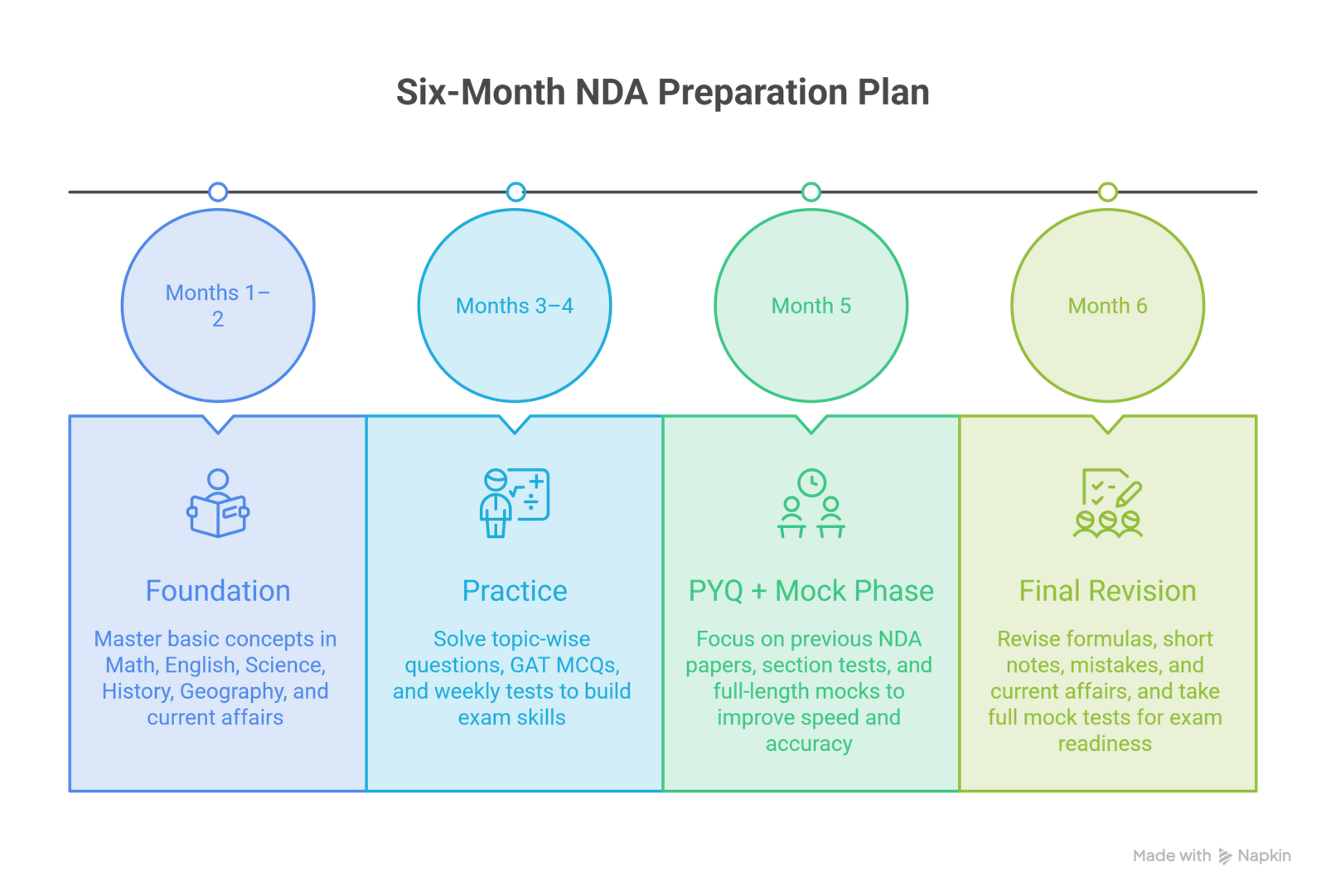
Suggested Daily NDA 2027 Study Routine
A student can structure preparation approximately like this:
| Area | Suggested Focus |
|---|---|
| Mathematics | 2–3 hours |
| GAT Core Subjects | 1½–2 hours |
| English | 30–45 minutes |
| Current Affairs | 30 minutes |
| PYQ / MCQ Practice | 1 hour |
| Physical Activity | 45–60 minutes |
This is only a framework.
School schedules and individual strengths differ, so students should adjust the routine according to their available time.
Consistency matters more than copying someone else’s timetable.
How Should Class 11 Students Prepare for NDA 2027?
Class 11 is an excellent stage to begin.
Do not try to prepare as though the examination were next month.
Instead:
Step 1
Strengthen Mathematics.
Step 2
Build English vocabulary and reading ability.
Step 3
Understand basic Science, History and Geography.
Step 4
Start following current affairs.
Step 5
Develop a regular fitness routine.
The advantage of beginning early is that preparation can remain balanced with school instead of becoming stressful immediately before the examination.
How Should Class 12 Students Prepare?
Class 12 students need to balance:
Board Preparation + NDA Preparation
Fortunately, parts of Mathematics, Physics and Chemistry preparation can support both.
However, NDA also requires:
- Speed
- Objective-question practice
- GAT preparation
- Current affairs
- Previous-year-paper practice
Therefore, keep separate NDA practice sessions even during board preparation.
Most Common NDA Preparation Mistakes
Mistake 1: Ignoring Mathematics
Some candidates concentrate heavily on GAT because it carries 600 marks.
But Mathematics remains a compulsory written paper and requires consistent practice.
Mistake 2: Preparing only Mathematics
The opposite mistake is equally dangerous.
GAT carries a substantial portion of the written marks.
English, Science, Social Studies, Geography and current affairs need systematic preparation.
Mistake 3: Collecting Too Many Books
More resources do not automatically produce better marks.
Use a limited set of reliable materials and revise them repeatedly.
Mistake 4: Avoiding Previous-Year Papers
Preparing without PYQs makes it difficult to understand the actual nature of UPSC questions.
Mistake 5: Taking Mock Tests Without Analysis
A score alone tells you very little.
A mock test becomes useful when you discover:
Where did I lose marks and why?
Mistake 6: Starting SSB Preparation Too Late
The NDA pathway is about becoming an officer, not merely clearing an MCQ examination.
Develop communication, awareness, fitness and teamwork gradually.
Best Way to Prepare for NDA 2027
A simple preparation cycle works well:
Learn → Practise → Test → Analyse → Revise → Reattempt
For every chapter:
- Understand the concept.
- Solve basic questions.
- Attempt NDA-level questions.
- Solve PYQs.
- Record mistakes.
- Revise.
- Reattempt the questions later.
Repeated cycles create stronger preparation than studying a topic once and moving permanently to the next chapter.
Why Start NDA 2027 Preparation Early?
NDA preparation involves multiple areas:
Mathematics + English + GK + Current Affairs + SSB Readiness + Physical Fitness
Trying to build all of them within a short period creates unnecessary pressure.
Starting early gives candidates time to:
- Identify weak chapters
- Improve calculation speed
- Develop reading habits
- Build current-affairs knowledge
- Solve more PYQs
- Take sufficient mock tests
- Work on communication
- Improve physical fitness
Preparation becomes progressive instead of rushed.
NDA 2027 Preparation with Vision Defence
At Vision Defence, NDA preparation is approached as a structured journey rather than simply completing chapters.
Students preparing for NDA require:
- Concept clarity
- Exam-oriented Mathematics preparation
- GAT preparation
- Previous-year-question practice
- Regular testing
- Performance analysis
- Revision strategy
- Mentorship
- Guidance for the larger defence-selection journey
The objective is to help aspirants understand what to study, how to practise and how to improve their performance over time.
If you are targeting the NDA 2027 examination, beginning with a structured preparation plan now can give you considerably more time to strengthen your fundamentals and correct weaknesses before the examination.
Frequently Asked Questions About NDA 2027
1. Who conducts the NDA 2027 examination?
The Union Public Service Commission (UPSC) conducts the National Defence Academy and Naval Academy Examination.
2. How many times is NDA conducted?
UPSC generally conducts the examination twice annually as:
- NDA & NA I
- NDA & NA II
3. Can girls apply for NDA 2027?
Eligible female candidates can apply for NDA subject to the eligibility conditions and service-wise vacancies specified in the official notification.
4. Can Commerce students apply for NDA?
Commerce students can potentially apply for the Army Wing if they satisfy the prescribed Class 12 and other eligibility requirements.
Air Force and Naval entries have additional subject requirements.
5. Is Mathematics compulsory for NDA?
Mathematics is one of the two written NDA examination papers and carries 300 marks.
6. How many marks does GAT carry?
The General Ability Test carries 600 marks.
7. What is the total written score in NDA?
The written examination carries 900 marks.
The SSB test/interview carries another 900 marks under the established UPSC scheme.
8. Can a Class 12 student apply for NDA?
Candidates appearing in Class 12 can apply subject to UPSC’s eligibility conditions and prescribed deadlines for providing proof of qualification.
9. Can Class 11 students apply for NDA?
Class 11 students are not eligible merely on the basis of appearing in Class 11. Recent UPSC notifications explicitly state that candidates appearing in the Class 11 examination are not eligible.
However, Class 11 is an excellent stage to start preparing for a future NDA attempt.
10. Is the NDA 2027 notification released?
As of 22 September 2026, UPSC has published its Annual Calendar 2027, but the detailed NDA 2027 examination notification containing the final eligibility window, vacancies and application instructions has not yet been published.
Candidates should rely on the official UPSC notification once released.
Final Takeaway
Cracking the NDA examination requires much more than studying hard for a few weeks.
A successful preparation approach combines:
Strong Fundamentals + Daily Practice + PYQs + Mock Tests + Revision + Physical Fitness + SSB Readiness
If NDA 2027 is your target, begin by understanding the syllabus, identifying your current strengths and weaknesses, and following a structured preparation plan.
Do not wait for the examination notification to begin studying.
Use the months available now to build the foundation that you will need when the actual examination arrives.
Your NDA journey starts long before the examination day. Prepare with discipline, practise with purpose, and keep improving every week.