Complete SSB Selection Process: 5-Day Guide for Defence Aspirants
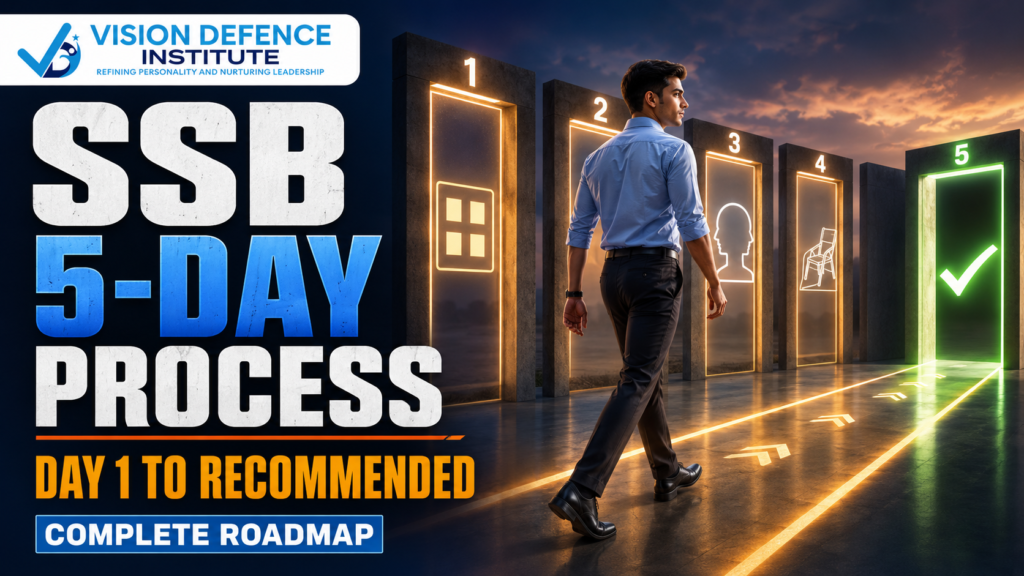
Introduction Picture this. You walk into the SSB centre on Day 0. You look around and see 80–100 other candidates. All of them have cleared the written exam just like you. All of them want to serve the nation. By the end of Day 1, nearly 40–60% of them will be sent home. By Day 5, only a handful will walk out with a “Recommended.” Who survives? Who gets through? The answer isn’t about being the smartest or the most physically fit. It’s about understanding the SSB selection process inside out. The Services Selection Board is not a university exam. It is a five-day personality assessment designed to evaluate whether you have what it takes to be an officer in the Indian Armed Forces. At Vision Defence Institute in Madurai, we’ve guided hundreds of aspirants through this exact journey. We’ve seen what works and what doesn’t. In this complete guide, we’ll walk you through every single day of the SSB selection process — from reporting and documentation to the final conference and medical examination. Whether you’re preparing for NDA coaching Madurai, CDS coaching Madurai, AFCAT coaching Madurai, or looking for the best defence academy in Tamil Nadu, understanding the SSB selection process is your first step toward success. What is SSB? The Services Selection Board (SSB) is a five-day personality assessment procedure conducted for officer-level selection for the Army, Navy, Air Force, and the Coast Guard. It is a two-stage selection system: Stage 1 is held on the day of arrival, and Stage 2 spans the remaining four days. The Core Philosophy The SSB is deliberately designed so that the same set of underlying traits — called Officer Like Qualities (OLQs) — are assessed repeatedly through different tests. Three different assessors — the Psychologist, the Group Testing Officer (GTO), and the Interviewing Officer — evaluate the candidate independently. Assessor Role Psychologist Evaluates subconscious personality through TAT, WAT, SRT, SDT GTO Assesses group behavior, leadership, and physical tasks Interviewing Officer Conducts personal interview to verify real-life personality A recommendation generally requires their assessments to align — which is why genuine, consistent behaviour matters more than a rehearsed performance. 5-Day SSB Selection Process Overview Day Stage Key Focus Day 0 Reporting & Documentation Verification, briefing, PIQ filling Day 1 Screening Test OIR + PPDT — Elimination round Day 2 Psychological Tests TAT, WAT, SRT, SDT — Personality assessment Day 3 GTO Tasks (Part 1) GD, GPE, PGT, HGT — Teamwork & leadership Day 4 GTO Tasks (Part 2) + Interview Individual Obstacles, Command Task, Lecturette, PI Day 5 Conference Final assessment and result Day 0: Reporting and Documentation Most SSB centres require candidates to report the evening before Day 1. This is your first interaction with the selection centre. What Happens on Day 0 1. Arrival at the Selection Centre You report to one of the Selection Centres — Allahabad, Bhopal, Bangalore, Gandhinagar, or others. 2. Document Verification Your original documents along with photocopies are verified — admit card, certificates, ID proof. 3. Chest Number Allocation You are allotted a chest number for identification throughout the 5-day process. 4. PIQ (Personal Information Questionnaire) Filling You fill out the PIQ form, which becomes the foundation of your Personal Interview. Fill it carefully, honestly, and specifically. Avoid vague entries — everything you write becomes material for your Interviewing Officer. 5. Briefing Session A Duty Officer conducts a short briefing about the schedule and rules. An officer of the board gives an ‘Opening Address’ explaining your stay for the next 5 days. How to Prepare for Day 0 Carry all original documents and multiple photocopies Dress formally and professionally Listen carefully during the briefing Fill the PIQ with complete honesty — no exaggerations Get a good night’s sleep — the next day is intense Day 1: Screening Test (The Elimination Round) Day 1 is the most critical day for many candidates — 40–60% are screened out and sent home. This is the first stage of the SSB selection process, and it consists of two parts. Part 1: Officer Intelligence Rating (OIR) Test What it is: Two sets of written tests — verbal and non-verbal reasoning. Format: Two papers of approximately 40 questions each Approximately 17 minutes per paper Verbal: Analogies, Number Series, Coding-Decoding, Syllogisms Non-Verbal: Figure Series, Pattern Matching, Mirror Images, Paper Folding What it assesses: Logical and analytical ability Reasoning ability, pattern recognition, analytical thinking Speed and accuracy OIR Ratings: Range from OIR-1 (Outstanding) to OIR-5 (Below Average) Part 2: Picture Perception and Description Test (PPDT) What it is: A blurred picture is shown for 30 seconds. The Process: Observe the picture for 30 seconds Write a story in 4 minutes describing: Number of characters Their mood and age What is happening Past, present, and future actions Narrate your story individually in a group Group Discussion — the group creates a common story together What assessors look for: Clarity of thought Positive story with a constructive outcome Initiative and communication clarity How you interact in a group Pro Tip: Write clear and logical stories. Speak confidently in the group discussion. Listen to others and build on their ideas. Result of Day 1 Based on OIR + PPDT performance, assessors shortlist candidates. Selected candidates proceed to Stage 2; others are sent back home the same day. How to Prepare for Day 1 Practice OIR tests extensively beforehand Practice writing stories from random images — time yourself to 4 minutes Develop the habit of positive, action-oriented thinking Practice group discussions with friends Day 2: Psychological Tests For screened-in candidates, Day 2 is entirely psychology tests conducted by a trained Psychologist. These tests evaluate your subconscious personality, mindset, emotional balance, and leadership potential. The Four Psychological Tests 1. Thematic Apperception Test (TAT) Format: 11 blurred or ambiguous pictures + 1 blank slide. Write a story for each in 4 minutes. What it assesses: Imagination and personality traits Initiative, leadership, problem-solving, empathy Your thought patterns, values, and personality traits Key Rule: Use hero-centric, positive-ending stories. Every story must have a protagonist who identifies a problem, takes initiative, uses available resources, and arrives at a constructive solution. 2. Word Association Test (WAT) Format: 60 words flashed one at a time — 15 seconds per word. Write the first word or phrase that comes to your mind. What it assesses: Spontaneous
Complete GTO Obstacles Guide for SSB Success

Introduction Ramesh had been preparing for the SSB for over a year. He had memorized every psychology test pattern, practiced dozens of group discussions, and could speak fluently on any topic. But when he stood at the starting line of the Individual Obstacles course, his heart sank. He had never climbed a rope. He had never jumped from a 12-foot platform. He had never even attempted a Burma Bridge. He froze. And just like that, months of preparation meant nothing. Because the GTO obstacles in SSB are not optional. They are not a formality. They are a make-or-break part of your selection process. At Vision Defence Institute in Madurai, we’ve seen countless brilliant candidates crumble on the GTO ground. Not because they weren’t smart enough — but because they underestimated the physical and mental demands of GTO tasks. The Group Testing Officer is not looking for a bodybuilder. He is looking for courage, determination, teamwork, and the ability to perform under pressure. This comprehensive guide covers everything you need to know about GTO obstacles — from the complete list of Individual Obstacles to Progressive Group Task (PGT), Half Group Task (HGT), Command Task, Snake Race, and more. We’ll break down the rules, share proven strategies, and give you a preparation plan that actually works. What is the GTO Test? The Group Testing Officer (GTO) test is conducted on Days 3 and 4 of the SSB interview. It is designed to evaluate your Officer Like Qualities (OLQs) through a series of indoor and outdoor tasks. What the GTO Assesses The GTO evaluates candidates on multiple OLQs including: Initiative – Do you take the first constructive step? Effective Intelligence – Can you solve practical problems? Planning Ability – Can you think ahead and organize? Courage – Are you willing to take calculated risks? Self-Confidence – Do you trust your own abilities? Communication Skills – Can you express yourself clearly? Responsibility – Do you own your actions? Cooperation – Can you work harmoniously with others? Decision-Making – Can you make quick, sound decisions? Physical Stamina – Do you have the endurance to keep going? Team Spirit – Do you put the group above yourself? Determination – Do you persist despite obstacles? Structure of GTO Tasks GTO tasks are divided into two categories: Indoor Tasks: Group Discussion (GD) Group Planning Exercise (GPE) Lecturette Outdoor Tasks: Progressive Group Task (PGT) Group Obstacle Race / Snake Race (GOR) Half Group Task (HGT) Command Task (CT) Individual Obstacles (IO) Final Group Task (FGT) Individual Obstacles (IO) Individual Obstacles is your chance to showcase personal courage, stamina, and determination. This is the only GTO task where you perform completely alone, and it happens on the first or second day of GTO testing. The Rules Rule Details Time Limit 3 minutes Number of Obstacles 10 obstacles (numbered 1-10 by difficulty) Scoring Each obstacle carries marks from 1 to 10 (total 55 marks) Order You can attempt obstacles in any order you choose Repetition If you complete all 10, you can repeat obstacles for extra points Time Warning GTO blows whistle at 2 minutes 30 seconds Participants Only 1-3 candidates on the ground at a time Complete List of Individual Obstacles Here are the 10 individual obstacles you will typically face: 1. Single Ramp / Jumping Over a Slide (1 point) What it is: Run on a slope and jump across a line about 4 feet away. Tests: Basic agility and confidence. Difficulty: Easiest. Start with this to build momentum. 2. Zig-Zag Balance (2 points) What it is: Walk on a narrow zig-zag beam at a height. Tests: Focus, balance, and body control. Note: Not used in Air Force entries. 3. Burma Bridge (3 points) What it is: Walk on ropes suspended between poles, covering 25 feet. The ropes shake as you move. Tests: Fearlessness, coordination, stability. Difficulty: HIGH. Note: Not used in Air Force entries. 4. Tarzan Swing (4 points) What it is: Climb to a 10-12 foot platform, swing on a rope like Tarzan, and land at a marked spot. Tests: Timing, grip strength, risk-taking ability. Note: Not used in Air Force entries. 5. Double Ditch (5 points) What it is: Cross two ditches — one with a rope, the other with a jump. Tests: Agility, lower body strength, confidence. Note: Not used in Air Force entries. 6. Commando Walk (6 points) What it is: Walk across ropes, beams, and bars at a height. Tests: Balance, coordination, upper body strength. 7. Tiger Leap (7 points) What it is: Climb a 9-foot platform and leap 4 feet to catch a rope, then descend using it. Tests: Courage, decision-making, upper body strength. Difficulty: HIGH. Key Tip: Catch the rope at chest level to prevent sliding and hurting your hands. 8. Monkey Crawl (8 points) What it is: Crawl under low structures like nets and ropes. Tests: Endurance, flexibility, mental toughness. 9. Rope Climbing (9 points) What it is: Climb a vertical rope and touch a post 4-5 meters high, then descend. Tests: Grip strength, technique, determination. Difficulty: HIGH. 10. Wall Jump / Climbing the Wall (10 points) What it is: Run up an inclined plane and climb over an 8-foot wooden wall. Tests: Strength, determination, confidence. Strategy for Individual Obstacles Attempt easier obstacles first (1-6 points), then move to complex ones Don’t waste time on an obstacle you find too difficult — skip it and move on The number of obstacles completed doesn’t matter as much as your determination Stay alert — injuries during this round can affect your performance in other tasks Keep trying even if you fail on the first attempt — never give up before the 3 minutes are over Important: Candidates who completed just 5-6 obstacles have been recommended, as well as those who completed all ten and repeated 4-5 additional ones. Determination counts more than total score. Progressive Group Task (PGT) Progressive Group Task (PGT) is the first outdoor group task in the GTO series. It tests teamwork, leadership, intelligence, and problem-solving. The Rules The group faces four progressively difficult obstacles Each obstacle has structures, planks, ropes, and other materials Colour rule: Red areas are out of bounds — you cannot touch them Group rule: The group cannot be split during the task Listen to the GTO’s briefing carefully — do not miss any information Look at the resources (helping materials) provided to you Obstacles can be crossed with basic practical knowledge and common sense Strategy for PGT Don’t
15 OLQs in SSB: Complete Guide for Defence Aspirants
Introduction Picture this. Two candidates walk into the SSB interview on Day 1. One has a 9.8 CGPA, speaks flawless English, and knows every date in Indian history. The other has 65% marks, speaks functional but imperfect English, and looks visibly nervous. Who gets recommended? If you guessed the first one, you’d be wrong. At Vision Defence Institute in Madurai, we’ve seen this play out hundreds of times. The topper crumbles. The “average” candidate shines. Why? Because the SSB interview is NOT a university exam. The Services Selection Board is NOT looking for the smartest person in the room. They are looking for something far more specific — Officer Like Qualities (OLQs) . These 15 officer like qualities are the foundation of every SSB selection. They determine whether you walk out of the conference room with a “Recommended” or a “Not Recommended.” And here’s the good news — these qualities are NOT something you’re born with. You can develop them. You can practice them. You can become the person who naturally displays these traits. In this comprehensive guide, we’ll break down all 15 OLQs, explain how assessors evaluate them, and give you practical, actionable tips to develop each quality. Whether you’re preparing for NDA coaching Madurai, CDS coaching Madurai, AFCAT coaching Madurai, or looking for the best defence academy in Tamil Nadu, this guide is your roadmap to SSB success. What Are Officer Like Qualities (OLQs)? Before we dive into the list, understand this: OLQs are NOT something you “fake” for 5 days. They are not a checklist you memorize the night before. The psychologists at the SSB have been doing this for 20+ years. They have seen every trick. They have heard every rehearsed answer. The 15 officer like qualities are a reflection of who you actually are. They define your leadership potential, decision-making ability, and overall personality. The SSB is designed to identify your genuine personality — not your ability to memorize answers. The Four Pillars of OLQs Pillar What It Means Qualities Included Planning & Organizing Can you think ahead? Effective Intelligence, Reasoning Ability, Organising Ability, Power of Expression Social Adjustment Can you work with others? Social Adaptability, Cooperation, Sense of Responsibility Social Effectiveness Can you lead and persuade? Initiative, Self-Confidence, Speed of Decision, Ability to Influence the Group, Liveliness Dynamic & Determination Do you have a never-say-die attitude? Determination, Courage, Stamina The Complete List: 15 Officer Like Qualities for SSB PILLAR 1: PLANNING & ORGANIZING (The Thinker) OLQ #1: Effective Intelligence What it means (in simple words): Not “book smart.” Practical smart. Can you look at a problem and find a solution using what you already know? Effective intelligence is the ability to deal with actual problems of varying complexity. It differs from basic intelligence, which is the ability to detect relationships and think abstractly. EI focuses on your problem-solving skills and ability to handle everyday challenges. SSB Example: During the GTO (Group Testing Officer) tasks, you are given a plank, a rope, and a pole. You need to cross a “river” marked on the ground. The engineer will try to calculate angles. The person with effective intelligence will just tie the rope and test it. How to develop it: Stop using GPS for one week. Navigate your own city using landmarks Fix something broken in your house (fan, chair, tap) without watching YouTube tutorials Play chess or Sudoku daily Find quick solutions to real-life problems — if your friend’s bike runs out of petrol late at night, don’t panic; find the nearest petrol pump, arrange a bottle, or push together until help comes OLQ #2: Reasoning Ability What it means: Can you connect dots that aren’t obviously connected? Can you see cause and effect? Reasoning ability is the capacity to understand a given situation and reach logical conclusions through rational thinking. It assesses your receptiveness, inquisitive nature, logical reasoning, and ability to identify the essence of a problem. SSB Example: In the Psychology Test (TAT — Thematic Apperception Test), you see a blurry picture. You have to write a story. The officer is not checking your creative writing skills. They are checking how your mind processes information and draws conclusions. How to develop it: Practice solving complex problems and puzzles to sharpen analytical skills Play chess or participate in strategy-based games Develop the habit of questioning assumptions and exploring alternative perspectives Read newspapers daily to form fair opinions on various topics OLQ #3: Organising Ability What it means: Can you arrange resources — people, time, materials — to achieve a goal efficiently? Organising ability involves the systematic utilization of resources to achieve effective results. Assessors are interested in how you employ various resources to produce outcomes. SSB Example: In the Group Planning Exercise (GPE), you are given a map, a scenario, and limited resources. Your ability to organize people, prioritize tasks, and execute a plan is being watched closely. How to develop it: Plan a family event or trip from start to finish Take part in competitions like drama, skits — engage yourself in organizing lifestyle and small functions Be a volunteer in stage programs In group tasks, take the lead in organizing roles and responsibilities OLQ #4: Power of Expression What it means: Can you communicate your ideas clearly, confidently, and convincingly? Power of Expression is the ability to adequately and clearly communicate one’s ideas. It is not just about speaking English fluently — it’s about conveying thoughts clearly, confidently, and convincingly under pressure, especially in a group. SSB Example: During group discussions, lecturette, or personal interview, your ability to articulate your thoughts matters more than the content itself. How to develop it: Practice speaking 2 minutes in front of a mirror daily Record a short motivational speech on your phone and review it Narrate a news article to your family as if teaching a class Participate actively in family discussions instead of staying quiet Speak with people who have good speaking skills PILLAR 2: SOCIAL ADJUSTMENT (The Team Player) OLQ #5: Social Adaptability What it means: Can you adjust to different people and environments? Can you work with anyone? Social adaptability is the ability to
SSB Physical Requirements 2026: Complete Guide
SSB Physical Eligibility: The Exact Standards for 2026 Let’s get straight to the numbers. These are the official SSB physical requirements issued by UPSC and the Indian Armed Forces. 1. SSB Running Time (The Most Important Standard) This is the first filter. You will run 1.6 kilometers (approx 1 mile). There is no “walking break.” There is no “I will try my best.” Gender/Age Group Minimum Time Maximum Allowed Male (NDA/CDS) 6 min 30 sec 7 min 30 sec Female (CDS – OTA) 7 min 30 sec 8 min 30 sec Navy/IAF Candidates 6 min 15 sec 7 min 15 sec Warning: The above times are the bare minimum. To impress the GTO (Group Testing Officer), you should aim for under 6 minutes for males and under 7 minutes for females. What Happens If You Fail the SSB Running Time? You are marked NOT RECOMMENDED for the day. You are sent home immediately. You cannot appear for any further tests. 2. Height Requirements for SSB Height is the first thing checked in the SSB physical test. Even 1 cm below the minimum results in rejection. Service Male Minimum Female Minimum Indian Army 157 cm (5’2″) 152 cm (5’0″) Indian Navy 157 cm (5’2″) 152 cm (5’0″) Indian Air Force 162.5 cm (5’4″) 152 cm (5’0″) Army (Gorkha/NE) 152 cm 148 cm Important Notes: Height is measured without shoes Air Force has stricter height requirements due to cockpit and equipment ergonomics Candidates from Gorkha, North-Eastern hills, Garhwal, and Kumaon regions may get relaxations of 2–5 cm An allowance of about 2 cm for growth may be considered for candidates below 18 years 3. Weight Standards (Proportionate to Height) Weight must be proportionate to height and age as per the UPSC-prescribed chart. Key Points: BMI should ideally fall between 18.5 and 25 A variation of up to ±10% from the ideal is generally acceptable Both underweight and overweight candidates can be declared Temporarily Unfit and asked to reappear after correction Approximate Weight Ranges for Male Candidates: Height (cm) Acceptable Weight Range (kg) 157 44 – 57 160 47 – 61 163 50 – 64 168 54 – 70 172 57 – 74 175 60 – 77 Female candidates follow a similar proportionate chart. 4. Chest Measurement Requirements (Male Candidates) For male candidates, the chest is measured both unexpanded and fully expanded. Parameter Requirement Minimum Chest (unexpanded) 77 cm Minimum Expansion 5 cm Expanded Chest 82 cm minimum What This Means: If your expanded chest is 81 cm, your unexpanded chest should be no more than 76 cm Candidates with poor expansion are marked unfit Regular breathing exercises, swimming, and cardio training can improve chest expansion significantly The chest should be symmetrical without deformities such as pigeon chest, sunken chest, or asymmetry 5. Vision and Eye Standards for SSB Vision is the most commonly failed criterion – especially for the Air Force. Service Standard Spectacles Allowed? Army 6/6 better eye, 6/9 worse eye (correctable). Myopia max –2.5D, Hypermetropia max +3.5D Yes Navy 6/6 better eye, 6/9 worse eye (correctable). Myopia max –2.5D, Hypermetropia max +3.5D Yes Air Force (Flying) 6/6 in both eyes uncorrected. No myopia or hypermetropia beyond limits. Colour vision CP-I required No Critical Points: Candidates who have undergone LASIK, Radial Keratotomy, or any refractive surgery are permanently rejected for all Services – not just Air Force Color blindness is not allowed Night blindness is not acceptable For IMA and OTA entry, the standard requires a minimum of 6/6 distance vision in the better eye and 6/18 in the worse eye, correctable to 6/6 and 6/9 respectively Refractive Error Limits for Graduate-Level Officer Entries: Male candidates: Myopia up to -3.5 dioptres Female candidates: Myopia up to -5.5 dioptres (including astigmatism) 6. Physical Fitness Test (PFT) Standards Beyond the running test, you will be assessed on multiple physical parameters: Exercise Minimum Standard Running (1.6 km) As per time table above Push-ups 15–20 (minimum) Sit-ups 30–40 (minimum) Pull-ups / Chin-ups 6–8 (minimum) Rope Climbing 3–4 meters For Female Candidates (NDA): 1.6 km Run: As per time standards Push-Ups: Minimum 15 repetitions (full form) Sit-ups: Minimum 20 repetitions Pro Tip: Aim for at least 40 push-ups and 50 sit-ups in a single set before your SSB date. Common Medical Disqualifications to Avoid Knowing what gets candidates rejected can save your dream. Here are the most common reasons for SSB medical rejection: Orthopaedic Issues Knock knees – One of the most common reasons for rejection Flat feet – A frequent disqualifier Bow legs Poor spine posture / Scoliosis Vision Problems Below-standard eyesight Colour blindness – Not acceptable High refractive error beyond permissible limits Poor night vision Weight Issues Overweight or underweight beyond permissible range Other Common Issues Dental problems – Fewer than required sound teeth, gum disease Hearing deficiency High or low blood pressure Deviated nasal septum (DNS) Chronic respiratory diseases Skin conditions – Eczema, vitiligo, visible tattoos in prohibited areas SSB Physical Preparation Checklist Start your preparation right now. Don’t wait until the SSB call letter arrives. 4-Week Training Plan Week 1: Foundation Building Running: 1–1.5 km daily Push-ups: 10 reps × 2 sets Sit-ups: 15 reps × 2 sets Stretching: 10 minutes Focus: Build habit Week 2: Strength + Stamina Running: 2 km daily Push-ups: 15 × 3 sets Sit-ups: 20 × 3 sets Plank: 30–45 sec Focus: Improve endurance Week 3: Performance Level Running: 2.4 km (timed) Push-ups: 20 × 3 sets Sit-ups: 25 × 3 sets Pull-ups: Start practice Focus: Speed + strength Week 4: SSB Standard Preparation Running: 2.4 km under 12 min Push-ups: 25+ Sit-ups: 30+ Pull-ups: 6–8 Focus: Achieve SSB level Daily Fitness Routine Time Activity Morning Running + Cardio Afternoon Rest / Light activity Evening Strength Training Night Stretching Diet Plan for Defence Aspirants What to Eat: Protein: Eggs, milk, dal, chicken, fish Carbs: Rice, chapati, oats Fruits & vegetables – all colors Nuts – almonds, walnuts What to Avoid: Junk food Sugary drinks Excess fried items Hydration is key: 3–4 liters water daily SSB Physical Requirements: Male vs Female Parameter Male Candidates Female Candidates Height (Army) 157 cm 152 cm Height (Navy) 157 cm 152 cm Height (IAF) 162.5 cm 152 cm Chest Expansion 5 cm minimum Not applicable Running (1.6 km) Under 7:30 min Under 8:30 min Push-ups 15–20 minimum 15 minimum Sit-ups 30–40 minimum 20 minimum Key Takeaways for SSB Physical Eligibility Start early – Physical fitness cannot be built overnight Know the exact standards – Don’t guess; check official requirements Get a medical check-up – Identify
SSB Running Time: 1.6km & 2.4km 2026 Plan and Tips
SSB Running Time: Why It Matters If you have ever stared at a track on a cold morning, heart pounding, dreading the whistle, you already understand why SSB running time decides more defence careers than almost anything else you will train for. Everyone obsesses over the written exam, the OIR, and the PPDT story-writing—but barely anyone talks about the run. Then the ground opens up, your legs go heavy, and a fit candidate gets screened out because they simply were not running-conditioned. The truth is simple: your stamina is scored before your personality is. In the 5‑day Services Selection Board (SSB) process, physical fitness runs through nearly every round, from the energy you carry into the screening hall to the ground tasks on Days 3 and 4. Walking in underprepared for the SSB running time is the fastest way to throw away months of hard work. This guide gives you the exact 1.6 km and 2.4 km standards to aim for, male vs female expectations, how running is really assessed, the mistakes that quietly fail candidates, and a 30‑day plan to arrive confident and fast. A Story You Will Recognise The Day Breath Runs Out Last year, Arjun—a bright engineering student from Madurai—cleared the AFCAT written exam with flying colours. The whole city was proud. He had solved every reasoning paper, memorised every current affair, and walked into the SSB with absolute confidence. Then on the ground, during the group obstacle task, his breath left him halfway. His legs cramped. He finished, but barely, and the assessing officers saw a candidate who had not done enough running. He was screened out. Arjun’s problem was never intelligence. It was that he treated the SSB running time as optional. He had pushed-ups and sit-ups at home, but he never timed a real distance run on the track. When the moment arrived, his body betrayed him. You do not have to make the same mistake. A steady, honest running routine is the difference between being “fit on paper” and being fit on the ground. SSB Running Time: The Numbers There is no single, identical stopwatch for every board, but the benchmarks below are what trainers and selection centres consistently use for officer entry. Aim to hit the stronger end, not just the minimum. 1.6 km Standard Comfortable baseline: run 1.6 km in roughly 6–7 minutes—this is the sweet spot most SSB coaching plans target for officer aspirants. Group I (full marks): under 5 min 30 s Group II (qualifying): under 5 min 45 s to 6 mindoondefencedreamers+1 For Air Force entry, an initial 1.6 km in ~10 minutes plus basic push-ups and chin-ups is the common starting bar. Treat 1.6 km as your “comfortable everyday” distance. You should be able to hold a conversation at the end of it, not collapse. 2.4 km Standard Officer-entry benchmark: for NDA and CDS, the 2.4 km test is measured at under 10 min 30 s for full marks and under 11 minutes to qualify. Academy standard: once you reach training, the PT run is 2.4 km in roughly 9 minutes (male) and under 12 min 30 s (female). Our practical target: build up to running 2.4 km in 12–14 minutes comfortably before your board. Why both distances? The 1.6 km builds your base speed, and the 2.4 km proves you have real endurance. Selection centres want to see you handle both with a calm, controlled pace. Male vs Female Expectations The physical demand is the same for male and female officers—the extra time is the only difference. Male candidates: target 1.6 km in ~6 min and 2.4 km in ~9–12 min.nimbusdefenceacademy+1 Female candidates: target 1.6 km in ~7–8 min and 2.4 km in under 12 min 30 s. Non-negotiables for both: steady breathing, upright posture, and the ability to keep a controlled pace while a group runs alongside you. Do not fixate only on speed. Test assessors watch how you run—whether you panic, surge early, and fade. Consistency and composure matter more than a one-off fast lap. How Running Is Assessed Running does not always appear as a single “race” with a scoreboard. It is woven through the week: Screening Day (Day 1): you are assigned chest numbers and must sit through the OIR and PPDT fresh and focused. Fatigue from poor training hits you here first.wikipedia+1 GTO Ground Tasks (Days 3–4): the Snaked Race / Group Obstacle Race and the individual obstacles demand genuine running capacity and coordination.pw+2 Command and Group Tasks: these are done outdoors across the ground. If you are out of breath after each sprint, you cannot think clearly to lead. Later Academy PT: after selection, the official fitness run (often 2.4 km) is a graded event, so the habits you build now carry you forward. In short, SSB running time is assessed as physical proof of your spirit, not a box to tick. Strong runners stand out; unprepared ones get exposed. Common SSB Running Mistakes Most candidates fail the running test long before the ground. Avoid these: Skipping distance training. Push-ups build arms, not lungs. If you never run a timed 1.6 km or 2.4 km, you cannot suddenly produce it. Starting too fast. Beginners sprint the first lap, hit a wall, and walk the last two. Always start at 70–80% effort. No warm-up or cool-down. Running cold increases injury risk and stiffens your legs for the days that follow. Ignoring time. Running the right distance at any speed is not enough—train with a stopwatch so the pace feels automatic. Changing shoes at the last minute. New, stiff shoes cause blisters exactly when you need trust in your feet. Overtraining in the final week. Peak early, then rest; an injury 10 days before can ruin everything. SSB Running Time: 30-Day Plan Follow this simple progression. Start gently if you are new, and build steadily every week. Weeks One and Two Days 1, 3, 5: run 1.6 km at a relaxed pace, then finish with 2–3 × 100 m relaxed sprints.