Complete SSB Selection Process: 5-Day Guide for Defence Aspirants
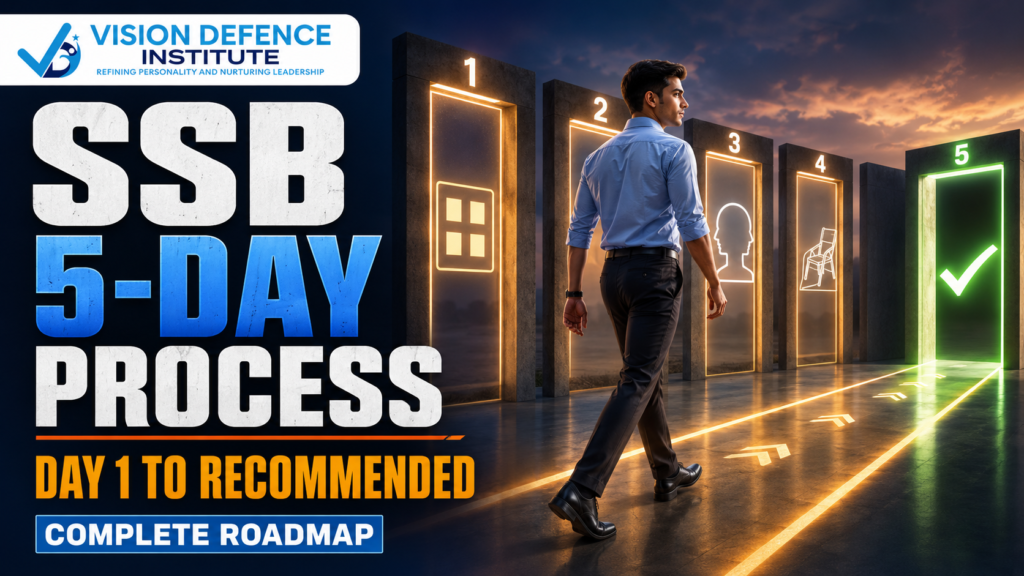
Introduction Picture this. You walk into the SSB centre on Day 0. You look around and see 80–100 other candidates. All of them have cleared the written exam just like you. All of them want to serve the nation. By the end of Day 1, nearly 40–60% of them will be sent home. By Day 5, only a handful will walk out with a “Recommended.” Who survives? Who gets through? The answer isn’t about being the smartest or the most physically fit. It’s about understanding the SSB selection process inside out. The Services Selection Board is not a university exam. It is a five-day personality assessment designed to evaluate whether you have what it takes to be an officer in the Indian Armed Forces. At Vision Defence Institute in Madurai, we’ve guided hundreds of aspirants through this exact journey. We’ve seen what works and what doesn’t. In this complete guide, we’ll walk you through every single day of the SSB selection process — from reporting and documentation to the final conference and medical examination. Whether you’re preparing for NDA coaching Madurai, CDS coaching Madurai, AFCAT coaching Madurai, or looking for the best defence academy in Tamil Nadu, understanding the SSB selection process is your first step toward success. What is SSB? The Services Selection Board (SSB) is a five-day personality assessment procedure conducted for officer-level selection for the Army, Navy, Air Force, and the Coast Guard. It is a two-stage selection system: Stage 1 is held on the day of arrival, and Stage 2 spans the remaining four days. The Core Philosophy The SSB is deliberately designed so that the same set of underlying traits — called Officer Like Qualities (OLQs) — are assessed repeatedly through different tests. Three different assessors — the Psychologist, the Group Testing Officer (GTO), and the Interviewing Officer — evaluate the candidate independently. Assessor Role Psychologist Evaluates subconscious personality through TAT, WAT, SRT, SDT GTO Assesses group behavior, leadership, and physical tasks Interviewing Officer Conducts personal interview to verify real-life personality A recommendation generally requires their assessments to align — which is why genuine, consistent behaviour matters more than a rehearsed performance. 5-Day SSB Selection Process Overview Day Stage Key Focus Day 0 Reporting & Documentation Verification, briefing, PIQ filling Day 1 Screening Test OIR + PPDT — Elimination round Day 2 Psychological Tests TAT, WAT, SRT, SDT — Personality assessment Day 3 GTO Tasks (Part 1) GD, GPE, PGT, HGT — Teamwork & leadership Day 4 GTO Tasks (Part 2) + Interview Individual Obstacles, Command Task, Lecturette, PI Day 5 Conference Final assessment and result Day 0: Reporting and Documentation Most SSB centres require candidates to report the evening before Day 1. This is your first interaction with the selection centre. What Happens on Day 0 1. Arrival at the Selection Centre You report to one of the Selection Centres — Allahabad, Bhopal, Bangalore, Gandhinagar, or others. 2. Document Verification Your original documents along with photocopies are verified — admit card, certificates, ID proof. 3. Chest Number Allocation You are allotted a chest number for identification throughout the 5-day process. 4. PIQ (Personal Information Questionnaire) Filling You fill out the PIQ form, which becomes the foundation of your Personal Interview. Fill it carefully, honestly, and specifically. Avoid vague entries — everything you write becomes material for your Interviewing Officer. 5. Briefing Session A Duty Officer conducts a short briefing about the schedule and rules. An officer of the board gives an ‘Opening Address’ explaining your stay for the next 5 days. How to Prepare for Day 0 Carry all original documents and multiple photocopies Dress formally and professionally Listen carefully during the briefing Fill the PIQ with complete honesty — no exaggerations Get a good night’s sleep — the next day is intense Day 1: Screening Test (The Elimination Round) Day 1 is the most critical day for many candidates — 40–60% are screened out and sent home. This is the first stage of the SSB selection process, and it consists of two parts. Part 1: Officer Intelligence Rating (OIR) Test What it is: Two sets of written tests — verbal and non-verbal reasoning. Format: Two papers of approximately 40 questions each Approximately 17 minutes per paper Verbal: Analogies, Number Series, Coding-Decoding, Syllogisms Non-Verbal: Figure Series, Pattern Matching, Mirror Images, Paper Folding What it assesses: Logical and analytical ability Reasoning ability, pattern recognition, analytical thinking Speed and accuracy OIR Ratings: Range from OIR-1 (Outstanding) to OIR-5 (Below Average) Part 2: Picture Perception and Description Test (PPDT) What it is: A blurred picture is shown for 30 seconds. The Process: Observe the picture for 30 seconds Write a story in 4 minutes describing: Number of characters Their mood and age What is happening Past, present, and future actions Narrate your story individually in a group Group Discussion — the group creates a common story together What assessors look for: Clarity of thought Positive story with a constructive outcome Initiative and communication clarity How you interact in a group Pro Tip: Write clear and logical stories. Speak confidently in the group discussion. Listen to others and build on their ideas. Result of Day 1 Based on OIR + PPDT performance, assessors shortlist candidates. Selected candidates proceed to Stage 2; others are sent back home the same day. How to Prepare for Day 1 Practice OIR tests extensively beforehand Practice writing stories from random images — time yourself to 4 minutes Develop the habit of positive, action-oriented thinking Practice group discussions with friends Day 2: Psychological Tests For screened-in candidates, Day 2 is entirely psychology tests conducted by a trained Psychologist. These tests evaluate your subconscious personality, mindset, emotional balance, and leadership potential. The Four Psychological Tests 1. Thematic Apperception Test (TAT) Format: 11 blurred or ambiguous pictures + 1 blank slide. Write a story for each in 4 minutes. What it assesses: Imagination and personality traits Initiative, leadership, problem-solving, empathy Your thought patterns, values, and personality traits Key Rule: Use hero-centric, positive-ending stories. Every story must have a protagonist who identifies a problem, takes initiative, uses available resources, and arrives at a constructive solution. 2. Word Association Test (WAT) Format: 60 words flashed one at a time — 15 seconds per word. Write the first word or phrase that comes to your mind. What it assesses: Spontaneous
Complete GTO Obstacles Guide for SSB Success

Introduction Ramesh had been preparing for the SSB for over a year. He had memorized every psychology test pattern, practiced dozens of group discussions, and could speak fluently on any topic. But when he stood at the starting line of the Individual Obstacles course, his heart sank. He had never climbed a rope. He had never jumped from a 12-foot platform. He had never even attempted a Burma Bridge. He froze. And just like that, months of preparation meant nothing. Because the GTO obstacles in SSB are not optional. They are not a formality. They are a make-or-break part of your selection process. At Vision Defence Institute in Madurai, we’ve seen countless brilliant candidates crumble on the GTO ground. Not because they weren’t smart enough — but because they underestimated the physical and mental demands of GTO tasks. The Group Testing Officer is not looking for a bodybuilder. He is looking for courage, determination, teamwork, and the ability to perform under pressure. This comprehensive guide covers everything you need to know about GTO obstacles — from the complete list of Individual Obstacles to Progressive Group Task (PGT), Half Group Task (HGT), Command Task, Snake Race, and more. We’ll break down the rules, share proven strategies, and give you a preparation plan that actually works. What is the GTO Test? The Group Testing Officer (GTO) test is conducted on Days 3 and 4 of the SSB interview. It is designed to evaluate your Officer Like Qualities (OLQs) through a series of indoor and outdoor tasks. What the GTO Assesses The GTO evaluates candidates on multiple OLQs including: Initiative – Do you take the first constructive step? Effective Intelligence – Can you solve practical problems? Planning Ability – Can you think ahead and organize? Courage – Are you willing to take calculated risks? Self-Confidence – Do you trust your own abilities? Communication Skills – Can you express yourself clearly? Responsibility – Do you own your actions? Cooperation – Can you work harmoniously with others? Decision-Making – Can you make quick, sound decisions? Physical Stamina – Do you have the endurance to keep going? Team Spirit – Do you put the group above yourself? Determination – Do you persist despite obstacles? Structure of GTO Tasks GTO tasks are divided into two categories: Indoor Tasks: Group Discussion (GD) Group Planning Exercise (GPE) Lecturette Outdoor Tasks: Progressive Group Task (PGT) Group Obstacle Race / Snake Race (GOR) Half Group Task (HGT) Command Task (CT) Individual Obstacles (IO) Final Group Task (FGT) Individual Obstacles (IO) Individual Obstacles is your chance to showcase personal courage, stamina, and determination. This is the only GTO task where you perform completely alone, and it happens on the first or second day of GTO testing. The Rules Rule Details Time Limit 3 minutes Number of Obstacles 10 obstacles (numbered 1-10 by difficulty) Scoring Each obstacle carries marks from 1 to 10 (total 55 marks) Order You can attempt obstacles in any order you choose Repetition If you complete all 10, you can repeat obstacles for extra points Time Warning GTO blows whistle at 2 minutes 30 seconds Participants Only 1-3 candidates on the ground at a time Complete List of Individual Obstacles Here are the 10 individual obstacles you will typically face: 1. Single Ramp / Jumping Over a Slide (1 point) What it is: Run on a slope and jump across a line about 4 feet away. Tests: Basic agility and confidence. Difficulty: Easiest. Start with this to build momentum. 2. Zig-Zag Balance (2 points) What it is: Walk on a narrow zig-zag beam at a height. Tests: Focus, balance, and body control. Note: Not used in Air Force entries. 3. Burma Bridge (3 points) What it is: Walk on ropes suspended between poles, covering 25 feet. The ropes shake as you move. Tests: Fearlessness, coordination, stability. Difficulty: HIGH. Note: Not used in Air Force entries. 4. Tarzan Swing (4 points) What it is: Climb to a 10-12 foot platform, swing on a rope like Tarzan, and land at a marked spot. Tests: Timing, grip strength, risk-taking ability. Note: Not used in Air Force entries. 5. Double Ditch (5 points) What it is: Cross two ditches — one with a rope, the other with a jump. Tests: Agility, lower body strength, confidence. Note: Not used in Air Force entries. 6. Commando Walk (6 points) What it is: Walk across ropes, beams, and bars at a height. Tests: Balance, coordination, upper body strength. 7. Tiger Leap (7 points) What it is: Climb a 9-foot platform and leap 4 feet to catch a rope, then descend using it. Tests: Courage, decision-making, upper body strength. Difficulty: HIGH. Key Tip: Catch the rope at chest level to prevent sliding and hurting your hands. 8. Monkey Crawl (8 points) What it is: Crawl under low structures like nets and ropes. Tests: Endurance, flexibility, mental toughness. 9. Rope Climbing (9 points) What it is: Climb a vertical rope and touch a post 4-5 meters high, then descend. Tests: Grip strength, technique, determination. Difficulty: HIGH. 10. Wall Jump / Climbing the Wall (10 points) What it is: Run up an inclined plane and climb over an 8-foot wooden wall. Tests: Strength, determination, confidence. Strategy for Individual Obstacles Attempt easier obstacles first (1-6 points), then move to complex ones Don’t waste time on an obstacle you find too difficult — skip it and move on The number of obstacles completed doesn’t matter as much as your determination Stay alert — injuries during this round can affect your performance in other tasks Keep trying even if you fail on the first attempt — never give up before the 3 minutes are over Important: Candidates who completed just 5-6 obstacles have been recommended, as well as those who completed all ten and repeated 4-5 additional ones. Determination counts more than total score. Progressive Group Task (PGT) Progressive Group Task (PGT) is the first outdoor group task in the GTO series. It tests teamwork, leadership, intelligence, and problem-solving. The Rules The group faces four progressively difficult obstacles Each obstacle has structures, planks, ropes, and other materials Colour rule: Red areas are out of bounds — you cannot touch them Group rule: The group cannot be split during the task Listen to the GTO’s briefing carefully — do not miss any information Look at the resources (helping materials) provided to you Obstacles can be crossed with basic practical knowledge and common sense Strategy for PGT Don’t
15 OLQs in SSB: Complete Guide for Defence Aspirants
Introduction Picture this. Two candidates walk into the SSB interview on Day 1. One has a 9.8 CGPA, speaks flawless English, and knows every date in Indian history. The other has 65% marks, speaks functional but imperfect English, and looks visibly nervous. Who gets recommended? If you guessed the first one, you’d be wrong. At Vision Defence Institute in Madurai, we’ve seen this play out hundreds of times. The topper crumbles. The “average” candidate shines. Why? Because the SSB interview is NOT a university exam. The Services Selection Board is NOT looking for the smartest person in the room. They are looking for something far more specific — Officer Like Qualities (OLQs) . These 15 officer like qualities are the foundation of every SSB selection. They determine whether you walk out of the conference room with a “Recommended” or a “Not Recommended.” And here’s the good news — these qualities are NOT something you’re born with. You can develop them. You can practice them. You can become the person who naturally displays these traits. In this comprehensive guide, we’ll break down all 15 OLQs, explain how assessors evaluate them, and give you practical, actionable tips to develop each quality. Whether you’re preparing for NDA coaching Madurai, CDS coaching Madurai, AFCAT coaching Madurai, or looking for the best defence academy in Tamil Nadu, this guide is your roadmap to SSB success. What Are Officer Like Qualities (OLQs)? Before we dive into the list, understand this: OLQs are NOT something you “fake” for 5 days. They are not a checklist you memorize the night before. The psychologists at the SSB have been doing this for 20+ years. They have seen every trick. They have heard every rehearsed answer. The 15 officer like qualities are a reflection of who you actually are. They define your leadership potential, decision-making ability, and overall personality. The SSB is designed to identify your genuine personality — not your ability to memorize answers. The Four Pillars of OLQs Pillar What It Means Qualities Included Planning & Organizing Can you think ahead? Effective Intelligence, Reasoning Ability, Organising Ability, Power of Expression Social Adjustment Can you work with others? Social Adaptability, Cooperation, Sense of Responsibility Social Effectiveness Can you lead and persuade? Initiative, Self-Confidence, Speed of Decision, Ability to Influence the Group, Liveliness Dynamic & Determination Do you have a never-say-die attitude? Determination, Courage, Stamina The Complete List: 15 Officer Like Qualities for SSB PILLAR 1: PLANNING & ORGANIZING (The Thinker) OLQ #1: Effective Intelligence What it means (in simple words): Not “book smart.” Practical smart. Can you look at a problem and find a solution using what you already know? Effective intelligence is the ability to deal with actual problems of varying complexity. It differs from basic intelligence, which is the ability to detect relationships and think abstractly. EI focuses on your problem-solving skills and ability to handle everyday challenges. SSB Example: During the GTO (Group Testing Officer) tasks, you are given a plank, a rope, and a pole. You need to cross a “river” marked on the ground. The engineer will try to calculate angles. The person with effective intelligence will just tie the rope and test it. How to develop it: Stop using GPS for one week. Navigate your own city using landmarks Fix something broken in your house (fan, chair, tap) without watching YouTube tutorials Play chess or Sudoku daily Find quick solutions to real-life problems — if your friend’s bike runs out of petrol late at night, don’t panic; find the nearest petrol pump, arrange a bottle, or push together until help comes OLQ #2: Reasoning Ability What it means: Can you connect dots that aren’t obviously connected? Can you see cause and effect? Reasoning ability is the capacity to understand a given situation and reach logical conclusions through rational thinking. It assesses your receptiveness, inquisitive nature, logical reasoning, and ability to identify the essence of a problem. SSB Example: In the Psychology Test (TAT — Thematic Apperception Test), you see a blurry picture. You have to write a story. The officer is not checking your creative writing skills. They are checking how your mind processes information and draws conclusions. How to develop it: Practice solving complex problems and puzzles to sharpen analytical skills Play chess or participate in strategy-based games Develop the habit of questioning assumptions and exploring alternative perspectives Read newspapers daily to form fair opinions on various topics OLQ #3: Organising Ability What it means: Can you arrange resources — people, time, materials — to achieve a goal efficiently? Organising ability involves the systematic utilization of resources to achieve effective results. Assessors are interested in how you employ various resources to produce outcomes. SSB Example: In the Group Planning Exercise (GPE), you are given a map, a scenario, and limited resources. Your ability to organize people, prioritize tasks, and execute a plan is being watched closely. How to develop it: Plan a family event or trip from start to finish Take part in competitions like drama, skits — engage yourself in organizing lifestyle and small functions Be a volunteer in stage programs In group tasks, take the lead in organizing roles and responsibilities OLQ #4: Power of Expression What it means: Can you communicate your ideas clearly, confidently, and convincingly? Power of Expression is the ability to adequately and clearly communicate one’s ideas. It is not just about speaking English fluently — it’s about conveying thoughts clearly, confidently, and convincingly under pressure, especially in a group. SSB Example: During group discussions, lecturette, or personal interview, your ability to articulate your thoughts matters more than the content itself. How to develop it: Practice speaking 2 minutes in front of a mirror daily Record a short motivational speech on your phone and review it Narrate a news article to your family as if teaching a class Participate actively in family discussions instead of staying quiet Speak with people who have good speaking skills PILLAR 2: SOCIAL ADJUSTMENT (The Team Player) OLQ #5: Social Adaptability What it means: Can you adjust to different people and environments? Can you work with anyone? Social adaptability is the ability to
SSB Physical Requirements 2026: Complete Guide
SSB Physical Eligibility: The Exact Standards for 2026 Let’s get straight to the numbers. These are the official SSB physical requirements issued by UPSC and the Indian Armed Forces. 1. SSB Running Time (The Most Important Standard) This is the first filter. You will run 1.6 kilometers (approx 1 mile). There is no “walking break.” There is no “I will try my best.” Gender/Age Group Minimum Time Maximum Allowed Male (NDA/CDS) 6 min 30 sec 7 min 30 sec Female (CDS – OTA) 7 min 30 sec 8 min 30 sec Navy/IAF Candidates 6 min 15 sec 7 min 15 sec Warning: The above times are the bare minimum. To impress the GTO (Group Testing Officer), you should aim for under 6 minutes for males and under 7 minutes for females. What Happens If You Fail the SSB Running Time? You are marked NOT RECOMMENDED for the day. You are sent home immediately. You cannot appear for any further tests. 2. Height Requirements for SSB Height is the first thing checked in the SSB physical test. Even 1 cm below the minimum results in rejection. Service Male Minimum Female Minimum Indian Army 157 cm (5’2″) 152 cm (5’0″) Indian Navy 157 cm (5’2″) 152 cm (5’0″) Indian Air Force 162.5 cm (5’4″) 152 cm (5’0″) Army (Gorkha/NE) 152 cm 148 cm Important Notes: Height is measured without shoes Air Force has stricter height requirements due to cockpit and equipment ergonomics Candidates from Gorkha, North-Eastern hills, Garhwal, and Kumaon regions may get relaxations of 2–5 cm An allowance of about 2 cm for growth may be considered for candidates below 18 years 3. Weight Standards (Proportionate to Height) Weight must be proportionate to height and age as per the UPSC-prescribed chart. Key Points: BMI should ideally fall between 18.5 and 25 A variation of up to ±10% from the ideal is generally acceptable Both underweight and overweight candidates can be declared Temporarily Unfit and asked to reappear after correction Approximate Weight Ranges for Male Candidates: Height (cm) Acceptable Weight Range (kg) 157 44 – 57 160 47 – 61 163 50 – 64 168 54 – 70 172 57 – 74 175 60 – 77 Female candidates follow a similar proportionate chart. 4. Chest Measurement Requirements (Male Candidates) For male candidates, the chest is measured both unexpanded and fully expanded. Parameter Requirement Minimum Chest (unexpanded) 77 cm Minimum Expansion 5 cm Expanded Chest 82 cm minimum What This Means: If your expanded chest is 81 cm, your unexpanded chest should be no more than 76 cm Candidates with poor expansion are marked unfit Regular breathing exercises, swimming, and cardio training can improve chest expansion significantly The chest should be symmetrical without deformities such as pigeon chest, sunken chest, or asymmetry 5. Vision and Eye Standards for SSB Vision is the most commonly failed criterion – especially for the Air Force. Service Standard Spectacles Allowed? Army 6/6 better eye, 6/9 worse eye (correctable). Myopia max –2.5D, Hypermetropia max +3.5D Yes Navy 6/6 better eye, 6/9 worse eye (correctable). Myopia max –2.5D, Hypermetropia max +3.5D Yes Air Force (Flying) 6/6 in both eyes uncorrected. No myopia or hypermetropia beyond limits. Colour vision CP-I required No Critical Points: Candidates who have undergone LASIK, Radial Keratotomy, or any refractive surgery are permanently rejected for all Services – not just Air Force Color blindness is not allowed Night blindness is not acceptable For IMA and OTA entry, the standard requires a minimum of 6/6 distance vision in the better eye and 6/18 in the worse eye, correctable to 6/6 and 6/9 respectively Refractive Error Limits for Graduate-Level Officer Entries: Male candidates: Myopia up to -3.5 dioptres Female candidates: Myopia up to -5.5 dioptres (including astigmatism) 6. Physical Fitness Test (PFT) Standards Beyond the running test, you will be assessed on multiple physical parameters: Exercise Minimum Standard Running (1.6 km) As per time table above Push-ups 15–20 (minimum) Sit-ups 30–40 (minimum) Pull-ups / Chin-ups 6–8 (minimum) Rope Climbing 3–4 meters For Female Candidates (NDA): 1.6 km Run: As per time standards Push-Ups: Minimum 15 repetitions (full form) Sit-ups: Minimum 20 repetitions Pro Tip: Aim for at least 40 push-ups and 50 sit-ups in a single set before your SSB date. Common Medical Disqualifications to Avoid Knowing what gets candidates rejected can save your dream. Here are the most common reasons for SSB medical rejection: Orthopaedic Issues Knock knees – One of the most common reasons for rejection Flat feet – A frequent disqualifier Bow legs Poor spine posture / Scoliosis Vision Problems Below-standard eyesight Colour blindness – Not acceptable High refractive error beyond permissible limits Poor night vision Weight Issues Overweight or underweight beyond permissible range Other Common Issues Dental problems – Fewer than required sound teeth, gum disease Hearing deficiency High or low blood pressure Deviated nasal septum (DNS) Chronic respiratory diseases Skin conditions – Eczema, vitiligo, visible tattoos in prohibited areas SSB Physical Preparation Checklist Start your preparation right now. Don’t wait until the SSB call letter arrives. 4-Week Training Plan Week 1: Foundation Building Running: 1–1.5 km daily Push-ups: 10 reps × 2 sets Sit-ups: 15 reps × 2 sets Stretching: 10 minutes Focus: Build habit Week 2: Strength + Stamina Running: 2 km daily Push-ups: 15 × 3 sets Sit-ups: 20 × 3 sets Plank: 30–45 sec Focus: Improve endurance Week 3: Performance Level Running: 2.4 km (timed) Push-ups: 20 × 3 sets Sit-ups: 25 × 3 sets Pull-ups: Start practice Focus: Speed + strength Week 4: SSB Standard Preparation Running: 2.4 km under 12 min Push-ups: 25+ Sit-ups: 30+ Pull-ups: 6–8 Focus: Achieve SSB level Daily Fitness Routine Time Activity Morning Running + Cardio Afternoon Rest / Light activity Evening Strength Training Night Stretching Diet Plan for Defence Aspirants What to Eat: Protein: Eggs, milk, dal, chicken, fish Carbs: Rice, chapati, oats Fruits & vegetables – all colors Nuts – almonds, walnuts What to Avoid: Junk food Sugary drinks Excess fried items Hydration is key: 3–4 liters water daily SSB Physical Requirements: Male vs Female Parameter Male Candidates Female Candidates Height (Army) 157 cm 152 cm Height (Navy) 157 cm 152 cm Height (IAF) 162.5 cm 152 cm Chest Expansion 5 cm minimum Not applicable Running (1.6 km) Under 7:30 min Under 8:30 min Push-ups 15–20 minimum 15 minimum Sit-ups 30–40 minimum 20 minimum Key Takeaways for SSB Physical Eligibility Start early – Physical fitness cannot be built overnight Know the exact standards – Don’t guess; check official requirements Get a medical check-up – Identify
SSB Running Time: 1.6km & 2.4km 2026 Plan and Tips
SSB Running Time: Why It Matters If you have ever stared at a track on a cold morning, heart pounding, dreading the whistle, you already understand why SSB running time decides more defence careers than almost anything else you will train for. Everyone obsesses over the written exam, the OIR, and the PPDT story-writing—but barely anyone talks about the run. Then the ground opens up, your legs go heavy, and a fit candidate gets screened out because they simply were not running-conditioned. The truth is simple: your stamina is scored before your personality is. In the 5‑day Services Selection Board (SSB) process, physical fitness runs through nearly every round, from the energy you carry into the screening hall to the ground tasks on Days 3 and 4. Walking in underprepared for the SSB running time is the fastest way to throw away months of hard work. This guide gives you the exact 1.6 km and 2.4 km standards to aim for, male vs female expectations, how running is really assessed, the mistakes that quietly fail candidates, and a 30‑day plan to arrive confident and fast. A Story You Will Recognise The Day Breath Runs Out Last year, Arjun—a bright engineering student from Madurai—cleared the AFCAT written exam with flying colours. The whole city was proud. He had solved every reasoning paper, memorised every current affair, and walked into the SSB with absolute confidence. Then on the ground, during the group obstacle task, his breath left him halfway. His legs cramped. He finished, but barely, and the assessing officers saw a candidate who had not done enough running. He was screened out. Arjun’s problem was never intelligence. It was that he treated the SSB running time as optional. He had pushed-ups and sit-ups at home, but he never timed a real distance run on the track. When the moment arrived, his body betrayed him. You do not have to make the same mistake. A steady, honest running routine is the difference between being “fit on paper” and being fit on the ground. SSB Running Time: The Numbers There is no single, identical stopwatch for every board, but the benchmarks below are what trainers and selection centres consistently use for officer entry. Aim to hit the stronger end, not just the minimum. 1.6 km Standard Comfortable baseline: run 1.6 km in roughly 6–7 minutes—this is the sweet spot most SSB coaching plans target for officer aspirants. Group I (full marks): under 5 min 30 s Group II (qualifying): under 5 min 45 s to 6 mindoondefencedreamers+1 For Air Force entry, an initial 1.6 km in ~10 minutes plus basic push-ups and chin-ups is the common starting bar. Treat 1.6 km as your “comfortable everyday” distance. You should be able to hold a conversation at the end of it, not collapse. 2.4 km Standard Officer-entry benchmark: for NDA and CDS, the 2.4 km test is measured at under 10 min 30 s for full marks and under 11 minutes to qualify. Academy standard: once you reach training, the PT run is 2.4 km in roughly 9 minutes (male) and under 12 min 30 s (female). Our practical target: build up to running 2.4 km in 12–14 minutes comfortably before your board. Why both distances? The 1.6 km builds your base speed, and the 2.4 km proves you have real endurance. Selection centres want to see you handle both with a calm, controlled pace. Male vs Female Expectations The physical demand is the same for male and female officers—the extra time is the only difference. Male candidates: target 1.6 km in ~6 min and 2.4 km in ~9–12 min.nimbusdefenceacademy+1 Female candidates: target 1.6 km in ~7–8 min and 2.4 km in under 12 min 30 s. Non-negotiables for both: steady breathing, upright posture, and the ability to keep a controlled pace while a group runs alongside you. Do not fixate only on speed. Test assessors watch how you run—whether you panic, surge early, and fade. Consistency and composure matter more than a one-off fast lap. How Running Is Assessed Running does not always appear as a single “race” with a scoreboard. It is woven through the week: Screening Day (Day 1): you are assigned chest numbers and must sit through the OIR and PPDT fresh and focused. Fatigue from poor training hits you here first.wikipedia+1 GTO Ground Tasks (Days 3–4): the Snaked Race / Group Obstacle Race and the individual obstacles demand genuine running capacity and coordination.pw+2 Command and Group Tasks: these are done outdoors across the ground. If you are out of breath after each sprint, you cannot think clearly to lead. Later Academy PT: after selection, the official fitness run (often 2.4 km) is a graded event, so the habits you build now carry you forward. In short, SSB running time is assessed as physical proof of your spirit, not a box to tick. Strong runners stand out; unprepared ones get exposed. Common SSB Running Mistakes Most candidates fail the running test long before the ground. Avoid these: Skipping distance training. Push-ups build arms, not lungs. If you never run a timed 1.6 km or 2.4 km, you cannot suddenly produce it. Starting too fast. Beginners sprint the first lap, hit a wall, and walk the last two. Always start at 70–80% effort. No warm-up or cool-down. Running cold increases injury risk and stiffens your legs for the days that follow. Ignoring time. Running the right distance at any speed is not enough—train with a stopwatch so the pace feels automatic. Changing shoes at the last minute. New, stiff shoes cause blisters exactly when you need trust in your feet. Overtraining in the final week. Peak early, then rest; an injury 10 days before can ruin everything. SSB Running Time: 30-Day Plan Follow this simple progression. Start gently if you are new, and build steadily every week. Weeks One and Two Days 1, 3, 5: run 1.6 km at a relaxed pace, then finish with 2–3 × 100 m relaxed sprints.
Power of Discipline Why It Matters More Talent
The Power of Discipline: Why It Matters More Than Talent Two Aspirants, One Dream, Two Different Outcomes Let me tell you about two students who walked into Vision Defence Institute at 2ND STOP, S ALANGULAM, Kulamangalam Main Rd, Madurai. One was brilliant. Scored 95% in 12th. Could solve complex math problems in seconds. Teachers called him “the genius.” The other was average. Scored 70%. Took time to understand concepts. Nothing special on paper. Everyone expected the brilliant one to crack the NDA easily. But something unexpected happened. The “genius” failed his SSB. Three times. The “average” student got recommended in his first attempt. He is now training at the National Defence Academy, Pune. What made the difference? The power of discipline. Talent got the brilliant student to the SSB. But it was the lack of discipline that made him fail. He couldn’t wake up at 5 AM consistently. He couldn’t complete his daily PT. He couldn’t practice psychology tests every single day. The average student had no natural talent to fall back on. So he built something stronger—the power of discipline. He showed up every day. He did the work. And the work rewarded him. Here’s the truth: the power of discipline always beats talent when talent doesn’t work hard . Why Discipline Matters More Than Talent You’ve heard this before, right? “Hard work beats talent when talent doesn’t work hard.” But why is this so true for defence aspirants? 1. The Power of Discipline Is a Learned Skill Most people think that when you’re born, you’re either gifted with self-discipline or you’re not . That’s completely false. Self-discipline is a learned skill . When you choose to exercise willpower and delay gratification, neuroscientists can detect higher levels of brain activity in the prefrontal cortex. When you make healthy choices, this area of the brain is strengthened like a bicep as you lift weights . Here’s what this means for you: Aspect What It Means Your brain can change Discipline is like a muscle—train it daily Every good choice matters Each small decision strengthens your discipline Bad choices weaken it Giving in to impulses makes the next time harder You can improve Talent is fixed—discipline can grow indefinitely Just as you train your body for the SSB physical tasks, you must train your brain for the power of discipline. 2. Talent Alone Won’t Build Officer-Like Qualities The SSB interview is a five-day process designed to test your Officer Like Qualities (OLQs) . And here’s the thing—the SSB doesn’t care how smart you are. They care about: Integrity – Can you be trusted when no one is watching? Self-discipline – Can you follow through on commitments? Resilience – Can you bounce back from failure? Mental toughness – Can you stay calm under pressure? These aren’t talents you’re born with. These are built through discipline—day after day, habit after habit. 3. Habits Are the Power of Discipline in Action Kurt Koepmeyer researched the secret of success for over 50 years. He found 999 principles. But he said only one matters most . “Without self-discipline, none of them really work.” The only difference between successful and unsuccessful people are the habits they follow each day . Talent might get you started. But discipline keeps you going. The Power of Discipline: What Research Tells Us The power of discipline is backed by science—not just motivation. The 40% Rule Navy SEALs have a rule: when you feel completely exhausted, you’ve only reached about 40% of your actual capacity . What this means: Feeling Reality “I can’t go on” You have 60% more in you “I’ve done enough” You’ve barely started “I’m too tired” Your body can push harder “I’ll do it tomorrow” Today is when it matters By pushing past this perceived limit, you build resilience and mental toughness . This is the power of discipline. The Stanford Marshmallow Experiment In 1972, researchers at Stanford did an interesting experiment. Children were given a marshmallow or candy. They were told they could eat it immediately—or wait and get two. Years later, they tracked these children. Those who had the discipline to wait were more successful in every area of life—better careers, better relationships, better health . The lesson: Even if you are less talented than others, the power of discipline will put you ahead in the long run . Discipline vs. Motivation Motivation gets you started. Discipline keeps you going when your drive runs out . Here’s the harsh reality: Motivation Discipline Fleeting Permanent Depends on mood Works regardless of mood Requires inspiration Requires routine Temporary Sustainable Starts the journey Finishes the journey The power of discipline is the engine that sustains you through challenges and builds your commitment to your future self . How the Power of Discipline Transforms Defence Aspirants At Vision Defence Institute, we don’t just teach you for the exam. We build the discipline you need for a life of service. 1. Master Your Time – The “No Excuse” Routine An officer’s life runs on precision. There is no “I’ll do it later” in the armed forces. What discipline looks like: Wake up at 5 AM every day—no weekends off Daily physical training at 6 AM—rain or shine Structured study schedule—no deviation Focused preparation—no distractions The power of discipline is about doing what you know you’ve got to do even when you don’t feel like it . 2. Train Your Body to Fortify Your Mind The armed forces don’t want weak bodies. They want resilient minds housed in strong bodies. Our daily PT at 6 AM—rain or shine: Day Activity Purpose Monday 1.6 km time trial + Push-ups Endurance building Tuesday Interval running + Sit-ups Speed and core strength Wednesday Obstacle course practice GTO task preparation Thursday Beep test + Pull-ups Cardiovascular and upper body Friday Long run (3-5 km) Stamina and mental toughness Saturday GTO task simulation Leadership in action Sunday Rest / Stretching Recovery One student’s story: “Sir, I was a Tamil medium student from a village near Madurai. My English was weak. VDI Madurai didn’t reject me—they worked with me. Extra English classes. Special pronunciation sessions. Today, I am at OTA Chennai.” That’s the power of discipline. Not giving up. Showing up. Every. Single. Day. 3. Build Habits, Not Just Skills Habits are daily activities you perform without even
Classroom to Parade Ground Defence Life Prep
From Classroom to Parade Ground: Preparing for a Life in Defence Two Journeys, One Dream: What Makes the Difference? Let me tell you about two young women—Minakshi and Tannu. Both are Flying Officers in the Indian Air Force today . But their journeys could not have been more different. Minakshi grew up moving across Army stations as her father served the nation. She studied at Army Public School, Dhaula Kuan, where the uniform was a part of everyday life. Watching officers in uniform and interacting with children from defence families gave her an understanding of military life long before she ever imagined becoming one . Tannu’s world was completely different. Born into a humble farming family in a small village in Haryana’s Hisar district, opportunities were limited. She had no family member in uniform to guide her. There were no military traditions to follow and no roadmap to success . Her mother believed education could change destinies and encouraged her to pursue studies beyond the village. But here’s the thing: both made it. Both are Flying Officers today. The difference? Tannu had to prepare harder. She had to build from scratch. She had to find the right guidance, the right environment, the right preparation pathway. And so do you. Today, Tannu is not just an officer—she was appointed Women Cadet Captain at the Air Force Academy, one of the highest responsibilities entrusted to a trainee officer . Her story proves one powerful truth: preparation is everything. The Problem: Why Most Aspirants Fail Let’s be honest. Every year, lakhs of students dream of wearing the uniform. But only a fraction make it. Why? Because they confuse “studying” with “preparation.” Studying is reading books. Preparation is becoming. Studying is learning facts. Preparation is building character. Most aspirants: Buy textbooks and solve past papers Join generic coaching centres with 100+ students Ignore physical training until the last month Practice psychology tests for the first time at SSB Walk into the interview with rehearsed answers And they fail. Over and over again. The Real Problem Revealed I remember a student, Arun, who came to Vision Defence Institute after his third “Not Recommended” at SSB . “I did everything the books said,” he told our faculty. “I initiated group discussions, I wrote positive stories in the psychology tests, I spoke confidently. What more do they want?” When our faculty—comprising ex-defence officers who have served on selection boards—spoke with him for 30 minutes, the problem became crystal clear . “You were performing a checklist,” one of our mentors explained. “Your actions looked right, but your motivation was transparently tactical, not authentic. The board doesn’t select actors; they select leaders.” Arun’s story is a classic case of preparing with theory, not insight. The Solution: What Real Preparation Looks Like Real preparation for a life in defence is holistic. It covers every aspect of who you are—your mind, your body, your character, your habits. Here’s what that looks like. 1. Academic Preparation: Building the Foundation Yes, you need to clear the written exam. That’s non-negotiable. What Most Aspirants Do Wrong: Cram subjects at the last minute Focus only on “easy” topics Ignore English and current affairs Solve only “favourite” question types What Proper Academic Preparation Looks Like: Structured Daily Study: 2 hours Mathematics 2 hours English/General Knowledge 1 hour Current Affairs Weekly Mock Tests: Simulate real exam conditions under timed pressure. Error Analysis: Track every mistake and learn from it—not just repeat the same errors. Bilingual Learning: For Tamil-medium students, concepts are taught in Tamil first, then English terminology is introduced . Why This Matters: For thousands of talented students across Tamil Nadu who have been educated in Tamil medium schools, the English language exam becomes a formidable barrier. They understand Physics principles in Tamil, but spend half their time decoding English sentences instead of solving problems . At Vision Defence, we address this by teaching the entire NDA, CDS, and AFCAT syllabus in clear, academic Tamil first. Once the concept is grasped, we introduce standard English terminology . The Result: Students build a strong, intuitive understanding. They learn that “கோண அளவீடு” is “Trigonometry” and “விசையியல்” is “Mechanics.” 2. Physical Preparation: Forging the Body The armed forces don’t want weak bodies. They want resilient minds housed in strong bodies. The Reality: You will run 1.6 km in SSB You will climb obstacles, carry logs, and do push-ups You will be expected to lead—and you can’t lead if you can’t keep up What Proper Physical Preparation Looks Like (60-Day Summer Challenge Format) : Day Activity Purpose Monday 1.6 km time trial + Push-ups Endurance building Tuesday Interval running + Sit-ups Speed and core strength Wednesday Obstacle course practice GTO task preparation Thursday Beep test + Pull-ups Cardiovascular and upper body Friday Long run (3-5 km) Stamina and mental toughness Saturday GTO task simulation Leadership in action Sunday Rest / Stretching Recovery Why Summer Matters for Physical Preparation: During school terms, your time is not your own. School from 8 AM to 3 PM, homework, tuition classes—by the time you sit for self-study, you’re exhausted. Summer gives you: Uninterrupted time (60 days with no school pressure) Mental freshness (you’re not burnt out from exams) Habit formation (60 days builds lasting habits) Experiment room (try different routines and see what works) Physical Preparation Tip: Do PT outdoors if possible. The sun, the fresh air, the early morning energy—it all contributes to building that “officer-like” mindset . 3. SSB Preparation: The Make-or-Break Phase This is where most aspirants fall apart. The SSB is a five-day process designed to test your Officer Like Qualities (OLQs) . The Four Stages of SSB : Stage What It Tests How to Prepare Screening (PPDT) Quick thinking, creativity Practice story-writing in 30 seconds Psychology (TAT, WAT, SRT) Your subconscious personality Daily practice with expert feedback GTO (Group Tasks) Leadership, teamwork, problem-solving Practice on real GTO ground Personal Interview Your life story, beliefs, integrity Mock interviews with ex-I-Os Why Most SSB Coaching Fails: Most coaching institutes operate in the realm of theory. They teach you: “Write a story with a positive ending for TAT.” “Take initiative in the Group Discussion.” “Be confident in
Officer Mindset Habits Turn Aspirants Leaders
The Officer Mindset: Habits That Turn Aspirants into Leaders Two Boys, One Dream, Two Different Paths Let me tell you about two friends from Madurai – Suresh and Anand. Both were 17. Both had the same dream: to wear the olive green uniform. Both had cleared their 12th standard with good marks. Both walked into defence coaching with the same fire in their eyes. But something was different. Suresh treated coaching like school. He came to class, took notes, went home, and waited for the exam to happen. He thought cracking the NDA was about passing a test. Anand did something else. He started becoming an officer long before he cleared any exam. He changed his habits. His daily routine. His way of thinking. His response to failure. Eight months later: Suresh failed the written exam. He didn’t even get an SSB call. Anand cleared NDA written, cracked SSB, and is now at the National Defence Academy, Pune. Same coaching centre. Same city. Same goal. Different mindset. Here’s the truth that most defence aspirants miss: the officer mindset is not something you switch on during the SSB interview. It’s something you build, day by day, through habits . The Officer Mindset: Not Born, Built What exactly is the “officer mindset”? It’s not about being loud or aggressive. It’s not about wearing a uniform. It’s not even about knowing the right answers. The officer mindset is about how you show up every single day. It’s about: Taking responsibility when things go wrong Staying calm when everyone else is panicking Leading when no one is watching Making decisions under pressure Putting the team before yourself Kiran Bedi, India’s first female IPS officer, put it perfectly: “The habits I built became me. They now define me.” She didn’t wake up one morning as a leader. She built it through small, consistent habits: waking up early, fitness, mental stability, time management, going the extra mile, getting out of comfort zones . The same applies to you. Your habits today determine whether you become an officer or stay an aspirant forever. Habit 1: Master Your Time – The “No Excuse” Discipline An officer’s life runs on precision. There is no “I’ll do it later” in the armed forces. The Problem: Most aspirants waste hours scrolling through Instagram, waking up late, and procrastinating on study. They think they have “enough time” because the exam is months away. The Solution: Start treating time like a weapon. Here’s how: Wake up at 5 AM every day. No weekends off. No excuses. This single habit separates serious aspirants from dreamers . Follow the “5-Minute Rule” – if a task takes less than 5 minutes, do it immediately . Create a daily schedule – study, physical training, reading, family time, rest – and STICK TO IT . Track your time – notice where you’re wasting it and cut that out ruthlessly. When you master your time, you master your life. When you can’t manage your own schedule, how will you manage a team? Habit 2: Lead Where You Stand – Even Without a Title You don’t need a rank to lead. You need the right mindset. The Problem: Many aspirants think leadership starts when they become officers. They wait for someone to give them authority before they act. The Solution: Start leading now, right where you are. Volunteer first – for school events, group projects, sports teams. Initiative is magnetic . Practice “We” over “I” – In group tasks, focus on team success. Listen to others, synthesize ideas, and help the group reach consensus . Solve problems, don’t just report them – If you see an issue, think of a solution and act . Encourage quieter members – In group discussions, make sure everyone speaks. This is direct practice for the SSB GTO tasks . The SSB doesn’t want to hear that you “could be” a leader. They want to see that you already are one – even without a uniform . Habit 3: Train Your Body to Fortify Your Mind The armed forces don’t want weak bodies. They want resilient minds housed in strong bodies. The Problem: Most aspirants focus only on written exams and neglect physical fitness. They think they’ll “start training” after clearing the written exam. The Solution: Your fitness journey starts TODAY. At Vision Defence Institute, our students train at 6 AM daily – rain or shine . Here’s what serious fitness looks like: Day Activity Purpose Monday 1.6 km time trial + Push-ups Endurance building Tuesday Interval running + Sit-ups Speed and core strength Wednesday Obstacle course practice GTO task preparation Thursday Beep test + Pull-ups Cardiovascular and upper body Friday Long run (3-5 km) Stamina and mental toughness Saturday GTO task simulation Leadership in action Sunday Rest / Stretching Recovery Sports like football, basketball, and athletics teach teamwork, strategy, and how to handle both victory and loss with grace . Remember: The GTO tasks are NOT about physical strength. They’re about mental clarity, leadership, and problem-solving. But a fit body gives you the confidence to think clearly under pressure . Habit 4: Read, Reflect, and Relate – Build Your General Awareness Officers need broad minds. They need to understand the world, India’s security challenges, and geopolitical dynamics. The Problem: Aspirants think current affairs can be “crammed” in the last month before exams. They read headlines but don’t understand context. The Solution: Read The Hindu editorial daily – 30 minutes, not just for facts but to understand viewpoints . Connect dots for defence – When you read about a geopolitical event, ask: “How does this affect India’s security?” Develop your own opinion – The SSB personal interview tests whether you can think critically, not just repeat what you’ve memorized. Follow defence news – India’s military exercises, new acquisitions, border issues – know what’s happening. At Vision Defence, we provide daily news summaries, weekly current affairs quizzes, and monthly in-house defence magazines . This isn’t just for exams – it’s for building an officer’s mind. Habit 5: Develop Your “Commander Mindset” – Observe Before Acting The GTO tasks in SSB are where most aspirants fail. Not because they’re weak, but because they rush. The Problem: Aspirants jump into tasks without thinking.
Can Leadership Be Learned Defence Training
Can Leadership Be Learned? What Defence Training Teaches Young Aspirants The Question That Haunts Every Defence Aspirant Let me tell you about two friends from Madurai – Karthik and Vinoth. Both were 17. Both dreamed of wearing the olive green uniform. Both wanted to serve the nation. Both had cleared their 12th standard with good marks. But they made one different choice. Karthik joined a random “coaching centre” near his house that promised him the world but delivered nothing. No physical training. No psychology classes. No mock SSB. Just a dusty classroom and old books. Vinoth walked into Vision Defence Institute (VDI) at 2ND STOP, S ALANGULAM, Kulamangalam Main Rd, Madurai. Eight months later: Karthik failed the NDA written exam. He didn’t even get an SSB call. Vinoth cleared NDA written, cleared SSB, and is now at the National Defence Academy, Pune. Same city. Same dream. Different outcome. Why? Because Vinoth discovered something that changed his life: leadership can be learned – and defence training is the fastest, most effective way to learn it . This is the truth that every defence aspirant needs to hear. You are NOT born a leader. You are TRAINED to become one. And that training starts with choosing the right defence coaching in Madurai. The Leadership Myth: Born or Made? For decades, we’ve been sold a lie. The lie that leaders are born, not made. That some people just “have it” and others don’t. That’s nonsense. Think about it. When a baby is born, can they lead a team? Can they make strategic decisions under pressure? Can they inspire others to follow them? Of course not. Leadership is a skill. And like any skill, it can be learned, practiced, and mastered . The real question isn’t “Can leadership be learned?” The real question is “What’s the best way to learn it?” And the answer, for millions of young Indians every year, is defence training. How Defence Training Builds Leaders Let me break down exactly how defence training transforms ordinary young men and women into extraordinary officers . 1. You Learn Through Experience, Not Theory You cannot learn leadership from a textbook. You cannot become a leader by memorizing theories. You become a leader by doing. At Vision Defence Institute, we don’t just teach you about leadership. We put you in leadership situations. You lead group tasks on our in-house GTO ground – the only one in Madurai You command teams during obstacle courses You make decisions under pressure during mock SSB interviews You practice psychological tests that reveal your natural leadership tendencies As Lance Corporal Avana Pohe discovered during her junior leadership training, “making a decision and sticking to it” was the most valuable lesson she learned . This is what leadership training looks like. Not lectures. Action. 2. You Fail – And Learn From Failure This is the part nobody tells you about. Defence training teaches you that failure is not the end. It’s the beginning. When Lt. Gen. Sean A. Gainey spoke to ROTC cadets, he shared something powerful: “Your ability to recognize [a challenge], adapt and move forward is what separates true leaders” . I remember a student named Muthu who joined us after failing his first NDA attempt. His English score was 42/100. He was devastated. But here’s what happened. Instead of giving up, Muthu used our bilingual teaching method – English with Tamil explanations – and six months later scored 82/100 in English. Now he’s an officer. His failure wasn’t the end. It was the beginning of his real growth. 3. You Learn The “WHY” Behind Everything Here’s something that most army coaching centres in Tamil Nadu get wrong. They teach you the “how” – how to solve math problems, how to answer English questions, how to pass the written exam. But they never teach you the “why.” Why do officers need these skills? Why does the military value certain qualities over others? Defence training teaches you to understand the purpose behind every action . This trained inquisitiveness becomes your “superpower” when looking for better outcomes or improvements. SSB interview coaching tests this relentlessly: Why do you want to join the armed forces? Why are you suited for a leadership role? Why should we select you over others? If you can’t answer the “why,” you can’t lead. 4. You Build Resilience – The Ultimate Leadership Trait Resilience isn’t just “bouncing back” from failure. It’s growing stronger because of it. Lt. Gen. Gainey gave this crucial advice to young aspirants: “Building resilience is important in life. A lot of the younger generation feel like if there is a tough event that you can’t overcome, it’s over. But the key to overcoming them is finding someone to help you get through those tough times” . NDA coaching in Madurai that doesn’t include resilience training is incomplete. At VDI, we build resilience through: Early morning physical training (6 AM daily – rain or shine) Repeated mock tests that simulate exam pressure SSB psychological test practice that pushes mental boundaries Group tasks that require teamwork even when you’re exhausted When you can survive these challenges, you can survive anything. 5. You Develop Emotional Intelligence Leadership isn’t about being the loudest person in the room. It’s about understanding yourself and others. The Defence Senior Enlisted Leadership Programme (DSELP) emphasizes emotional intelligence, inclusive leadership, and ethical leadership as key themes for developing leaders . At VDI, we incorporate these same principles: Leadership Skill How VDI Develops It Self-awareness Psychological tests (TAT, WAT, SRT) Empathy Group discussions and team tasks Communication Mock interviews and presentations Decision-making Command tasks and GTO exercises Ethics Integrity-focused training sessions You cannot lead others effectively if you cannot lead yourself. What SSB Interview Coaching Actually Teaches You This is where most aspirants get confused. They think SSB interview preparation is about “cracking” a test. It’s not. The Services Selection Board (SSB) interview is a five-day process that evaluates your Officer Like Qualities (OLQs) . Here’s what it really tests: The Psychological Tests (TAT, WAT, SRT) These aren’t “tests” in the traditional sense. They’re windows into your mind. They reveal: How you think under pressure What your natural responses are
Online vs Offline Defence Coaching: Best Choice?

Online vs Offline Defence Coaching: Which One Gives Better Results? Let me tell you about two students. Same town. Same dream. Different choices. Rahul lived in a small village near Madurai. His parents couldn’t afford to send him to a city for coaching. He opted for online defence coaching from a popular platform. Cheap. Convenient. No travel. Priya lived just 10 km away. She joined Vision Defence Institute (offline) in Madurai. She woke up at 5 AM. She traveled 45 minutes each way. She paid more money. After 6 months of preparation, who cleared the NDA written exam? Both. But only one cleared the SSB interview. Priya did. Rahul didn’t. Why? Because online coaching taught Rahul how to answer questions. Offline coaching taught Priya how to become an officer. If you are searching “online vs offline defence coaching” , you are probably confused. Your parents want you to join a “real coaching center.” Your friends say “everything is available online for free.” Your budget is limited. Let me settle this debate once and for all. In this guide, I will compare online vs offline defence coaching across every parameter that matters for NDA, CDS, and AFCAT: Cost (fees + hidden costs) Discipline and routine SSB and GTO preparation (the real differentiator) Peer group and competition Doubt clearing Success rates and results Who should choose what (based on your profile) Let me be honest upfront: I run an offline coaching center (Vision Defence Institute in Madurai). So you might think I am biased. That’s fair. But I will give you the unvarnished truth. Online coaching works for some people. Offline coaching works for most people. Let me tell you why. The Problem: Online Feels Easier. Offline Feels Harder. Both Can Fail. Here is what aspirants don’t realize. Online defence coaching feels good in the beginning. You wake up at 9 AM. You open your laptop in your pajamas. You watch a recorded lecture at 1.5x speed. You feel productive. You are not. Offline defence coaching feels hard. You have to wake up early. You have to travel. You have to sit in a classroom with 30 other students. You cannot pause the teacher. You cannot rewind. You have to pay attention. But here is the truth: Discomfort is where growth happens. Online Coaching Offline Coaching Comfortable Uncomfortable (initially) Flexible Rigid schedule No travel Travel required Cheaper More expensive Easy to skip lectures Hard to skip (you are there) Low accountability High accountability No peer pressure Healthy competition At Vision Defence Institute, we have seen students switch from online to offline after failing for 1-2 years. They all say the same thing: “I wish I had joined offline from the beginning.” Now, let me break down every parameter. Round 1: Cost Comparison (Online vs Offline Defence Coaching) Let’s start with the elephant in the room: money. Online Defence Coaching Costs Type Cost (Approx) Free YouTube resources ₹0 (but scattered, no structure) Recorded courses (Unacademy, Khan Global, etc.) ₹5,000 – ₹15,000 per year Live online batches ₹15,000 – ₹35,000 per year Premium 1-on-1 online coaching ₹50,000+ per year Hidden costs of online coaching: Good internet connection (₹500-1000/month) Laptop/tablet (₹25,000+ one-time) Printer for study material (₹10,000+) Distraction management (priceless) No SSB GTO ground access Offline Defence Coaching Costs Type Cost (Approx) Local coaching center ₹30,000 – ₹60,000 per year Premium academy (like VDI Madurai) ₹45,000 – ₹75,000 per year (all inclusive) Hostel facility (if from outstation) ₹60,000 – ₹1,00,000 extra per year What offline coaching includes (that online doesn’t): Physical classroom infrastructure Library and study spaces GTO ground (obstacles, 400m track) Peer group and competition Faculty interaction face-to-face SSB psychology labs (group settings) Weekly physical training sessions Verdict on cost: Online is cheaper. Offline is more expensive but includes more. But here is the question: What is the cost of wasting 1-2 years trying to crack the exam alone? That lost time has value too. At defence coaching in Madurai (VDI), we offer EMI options. Many students pay in monthly installments. Do not let cost alone decide. Let value decide. Round 2: Discipline & Routine (Where Online Fails) This is the biggest difference between online vs offline defence coaching. The Online Discipline Problem You tell yourself: “I will wake up at 6 AM and study.” Your alarm goes off. It’s cold outside your blanket. You think: “I can watch the recorded lecture later.” You go back to sleep. This happens to 90% of online students. Online coaching has no external accountability. No one knows if you watched the lecture. No one knows if you did your PT. No one knows if you are struggling. The result: You fall behind. You feel guilty. You try to catch up. You fall further behind. You give up. The Offline Discipline Advantage At an Army coaching centre like VDI: Your faculty knows if you are absent. Your batchmates know if you missed a class. You have a fixed time to be at the center. If you don’t show up, someone calls you. The result: You show up. Even on days you don’t feel like it. Especially on those days. The data: VDI’s offline batch has a 92% attendance rate. Online courses typically have 40-60% completion rates. Verdict on discipline: Offline wins by a massive margin. Round 3: SSB & GTO Preparation (The Real Differentiator) Here is the secret that online coaching platforms don’t want you to know. You cannot prepare for the SSB interview fully online. Why? Because the SSB tests group dynamics, physical leadership, and real-time reactions. Online SSB Preparation (What’s Possible) Component Can be done online? PPDT story writing ✅ Yes TAT story writing ✅ Yes WAT word practice ✅ Yes SRT situation practice ✅ Yes Personal interview mocks 🟡 Partially (video call) Online SSB Preparation (What’s IMPOSSIBLE) Component Can be done online? Why Group Discussion (GD) ❌ No Real GD requires real people, real interruptions, real pressure Progressive Group Task (PGT) ❌ No Requires physical obstacles, planks, ropes, a team Group Obstacle Race ❌ No Requires a ground, a 400m track, physical competition Command Task ❌ No Requires 3 followers, a physical problem to solve Lecturette to a real audience ❌ No Speaking to a screen is NOT the same as speaking to 20 people Offline SSB