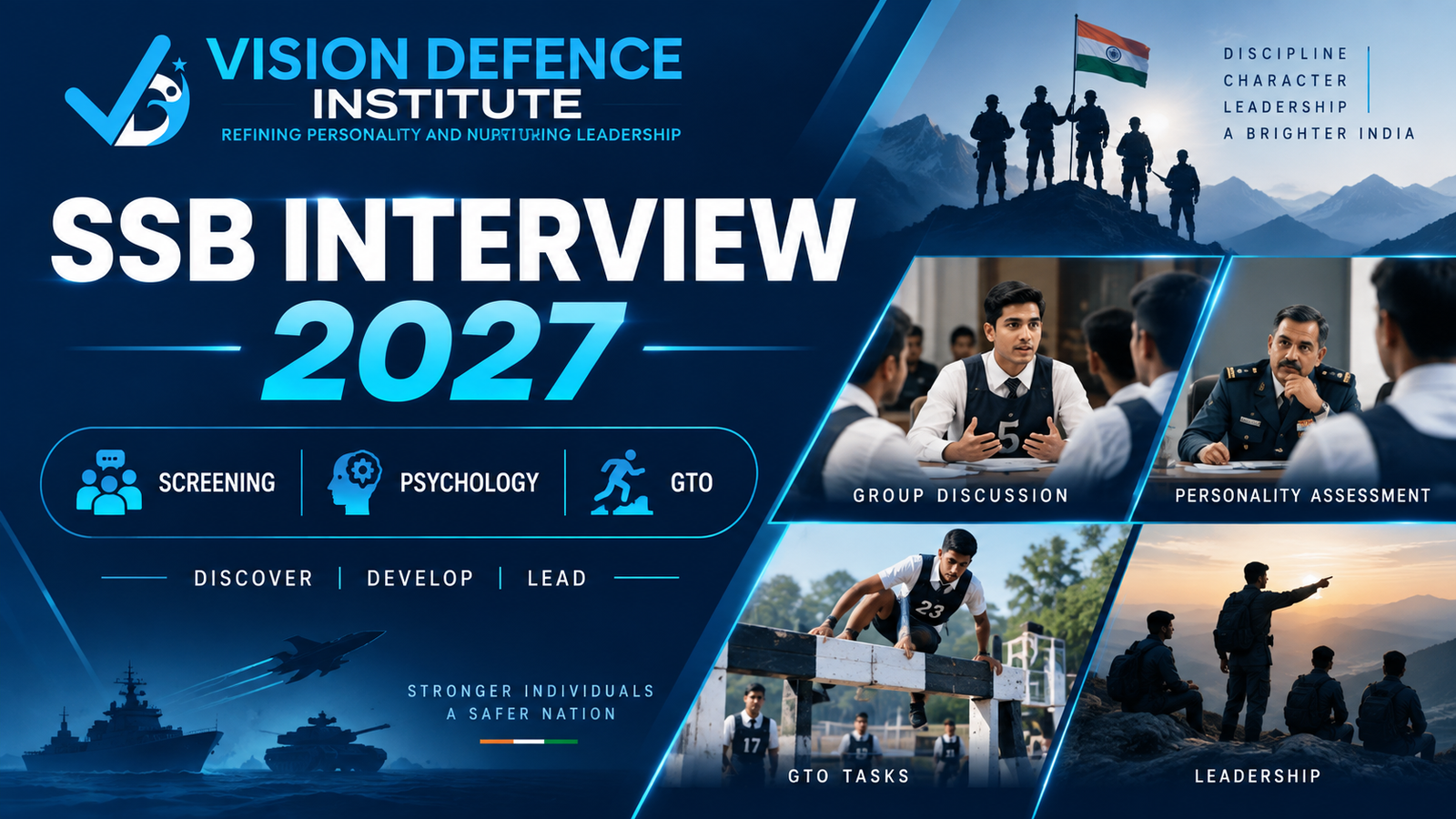
The SSB Interview is the next major stage for candidates who clear written defence exams such as NDA, CDS or AFCAT.
The SSB is not a normal interview.
It checks how you think, communicate, work with others, handle pressure and respond in different situations.
The main areas are:
- Screening
- Psychology Tests
- GTO Tasks
- Personal Interview
- Conference
This guide explains what happens in each stage and how to prepare for SSB Interview 2027.
1. Screening Test
The screening stage usually includes:
- Officer Intelligence Rating (OIR) Test
- Picture Perception and Discussion Test (PPDT)
Candidates who clear screening continue with the remaining SSB process.
OIR Test
OIR checks basic reasoning ability.
Questions may include:
- Number series
- Analogy
- Coding-decoding
- Classification
- Verbal reasoning
- Non-verbal reasoning
How to Prepare
Practise short reasoning sets regularly.
Focus on:
- Accuracy
- Speed
- Basic logic
PPDT
In PPDT, candidates are shown a picture for a short time.
You may be asked to:
- Observe the picture
- Write a short story
- Narrate your story
- Take part in a group discussion
What Matters
Your story should be:
- Clear
- Practical
- Positive
- Connected to the picture
During discussion, speak clearly and listen to others.
Do not try to dominate the group.
2. Psychology Tests
The psychology stage may include:
- Thematic Apperception Test (TAT)
- Word Association Test (WAT)
- Situation Reaction Test (SRT)
- Self Description Test (SDT)
These tests look at how you respond naturally to situations.
TAT
You are shown pictures and asked to write stories.
Focus on:
- Clear situation
- Practical action
- Logical result
Avoid writing unrealistic heroic stories.
Keep the response natural.
WAT
A word appears for a short time and you write the first meaningful sentence that comes to mind.
Do not try to memorise fixed sentences.
Your response should be simple and natural.
SRT
You are given situations and asked how you would respond.
The best approach is to write practical actions.
Avoid long explanations.
Focus on:
Problem → Action
Self Description Test
You may be asked to describe yourself from different viewpoints such as:
- Parents
- Teachers
- Friends
- Yourself
Be honest and balanced.
Do not present yourself as perfect.
3. GTO Tasks
GTO stands for Group Testing Officer.
The GTO stage checks how you behave in a group.
Activities may include:
- Group Discussion
- Group Planning Exercise
- Progressive Group Task
- Half Group Task
- Lecturette
- Command Task
- Individual Obstacles
- Final Group Task
Group Discussion
You may be given a topic to discuss with the group.
Focus on:
- Relevant points
- Clear speaking
- Listening
- Team behaviour
Do not shout or interrupt continuously.
Group Planning Exercise
You may be given a situation with several problems.
You need to work out a practical plan.
Focus on:
- Priority
- Time
- Distance
- Available resources
- Team coordination
Progressive Group Task
The group must cross obstacles using given helping materials.
Your role is not just to give ideas.
You should also:
- Support others
- Participate actively
- Help the group move forward
Lecturette
You are given a topic and asked to speak for a short time.
A simple structure is:
Introduction → Main Points → Conclusion
Choose a topic you understand well.
Command Task
You are given a task and asked to lead.
This checks how you:
- Understand the problem
- Use available resources
- Guide others
- Make decisions
Keep your instructions simple.
Individual Obstacles
This stage checks physical activity, confidence and effort.
Regular fitness helps.
Focus on:
- Running
- Basic strength
- Stamina
- Flexibility
4. Personal Interview
The Personal Interview is an important part of SSB.
Questions may be based on:
- Family
- Education
- Friends
- Hobbies
- Strengths
- Weaknesses
- Responsibilities
- Current Affairs
- Defence knowledge
- Motivation to join the Armed Forces
Personal Information Questionnaire
Many interview questions are linked to details given in your Personal Information Questionnaire.
Know what you have written.
Do not give false information.
If you mention a hobby, be ready to answer basic questions about it.
Common Personal Interview Questions
You may be asked:
- Tell me about yourself.
- Why do you want to join the Armed Forces?
- What are your strengths?
- What are your weaknesses?
- How do you spend your free time?
- Who are your close friends?
- What responsibilities do you handle at home?
- Why did you choose your degree or course?
- What defence news are you following?
Keep answers clear and genuine.
Current Affairs and Defence Awareness
Prepare basic awareness of:
- Indian Army
- Indian Navy
- Indian Air Force
- Major defence exercises
- Important defence appointments
- Recent defence developments
- National and international events
Do not memorise hundreds of facts.
Know the important events well enough to explain them.
5. Conference
The Conference is the final stage of the SSB process.
Assessors review your overall performance.
You may be asked a few simple questions.
Stay calm and answer normally.
30-Day SSB Interview Preparation Plan
Days 1–10
Focus on:
- OIR
- PPDT
- Current Affairs
- Self-introduction
Days 11–20
Focus on:
- TAT
- WAT
- SRT
- Group Discussion
- Lecturette
Days 21–30
Focus on:
- GTO basics
- Personal Interview
- Defence awareness
- Fitness
- Full SSB practice
Daily SSB Preparation Plan
A simple daily plan:
Reasoning – 30 Minutes
Psychology Practice – 30 Minutes
Current Affairs – 30 Minutes
Speaking Practice – 20 Minutes
Physical Activity – 45 Minutes
This is enough if done regularly.
Common Mistakes to Avoid
- Memorising model answers
- Trying to act like someone else
- Dominating group discussions
- Giving false information
- Ignoring current affairs
- Speaking without listening
- Overthinking psychology tests
- Neglecting physical fitness
SSB Interview Preparation with Vision Defence
Vision Defence can help candidates prepare for:
- Screening
- Psychology Tests
- GTO Tasks
- Personal Interview
- Current Affairs
- Defence Awareness
- Mock SSB practice
The main goal is to help candidates understand the process and perform naturally in each stage.
Frequently Asked Questions
What is SSB?
SSB stands for Services Selection Board.
It is used to assess candidates for officer selection in the Armed Forces.
What are the main stages of SSB?
The main areas include:
- Screening
- Psychology
- GTO
- Personal Interview
- Conference
How should I prepare for PPDT?
Practise picture observation, short story writing, narration and group discussion.
Can I memorise WAT and SRT answers?
It is better not to.
These tests are designed to see natural responses.
Is physical fitness important for SSB?
Yes.
Fitness helps during GTO activities and improves stamina during the overall process.
Final Takeaway
For SSB interview preparation 2027, focus on four things:
Clear Thinking + Communication + Teamwork + Self-Awareness
Prepare each stage separately:
Screening → Psychology → GTO → Personal Interview
Do not try to memorise perfect answers.
Understand the process, practise regularly and respond naturally.