The General Ability Test (GAT) is one of the most important parts of the NDA written examination.
For aspirants targeting NDA 2027, GAT preparation requires a balanced approach because the paper covers English, Science, Social Studies, Geography and Current Affairs.
Under the established UPSC NDA examination scheme:
- Mathematics – 300 marks
- General Ability Test – 600 marks
The GAT is divided into:
Part A – English
200 Marks
Part B – General Knowledge
400 Marks
The General Knowledge portion broadly covers:
- Physics
- Chemistry
- General Science
- Social Studies
- Geography
- Current Events
UPSC also states that the syllabus indicates the general scope of the examination and should not be treated as an exhaustive list of every possible topic.
NDA GAT 2027 Exam Structure
| Section | Marks |
|---|---|
| English | 200 |
| General Knowledge | 400 |
| Total GAT | 600 |
The GAT is an objective-type paper.
Because the syllabus covers several subjects, preparation is easier when it is divided into:
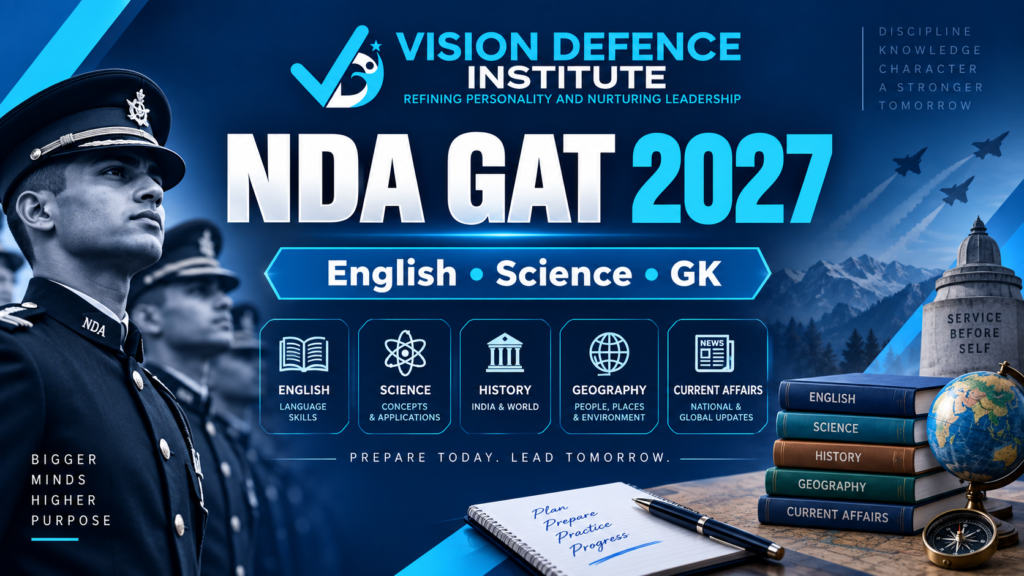
English + Science + History/Polity + Geography + Current Affairs
1. English Preparation for NDA GAT 2027
The English section tests a candidate’s understanding and effective use of the language.
Important areas include:
- Grammar
- Vocabulary
- Usage
- Comprehension
- Sentence structure
- Cohesion in passages
Grammar Topics to Focus On
Prepare:
- Parts of speech
- Tenses
- Articles
- Prepositions
- Subject-verb agreement
- Pronouns
- Adjectives
- Adverbs
- Conjunctions
- Active and passive voice
- Direct and indirect speech
The objective should be to understand how grammar rules are applied in questions rather than memorising definitions alone.
Vocabulary
Build vocabulary using:
Word → Meaning → Context → Synonym/Antonym
Learning words in sentences makes them easier to remember and apply correctly.
Reading Comprehension
For comprehension questions, practise identifying:
- Main idea
- Supporting detail
- Meaning in context
- Tone
- Logical connection between sentences
Regular reading of newspapers, editorials and quality articles can also improve speed and comprehension.
2. Physics Preparation for NDA GAT 2027
Physics questions are generally based on fundamental school-level concepts.
Important areas include:
- Matter
- Mass and weight
- Density
- Pressure
- Motion
- Velocity
- Acceleration
- Newton’s laws
- Force
- Momentum
- Gravitation
- Work
- Power
- Energy
- Heat
- Light
- Sound
- Electricity
- Magnetism
Physics should be prepared conceptually.
For example, instead of simply memorising:
Force = Mass × Acceleration
understand how force changes when mass or acceleration changes.
This helps with application-based questions.
3. Chemistry Preparation for NDA GAT 2027
Important Chemistry topics include:
- Physical and chemical changes
- Elements
- Compounds
- Mixtures
- Chemical symbols
- Acids
- Bases
- Salts
- Metals
- Non-metals
- Carbon
- Common chemical substances
- Everyday chemistry
Tables are useful for Chemistry revision.
For example:
| Topic | What to Remember |
|---|---|
| Acids | Properties, examples, reactions |
| Bases | Properties, uses |
| Salts | Formation and common examples |
| Metals | Reactivity and properties |
| Non-metals | Important characteristics |
4. General Science Preparation
General Science may include questions related to:
- Human body
- Food and nutrition
- Diseases
- Plants
- Animals
- Cells
- Environment
- Scientific discoveries
- Everyday science
Important Human Biology areas include:
- Digestive system
- Respiratory system
- Circulatory system
- Nervous system
- Skeletal system
- Vitamins
- Minerals
- Deficiency diseases
These are generally fact-based and concept-based questions, so concise revision notes work well.
5. History Preparation for NDA 2027
History preparation should focus on major developments rather than excessive detail.
Important areas include:
- Ancient Indian history basics
- Medieval Indian history basics
- Modern Indian history
- British expansion in India
- Revolt of 1857
- Indian National Movement
- Freedom fighters
- Major political developments
- Indian Independence
Modern Indian history deserves particular attention because it includes many important events, leaders and movements.
A useful way to organise History is:
Year → Event → Leader → Importance
6. Polity and Social Studies
Students should also understand basic constitutional and civic concepts.
Important topics include:
- Constitution of India
- Fundamental Rights
- Fundamental Duties
- Parliament
- President
- Prime Minister
- Supreme Court
- Elections
- Federal structure
- Local government
NDA Polity preparation should remain basic and exam-oriented.
There is no need to study Polity at Civil Services depth.
7. Geography Preparation for NDA 2027
Geography becomes much easier when maps are used alongside theory.
Important areas include:
- Earth
- Latitude and longitude
- Atmosphere
- Weather
- Climate
- Winds
- Rainfall
- Rivers
- Mountains
- Soil
- Vegetation
- Agriculture
- Minerals
- Industries
- Population
Indian Geography
Focus on:
- Himalayas
- Northern Plains
- Peninsular Plateau
- Coastal Plains
- Islands
- Major rivers
- Monsoon
- Soil types
- Agriculture
- Natural resources
World Geography
Prepare:
- Continents
- Oceans
- Mountain ranges
- Rivers
- Deserts
- Climatic regions
- Important geographical locations
Use maps wherever possible.
8. Current Affairs for NDA 2027
Current Affairs should focus on important developments rather than every daily news story.
Priority areas include:
- Defence
- National affairs
- International affairs
- Science and technology
- Space
- Government initiatives
- Sports
- Awards
- Important appointments
- Major organisations
Defence Current Affairs
NDA aspirants should pay attention to developments involving:
- Indian Army
- Indian Navy
- Indian Air Force
- Ministry of Defence
- DRDO
- Defence exercises
- Missile systems
- Indigenous defence projects
- Important defence appointments
However, preparation should not be limited only to defence-related news.
NDA GAT Subject-Wise Priority
A practical study priority can be:
| Subject | Preparation Priority |
|---|---|
| English | Very High |
| Physics | Very High |
| History / Social Studies | High |
| Geography | High |
| Chemistry | High |
| General Science | High |
| Current Affairs | Continuous |
This is a preparation framework, not an official UPSC weightage table.
UPSC does not guarantee a fixed number of questions from each individual subject every year.
A Practical Weekly NDA GAT Timetable
| Day | Main Focus |
|---|---|
| Monday | English + Physics |
| Tuesday | English + History |
| Wednesday | Chemistry + Current Affairs |
| Thursday | English + Geography |
| Friday | General Science + Current Affairs |
| Saturday | Mixed GAT MCQs |
| Sunday | GAT Test + Revision |
The timetable can be adjusted depending on individual strengths and weaknesses.
12-Week NDA GAT 2027 Study Plan
Weeks 1–2
Focus on:
- English grammar
- Basic Physics
Weeks 3–4
Focus on:
- Vocabulary
- Comprehension
- Chemistry
- General Science
Weeks 5–6
Focus on:
- Modern Indian History
- Freedom Movement
- Social Studies basics
Weeks 7–8
Focus on:
- Indian Geography
- World Geography
Weeks 9–10
Focus on:
- Mixed English practice
- Science revision
- Current Affairs
Weeks 11–12
Focus on:
- Full GAT revision
- Previous-year questions
- Sectional tests
- Weak areas
How to Use NDA GAT Previous-Year Papers
UPSC publishes official NDA General Ability Test papers.
Use them in three stages.
Stage 1 – Subject-Wise Practice
After completing a subject, solve related previous-year questions.
For example:
- Physics PYQs
- English PYQs
- Geography PYQs
Stage 2 – Mixed Practice
Once several subjects are complete, solve mixed sets.
This helps you practise switching quickly between English, Science and General Knowledge.
Stage 3 – Full GAT Paper
Once most of the syllabus is complete, attempt full GAT papers under timed conditions.
This helps you understand:
- Question distribution
- Time pressure
- Subject switching
- Accuracy
Negative Marking Strategy
NDA uses negative marking for incorrect answers.
That means attempts should be based on confidence.
Use three categories:
Confident
Attempt immediately.
Partially Confident
Use elimination carefully.
No Idea
Avoid random guessing.
The aim is to maximise the net score, not the number of attempts.
Last 30 Days NDA GAT Strategy
In the final month, concentrate on consolidation.
Week 1
Revise:
- English
- Physics
- Chemistry
Week 2
Revise:
- History
- Polity
- Geography
Week 3
Revise:
- General Science
- Current Affairs
- Weak topics
Week 4
Focus on:
- Short notes
- Vocabulary
- Maps
- Important Science facts
- Current Affairs summaries
- Full-length GAT tests
Avoid adding too many new study sources during the final stage.
Common NDA GAT Preparation Mistakes
Ignoring English
English carries 200 marks and should not be treated as a last-minute subject.
Studying Only Current Affairs
GAT also requires strong static knowledge in Science, History and Geography.
Overloading Notes
Long notes are difficult to revise.
Short and structured notes are more useful near the examination.
Ignoring Maps
Geography becomes much easier when rivers, mountains, countries and physical features are located visually.
Excessive Guessing
Negative marking makes uncontrolled guessing risky.
NDA GAT 2027 Preparation with Vision Defence
At Vision Defence, NDA GAT preparation can be structured around:
- English
- Physics
- Chemistry
- General Science
- History
- Geography
- Current Affairs
- Previous-year questions
- Sectional tests
- Full mock tests
The objective is to help students build both knowledge and examination accuracy across the complete GAT syllabus.
Frequently Asked Questions
How many marks does NDA GAT carry?
The General Ability Test carries 600 marks.
How many marks is English in NDA GAT?
English carries 200 marks.
How many marks does General Knowledge carry?
General Knowledge carries 400 marks.
What subjects are included in NDA GAT?
The syllabus broadly includes:
- English
- Physics
- Chemistry
- General Science
- Social Studies
- Geography
- Current Events
Is current affairs important for NDA GAT?
Yes.
Candidates should follow major national, international, defence, science, sports, awards and appointment-related developments.
Are previous-year GAT papers useful?
Yes.
They help candidates understand the actual question style, syllabus coverage and difficulty level.
Final Takeaway
The NDA GAT becomes easier when it is divided into clear subject groups.
Focus on:
English + Science + History + Geography + Current Affairs
Build strong fundamentals in each area, use official previous-year papers to understand question patterns, and gradually move toward mixed and full-length GAT tests.
The goal of NDA GAT preparation 2027 is not to collect unlimited information.
It is to know the right concepts and facts well enough to recall them accurately during the examination.