
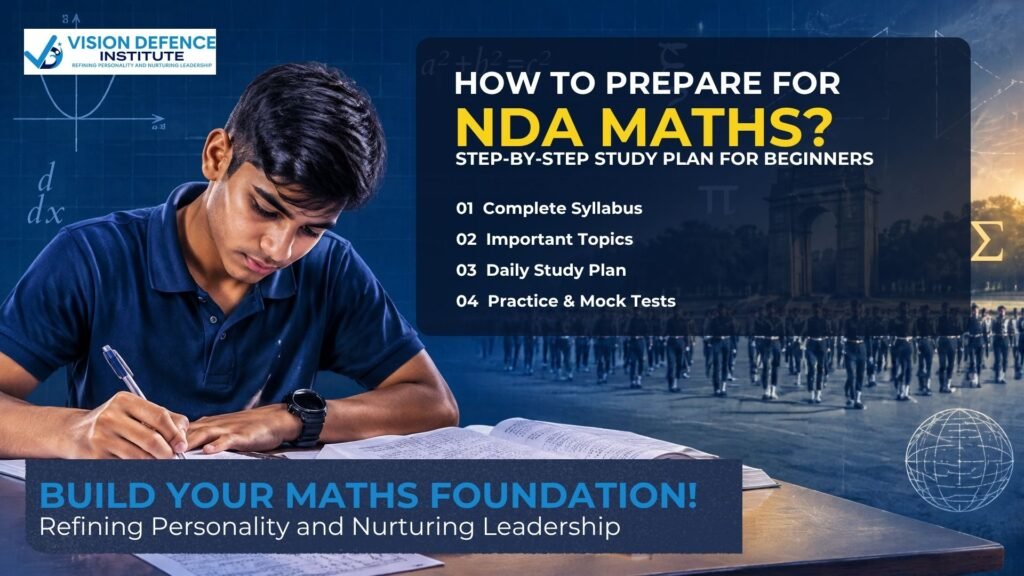
How to Prepare for NDA Maths: Step-by-Step Study Plan for Beginners
Mathematics is one of the most important subjects in the National Defence Academy (NDA) entrance examination. For many students, especially those who find Mathematics difficult, preparing for this examination can feel challenging.
Some aspirants struggle with basic calculations, while others find topics such as Trigonometry, Calculus and Algebra difficult to understand.
But does that mean you cannot clear the NDA Mathematics paper if you are weak in Maths?
Absolutely not!
With the right preparation strategy, regular practice and a clear understanding of fundamental concepts, beginners can gradually improve their mathematical skills and prepare effectively for the NDA examination.
Whether you are a Class 11 student, Class 12 student or a beginner starting your NDA preparation, this guide will help you understand the syllabus, identify important topics and create a practical study plan.
1. Understand the NDA Mathematics Exam Pattern
Before starting your preparation, understand how the NDA Mathematics examination is structured.
The Union Public Service Commission (UPSC) conducts the NDA examination twice a year.
The written examination consists of two papers:
| Subject | Maximum Marks | Duration |
|---|---|---|
| Mathematics | 300 | 2½ Hours |
| General Ability Test (GAT) | 600 | 2½ Hours |
| Total | 900 | 5 Hours |
The Mathematics paper consists of objective-type multiple-choice questions.
Candidates must solve mathematical problems within the allotted time. Therefore, understanding concepts alone is not enough. You must also develop calculation speed and accuracy.
Important: There is negative marking for incorrect answers. Under the prescribed marking scheme, one-third of the marks assigned to a question are deducted for a wrong answer. No marks are deducted for unanswered questions.
This makes accuracy and careful question selection important parts of NDA Maths preparation.
2. Understand the Complete NDA Maths Syllabus
The next step is to understand the topics included in the official NDA Mathematics syllabus.
According to the UPSC examination syllabus, Mathematics covers several important areas from higher secondary-level Mathematics.
A. Algebra
Algebra is an important foundation for solving different types of mathematical problems.
Important topics include:
- Sets and operations on sets
- Venn diagrams
- Real numbers
- Complex numbers
- Quadratic equations
- Arithmetic, Geometric and Harmonic Progressions
- Permutations and Combinations
- Binomial Theorem
- Logarithms
Preparation tip: Start with basic algebraic operations, formulas and equations before moving to advanced problems.
B. Matrices and Determinants
This section tests your understanding of matrices and their mathematical applications.
Important topics include:
- Types of matrices
- Matrix operations
- Determinants
- Properties of determinants
- Adjoint and inverse of matrices
- Solving systems of linear equations
Preparation tip: Practise matrix multiplication, determinants and inverse calculations regularly.
C. Trigonometry
Trigonometry is another important area of the NDA Mathematics syllabus.
Important topics include:
- Trigonometric ratios
- Trigonometric identities
- Inverse trigonometric functions
- Angles and their measurements
- Heights and distances
- Properties of triangles
Preparation tip: Learn basic trigonometric ratios and standard identities first. Understand how to apply them rather than simply memorising formulas.
D. Analytical Geometry
This section focuses on coordinate geometry in two and three dimensions.
Important topics include:
- Cartesian coordinate systems
- Straight lines
- Circles
- Conic sections
- Parabola
- Ellipse
- Hyperbola
- Three-dimensional geometry
Preparation tip: Practise coordinate-based problems and understand the basic equations of lines and curves.
E. Differential Calculus
Differential Calculus deals with functions, limits and derivatives.
Important topics include:
- Functions
- Domain and range
- Graphs of functions
- Limits
- Continuity
- Derivatives
- Applications of derivatives
Preparation tip: Build a strong understanding of functions and limits before starting differentiation.
F. Integral Calculus and Differential Equations
This section tests your understanding of integration and differential equations.
Important topics include:
- Integration
- Standard integrals
- Integration by substitution
- Integration by parts
- Definite integrals
- Differential equations
- Applications of integration
Preparation tip: Practise standard integration formulas and understand the steps involved in solving different types of problems.
G. Vector Algebra
Vector Algebra involves mathematical quantities that have both magnitude and direction.
Important topics include:
- Vectors in two and three dimensions
- Magnitude and direction
- Unit vectors
- Addition of vectors
- Scalar multiplication
- Dot product
- Cross product
Preparation tip: Start with basic vector operations before learning applications involving dot and cross products.
H. Statistics and Probability
This section tests your ability to understand data and calculate probabilities.
Important topics include:
Statistics:
- Mean, Median and Mode
- Frequency Distribution
- Histograms
- Pie Charts
- Variance
- Standard Deviation
- Correlation and Regression
Probability:
- Random Experiments
- Sample Space
- Events
- Conditional Probability
- Bayes’ Theorem
- Probability Distributions
Preparation tip: Understand the basic concepts and practise numerical problems using the correct formulas.
3. How to Start NDA Maths Preparation from Basics
If you are weak in Mathematics, do not immediately start solving difficult NDA-level questions.
First, strengthen your fundamentals.
Follow these steps:
Step 1: Improve Basic Mathematical Skills
Start by revising important school-level concepts.
Focus on:
- Addition, subtraction, multiplication and division
- Fractions and decimals
- Percentages
- Ratio and proportion
- Squares and square roots
- Basic algebra
- Simple equations
- Exponents and powers
These concepts will help you understand more advanced mathematical topics.
Step 2: Learn One Topic at a Time
Avoid studying several difficult topics simultaneously.
Choose one topic, understand its concepts, learn the formulas and solve basic examples.
Once you become comfortable with the fundamentals, gradually move to NDA-level questions.
Step 3: Maintain a Formula Notebook
Formula revision is important for competitive examinations.
Maintain a separate notebook containing:
- Algebra formulas
- Trigonometric identities
- Geometry formulas
- Differentiation rules
- Integration formulas
- Probability formulas
Revise this notebook regularly to improve memory and calculation speed.
Step 4: Practise Mathematics Every Day
Mathematics requires continuous practice.
Even if you can spend only one hour daily, use that time effectively.
Try solving problems independently before checking the answers.
Step 5: Analyse Your Mistakes
Whenever you solve a question incorrectly, identify the reason.
Ask yourself:
- Did I misunderstand the concept?
- Did I use the wrong formula?
- Was there a calculation error?
- Did I spend too much time on the question?
Understanding your mistakes will help you avoid repeating them.
4. Important NDA Maths Topics to Prioritise
Beginners often ask which Mathematics topics they should study first.
Instead of randomly selecting chapters, follow a logical learning order.
| Priority | Topic | What to focus on |
|---|---|---|
| 1 | Algebra | Equations, progressions and logarithms |
| 2 | Trigonometry | Ratios, identities and applications |
| 3 | Matrices | Matrix operations and determinants |
| 4 | Analytical Geometry | Lines, circles and conic sections |
| 5 | Differential Calculus | Functions, limits and derivatives |
| 6 | Integral Calculus | Integration and differential equations |
| 7 | Vector Algebra | Dot and cross products |
| 8 | Statistics and Probability | Data analysis and probability problems |
This is a suggested learning sequence for beginners, not an official UPSC ranking of chapter importance.
Make sure you eventually cover the complete syllabus rather than preparing only selected topics.
5. Daily NDA Maths Study Timetable for Beginners
A proper timetable helps students balance school studies and NDA preparation.
Here is a sample daily study schedule for beginners.
| Time | Activity |
|---|---|
| 30 minutes | Revise previous concepts |
| 45 minutes | Learn a new Mathematics topic |
| 30 minutes | Solve basic problems |
| 30 minutes | Practise NDA-level questions |
| 15 minutes | Revise formulas and analyse mistakes |
Total: 2 hours 30 minutes
Students can adjust the timetable according to their school schedule and preparation level.
Consistency is more important than studying for many hours on only a few days.
6. Three-Month NDA Maths Preparation Plan
A three-month preparation plan can help beginners organise their learning.
The following is a sample plan. Students who are starting with weak fundamentals may need additional time.
Month 1 – Build Strong Fundamentals
Main objective: Understand basic mathematical concepts.
Focus on:
- Number systems
- Basic Algebra
- Quadratic Equations
- Sets and Relations
- Trigonometric Ratios
- Basic Geometry
Daily activities:
- Learn concepts.
- Practise basic problems.
- Revise formulas.
- Take short topic-wise tests.
Month 2 – Cover Important NDA Topics
Main objective: Improve problem-solving ability.
Focus on:
- Matrices and Determinants
- Advanced Trigonometry
- Analytical Geometry
- Differential Calculus
- Integral Calculus
- Vector Algebra
Daily activities:
- Practise different question types.
- Solve previous-year questions.
- Improve calculation speed.
- Identify weak areas.
Month 3 – Practice and Revision
Main objective: Improve examination performance.
Focus on:
- Statistics and Probability
- Complete syllabus revision
- Previous-year question papers
- Mock examinations
- Formula revision
- Time management
Daily activities:
- Solve timed practice sets.
- Attempt mock tests.
- Analyse incorrect answers.
- Revise difficult chapters.
By the end of the three months, students should aim to understand the syllabus and identify the areas that need further improvement.
7. How to Improve Speed and Accuracy in NDA Maths
The NDA Mathematics paper requires candidates to solve objective questions within a limited time.
Developing calculation speed and accuracy can make a significant difference.
Here are some useful strategies.
Practise Mental Calculations
Learn to perform basic calculations without depending on a calculator.
Practise:
- Squares and cubes
- Multiplication tables
- Fraction conversions
- Percentage calculations
- Basic arithmetic shortcuts
Remember that calculators are not permitted in the NDA written examination.
Solve Previous-Year Question Papers
Previous-year question papers help students understand the examination format and the way mathematical concepts are tested.
They can help you:
- Identify frequently tested concepts.
- Understand question difficulty.
- Improve problem-solving techniques.
- Practise time management.
Attempt Mock Tests
Mock examinations help students evaluate their preparation.
After every mock test, analyse:
- Correct answers
- Incorrect answers
- Unanswered questions
- Time spent per question
- Topics requiring additional practice
Do not focus only on your mock-test score. Focus on improving your performance gradually.
Avoid Blind Guessing
Since the NDA examination includes negative marking, answering without sufficient understanding can reduce your score.
Read each question carefully, eliminate incorrect options where possible and make informed decisions.
8. Best Study Materials for NDA Mathematics Preparation
Choosing suitable study materials can make your preparation more organised.
Here are some useful resources:
NCERT Mathematics Textbooks
NCERT Mathematics textbooks for Classes 11 and 12 are useful for understanding fundamental concepts and practising school-level problems.
NDA Previous-Year Question Papers
Previous-year question papers help aspirants become familiar with the actual examination format.
Topic-Wise Practice Books
Choose a reliable NDA Mathematics practice book that covers the complete UPSC syllabus and includes explanations for answers.
Mock Test Papers
Regular mock tests help candidates practise under examination conditions.
Our suggestion: Do not collect too many books. Choose a few reliable resources and complete them properly.
9. Common Mistakes NDA Maths Aspirants Should Avoid
Even hardworking students sometimes make mistakes that affect their preparation.
Avoid these common problems:
1. Starting with Difficult Questions
Trying advanced questions without understanding the basics can create confusion.
Build your fundamentals first.
2. Ignoring Weak Topics
Do not study only your favourite chapters. Give additional time to topics you find difficult.
3. Memorising Formulas Without Understanding
Formulas are important, but knowing when and how to apply them is equally important.
4. Not Practising Regularly
Studying Mathematics only occasionally makes it difficult to remember concepts and improve speed.
5. Avoiding Mock Tests
Without timed practice, students may struggle to manage the examination effectively.
6. Ignoring Negative Marking
Blind guessing can reduce your score. Learn to answer questions with proper understanding.
10. How Vision Defence Helps Students Prepare for NDA Maths
Preparing for NDA requires a structured approach, especially for students who find Mathematics challenging.
At Vision Defence, NDA aspirants can receive guidance to strengthen their academic foundation and prepare systematically for the written examination.
Our NDA preparation approach focuses on:
- Concept-based Mathematics learning.
- Subject-wise syllabus coverage.
- Regular practice sessions.
- Previous-year question discussions.
- Mock examinations and performance analysis.
- Individual guidance for improving weak areas.
- English and General Ability Test preparation.
- SSB interview and personality development guidance.
Students can work towards improving their understanding, calculation skills and examination confidence with structured preparation.
If you are serious about joining the Indian Armed Forces, start strengthening your Mathematics skills today.
Frequently Asked Questions (FAQs)
1. Is NDA Maths difficult for beginners?
NDA Mathematics can be challenging for beginners, but students can improve with proper guidance, strong fundamentals and regular practice.
2. How can I prepare for NDA Maths from zero?
Start with basic arithmetic, algebra and school-level Mathematics. Gradually study the official NDA syllabus, practise topic-wise questions and attempt mock tests.
3. How many hours should I study Maths daily for NDA?
Beginners can start with 1–2 hours of focused daily Mathematics practice and increase their study time according to their preparation needs.
4. Which topics are important in NDA Mathematics?
The official syllabus includes Algebra, Matrices and Determinants, Trigonometry, Analytical Geometry, Calculus, Vector Algebra, Statistics and Probability. All topics should be covered systematically.
5. Can I prepare for NDA Maths without coaching?
Yes. Students can prepare independently using NCERT textbooks, official syllabus documents, previous-year question papers and mock tests. Coaching can provide additional structure and guidance.
6. Are NCERT books enough for NDA Maths?
NCERT textbooks are useful for building fundamentals, but students should also practise NDA-level questions and previous-year papers.
7. Is a calculator allowed in the NDA Mathematics examination?
No. Calculators and mathematical or logarithmic tables are not permitted in the NDA objective-type examination.
8. Is there negative marking in NDA Maths?
Yes. One-third of the marks assigned to a question are deducted for an incorrect answer under the prescribed marking scheme.
9. Can a Commerce or Arts student prepare for NDA Maths?
Yes. Students from Commerce or Arts backgrounds can prepare for the Army Wing if they meet the educational eligibility requirements. They should give additional attention to Mathematics preparation.
10. When should I start NDA Maths preparation?
Students can begin building their mathematical foundation after Class 10. Starting early provides more time to understand concepts and practise the complete syllabus.
Conclusion
Mathematics should not become a barrier between you and your dream of joining the Indian Armed Forces.
If you find Maths difficult, remember that improvement comes through consistent effort, proper learning and regular practice.
Start with the basics, understand each topic, practise previous-year questions and evaluate your performance through mock tests.
Do not compare your preparation speed with others. Focus on improving your own understanding every day.
Your NDA journey begins with strong fundamentals. Prepare smartly and move closer to your dream with Vision Defence.
Contact Vision Defence
Vision Defence Institute
- Website: https://visiondefence.com/
- Explore NDA Preparation: https://visiondefence.com/nda/
Build Your Foundation. Strengthen Your Confidence. Prepare for Your Defence Dream.