SSB Psychological Test: Complete Guide to Cracking It
Let me tell you about Arjun.
He was bright. Engineering graduate, good marks, confident speaker. He walked into our centre at 2ND STOP, S ALANGULAM, Madurai, after his first SSB attempt. “Sir, I don’t understand what went wrong,” he said, frustration evident in his voice. “The GTO tasks went well. The interview was okay. But the psychologist… I think I failed there. My stories were good, my words were positive, my situations were practical. What did I miss?”
I asked him to write a story for a TAT picture right there in my cabin. He wrote for four minutes, exactly as he would in the real test. When he finished, I read it. And then I understood.
Arjun’s problem wasn’t that his stories were bad. They were technically correct. But they were generic. They could have been written by anyone. They didn’t reveal Arjun—his personality, his values, his instincts. And that’s exactly what the SSB psychological test is designed to uncover.
The psychology tests at SSB—TAT, WAT, SRT, and Self Description—are not exams you can cram for. They’re windows into your subconscious mind. Your first thoughts, your spontaneous reactions, your deepest values—they all come out in these tests.
And here’s the truth most aspirants don’t realize: You cannot fake these tests for five days. Your true personality will emerge. The psychologist is trained to see patterns across all your responses. One “perfect” story means nothing if the next eleven reveal something different.
But here’s the good news: You can prepare for the SSB psychological test—not by memorizing answers, but by understanding yourself better and practicing the right way.
In this comprehensive guide, I’m going to share everything you need to know about cracking the SSB psychology tests. From TAT storytelling techniques to WAT word associations, from SRT practical reactions to Self Description—consider this your complete playbook.
Let’s begin.
Understanding the SSB Psychological Test: The Big Picture
What is the SSB Psychological Test?
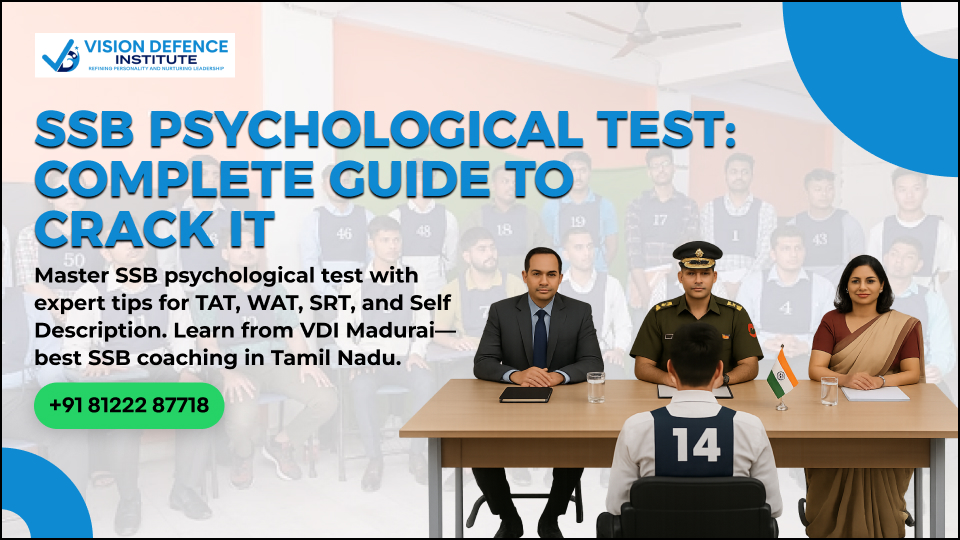
The psychology tests at SSB are conducted on Day 2 of the 5-day selection process. They consist of four distinct tests:
| Test | Full Form | Duration | What You Do |
|---|---|---|---|
| TAT | Thematic Apperception Test | 60 minutes | Write stories for 11-12 pictures |
| WAT | Word Association Test | 15 minutes | Write first thought for 60 words |
| SRT | Situation Reaction Test | 30 minutes | Write reactions for 60 situations |
| SD | Self Description | 15 minutes | Write how others describe you |
What Do Psychologists Look For?
The psychologist evaluates you on 15 Officer-Like Qualities (OLQs):
| Category | OLQs |
|---|---|
| Physical | Physical fitness, stamina, energy |
| Intellectual | Effective intelligence, reasoning ability, situation adaptability |
| Social | Cooperation, social adaptability, sense of responsibility |
| Emotional | Self-confidence, self-control, courage, determination |
| Leadership | Initiative, organizing ability, command, influence on others |
Every story, every word association, every situation reaction reveals something about these qualities. The psychologist looks for patterns across all your responses. Consistency is key.
The Golden Rule of SSB Psychological Test
Here’s the most important thing to remember: Be yourself. But be your best self.
The psychologist doesn’t expect you to be perfect. They expect you to be genuine. A candidate who admits a weakness but shows they’re working on it is more credible than one who claims to have no weaknesses.
Your responses should reflect who you really are—not who you think the psychologist wants you to be. Because here’s the secret: they’ve seen thousands of candidates. They know when you’re pretending.
TAT: Thematic Apperception Test
What is TAT?
You’ll see 11-12 pictures, one by one. For each picture, you have 30 seconds to observe and 4 minutes to write a story. The pictures are usually ambiguous—they could be interpreted in many ways.
The TAT Formula
Every story must have:
-
Hero: A central character (preferably your age or slightly older)
-
Situation: What’s happening in the picture? Describe the setting
-
Problem: What challenge does the hero face?
-
Action: What does the hero DO to solve it? (This is the most important part)
-
Outcome: How does it end? (Positive, always)
Sample TAT Story Structure
[Name], a [age]-year-old [profession/student], was [description of situation].
He/She faced [problem/challenge].
He/She decided to [action taken].
He/She [steps taken - describe the process].
In the end, [positive outcome].
He/She felt [emotion] and learned [lesson].
TAT Themes That Work
| Theme | Example |
|---|---|
| Helping others | Helping an accident victim, assisting an elderly person, guiding lost child |
| Teamwork | Group projects, sports teams, community service |
| Overcoming challenges | Studying hard for exams, physical training, learning new skills |
| Leadership | Organizing events, leading a team, guiding juniors |
| Social responsibility | Cleanliness drives, helping the poor, environmental awareness |
| Problem-solving | Fixing something broken, resolving conflicts, finding creative solutions |
TAT Themes to Avoid
| Theme | Why to Avoid |
|---|---|
| Violence, accidents with negative outcomes | Shows negative mindset |
| Death, illness, tragedy | Too dark, doesn’t show positive action |
| Corruption, cheating, dishonesty | Questions your integrity |
| Passivity (hero watching, not doing) | Shows lack of initiative |
| Superhero/fantasy themes | Not realistic, shows poor reality perception |
Common TAT Mistakes
-
No Action: Describing the picture without showing what the hero DOES
-
Negative Endings: Accident, death, failure
-
Multiple Heroes: Confusing story with too many characters
-
No Time Management: Incomplete stories
-
Repetitive Themes: Same pattern in all stories
TAT Practice Tips
-
Write Daily: Practice at least 2-3 stories every day
-
Time Yourself: 4 minutes per story—strictly
-
Get Feedback: Have someone read your stories and tell you what personality they reveal
-
Analyze Patterns: Are all your stories similar? Do they reveal different aspects of your personality?
-
Build a Vocabulary: Learn action words (initiated, organized, motivated, guided, helped)
Pro TAT Tip for SSB Psychological Test
The psychologist sees patterns across all 12 stories. If 10 of your stories have the hero helping someone, that’s your dominant trait—helping others. If 8 stories show the hero studying hard, that’s your dominant trait—hard work.
Make sure your patterns reflect positive Officer-Like Qualities.
WAT: Word Association Test
What is WAT?
You’ll see 60 words, one by one, projected on a screen. For each word, you have 15 seconds to write the first thought that comes to your mind. One word, one phrase—that’s it.
WAT Strategy
-
First thought, best thought: Don’t overthink. Write quickly
-
Keep it positive: Even for negative words, find a positive association
-
Keep it action-oriented: Use verbs when possible
-
Vary your responses: Don’t repeat the same word pattern
-
Be specific: Generic responses are forgettable
Sample WAT Responses
| Word | Good Response | Poor Response |
|---|---|---|
| Leader | guides | boss |
| Team | together | work |
| Challenge | overcome | difficult |
| Enemy | defeat | hate |
| Friend | help | good |
| Success | hard work | money |
| Failure | learn from | bad |
| Mother | love | woman |
| Soldier | protect | army |
| India | proud | country |
WAT Themes to Project
| Theme | Sample Words |
|---|---|
| Leadership | guide, lead, inspire, motivate, organize |
| Teamwork | together, cooperate, help, share, support |
| Positive Attitude | hope, optimistic, confident, believe, achieve |
| Hard Work | effort, dedication, perseverance, practice, improve |
| Social Responsibility | serve, help, contribute, community, society |
| Courage | brave, face, overcome, fearless, determined |
Common WAT Mistakes
-
Negative Responses: fear, hate, fail, lose, bad
-
Repeating Same Words: If “help” appears 10 times, it’s a pattern—make sure it’s intentional
-
Complex Sentences: Keep it 1-3 words maximum
-
Overthinking: Missing words because you’re trying to be “perfect”
-
Irrelevant Responses: Words that don’t connect to anything
WAT Practice Tips
-
Practice Daily: Take random words and practice 15-second responses
-
Build a Word Bank: Create lists of positive associations for common words
-
Record Yourself: Speak your responses and analyze them
-
Group Practice: Practice with friends and compare responses
Pro WAT Tip for SSB Psychological Test
The psychologist looks for patterns across 60 responses. If most of your responses are action-oriented (verbs), you project a “doer” personality. If most are feeling-oriented (adjectives), you project a “thinker” personality. Both are fine—but consistency matters.
SRT: Situation Reaction Test
What is SRT?
You’ll have 60 situations and 30 minutes to write your reactions. Each situation describes a problem—what would you do?
The SRT Formula
-
Understand the situation quickly
-
Write a practical, immediate reaction
-
Show common sense and responsibility
-
Be concise but complete
-
Prioritize: Safety > Property > Convenience
SRT Principles
| Principle | Explanation |
|---|---|
| Safety First | Human life is most important |
| Involve Authorities | Police, fire, ambulance, parents, teachers |
| Take Initiative | Don’t wait for others to act |
| Be Practical | Realistic solutions, not heroic fantasies |
| Show Responsibility | Own the situation, don’t blame others |
Sample SRT Responses
Situation: You see a fire in a neighbour’s house.
Good Reaction: Immediately call fire brigade, alert neighbours, help evacuate residents, try to control fire with available water until help arrives, ensure no one is injured.
Poor Reaction: Panic, run away, wait for someone else to do something.
Situation: You witness a road accident with injured people.
Good Reaction: Stop to help, call ambulance, provide first aid if trained, direct traffic to avoid further accidents, inform police, contact victims’ families if possible.
Poor Reaction: Take photos for social media, drive away, wait for others to help.
Situation: You find a wallet with money and documents on the road.
Good Reaction: Check for ID, contact owner if possible, if not, submit to nearest police station, ensure documents are returned safely.
Poor Reaction: Keep the money, throw away documents, ignore it.
SRT Themes to Project
| Theme | How to Show It |
|---|---|
| Social Responsibility | Help others, involve community |
| Problem-Solving | Think practically, find solutions |
| Initiative | Act first, don’t wait |
| Common Sense | Prioritize correctly, think logically |
| Empathy | Consider others’ feelings |
| Respect for Law | Involve authorities, follow rules |
Common SRT Mistakes
-
No Action: “I will think about it” is not action
-
Impractical Heroics: Single-handedly fighting dacoits
-
Ignoring Authorities: Not calling police, ambulance when needed
-
Selfish Responses: Only thinking about yourself
-
Vague Responses: “I will help” (how? when? what exactly?)
SRT Practice Tips
-
Practice Daily: Solve 10-15 situations every day
-
Observe Life: Notice situations around you—how would you react?
-
Discuss with Others: Compare your reactions with friends
-
Read News: See how people reacted in real situations—learn from them
Pro SRT Tip for SSB Psychological Test
The psychologist evaluates your practical intelligence. Your reactions should show that you can handle real-life situations calmly and effectively. Be realistic, not heroic.
SD: Self Description
What is Self Description?
You have 15 minutes to write how others describe you:
-
How your parents describe you
-
How your teachers describe you
-
How your friends describe you
-
How you describe yourself
Self Description Strategy
-
Be honest but positive: Everyone has weaknesses—acknowledge them but show you’re working on them
-
Give examples: Don’t just say “I’m hardworking.” Write “My teachers say I complete assignments before deadlines”
-
Be specific: Generic descriptions are forgettable
-
Show self-awareness: Know your strengths AND weaknesses
-
Consistency matters: Your self-description should match your TAT, WAT, and SRT responses
Sample Self Description Structure
How my parents describe me:
-
Responsible: I take care of my younger siblings
-
Hardworking: I study regularly without being told
-
Respectful: I listen to their advice
How my teachers describe me:
-
Sincere: I complete all assignments on time
-
Helpful: I assist classmates who struggle
-
Disciplined: I follow rules and respect authority
How my friends describe me:
-
Loyal: I stand by them in difficult times
-
Fun-loving: I enjoy games and outings
-
Trustworthy: They share secrets with me
How I describe myself:
-
Ambitious: I have clear goals for my future
-
Determined: I don’t give up easily
-
Improving: I work on my weaknesses (e.g., public speaking)
Common Self Description Mistakes
-
No Weaknesses: Everyone has weaknesses—denying them shows lack of self-awareness
-
Fake Weaknesses: “I work too hard” is not a real weakness
-
Inconsistency: Self-description that contradicts other tests
-
Vague Statements: “I am a good person” (what does that mean?)
-
Negative Focus: Too many weaknesses, not enough strengths
Pro Self Description Tip for SSB Psychological Test
Your self-description should be credible. If you claim to be “always helping others” in SD, your TAT stories should show helping behavior, your WAT should have helping-related words, and your SRT should involve helping others.
Consistency across all tests is what convinces the psychologist.
Patterns Across Tests: The Big Picture
The psychologist doesn’t evaluate each test in isolation. They look for patterns across all four tests.
Example Pattern: The “Helper” Personality
| Test | What It Shows |
|---|---|
| TAT | Stories where hero helps others |
| WAT | Words like help, assist, support, guide |
| SRT | Reactions that involve helping others |
| SD | Described as helpful by friends/family |
Example Pattern: The “Leader” Personality
| Test | What It Shows |
|---|---|
| TAT | Stories where hero organizes, leads, motivates |
| WAT | Words like lead, guide, organize, motivate |
| SRT | Reactions that take charge of situations |
| SD | Described as leader by teachers/friends |
Example Pattern: The “Hard Worker” Personality
| Test | What It Shows |
|---|---|
| TAT | Stories where hero studies/practices diligently |
| WAT | Words like effort, practice, improve, persevere |
| SRT | Reactions that show dedication to tasks |
| SD | Described as hardworking by parents/teachers |
Common Mistakes in SSB Psychological Test
Mistake 1: Trying to Be Perfect
Perfect responses are suspicious. Real people have strengths AND weaknesses. Show both.
Mistake 2: Inconsistency
If your TAT shows leadership but your SD says you’re shy, the psychologist notices.
Mistake 3: Over-Preparation
Memorized responses sound robotic. Be spontaneous.
Mistake 4: Negative Patterns
Too many negative words, sad stories, passive reactions—these sink your chances.
Mistake 5: Ignoring Time Management
Incomplete stories, unfinished SRT responses—these show poor planning.
Why Choose VDI Madurai for SSB Psychological Test Training?
At Vision Defence Institute, Madurai, we’ve helped hundreds of candidates master the SSB psychological test. Here’s what makes us the best institute for SSB interview in Madurai:
Expert Psychology Trainers
Our trainers have years of experience analyzing TAT, WAT, SRT, and SD responses. They give personalized feedback on every practice test.
Regular Mock Tests
We conduct weekly psychology tests with detailed analysis. Every response is evaluated, and patterns are identified.
Pattern Analysis
We help you understand what your responses reveal about your personality—and how to project Officer-Like Qualities consistently.
Individual Feedback
One-on-one sessions to discuss your strengths, weaknesses, and improvement areas.
Integrated Training
Psychology training is integrated with GTO tasks and interview preparation—because all parts of SSB are connected.
Tamil Medium Support
For students from Tamil medium backgrounds, we offer special coaching in Tamil to ensure language is not a barrier.
Resources for SSB Psychological Test Preparation
Books
| Book | Author | What It Covers |
|---|---|---|
| Crack SSB Interview | Dr. N.K. Natarajan | Complete SSB guide with psychology section |
| SSB Psychology Tests | Editorial Board | Practice TAT, WAT, SRT exercises |
| Word Power Made Easy | Norman Lewis | Vocabulary building for WAT |
Online Resources
-
YouTube: Vision Defence Institute YouTube channel (free psychology test tips)
-
Mobile Apps: SSB preparation apps with practice tests
-
Telegram Channels: Daily practice words and situations
External Links
-
Join Indian Army Official: https://joinindianarmy.nic.in
-
SSB Interview Tips: https://www.ssbcrack.com
Success Story: From Confusion to Recommendation
Remember Arjun from the beginning?
After his first SSB failure, we worked with him for three months. Every week, he wrote TAT stories—and we analyzed them. Every week, he practiced WAT—and we identified patterns. Every week, he solved SRT situations—and we discussed better approaches.
The problem wasn’t that his responses were bad. They were technically correct. But they were generic. They didn’t reveal him.
We helped him understand his own personality—his values, his instincts, his natural strengths. And then we helped him project those authentically in the tests.
Six months later, Arjun called me. “Sir, I’m recommended. The psychologist said my stories were the most genuine he’d seen all week.”
Today, Arjun is at IMA, Dehradun. And he still sends me stories he writes—not for SSB anymore, but because he’s fallen in love with expressing himself.
Arjun’s story proves one thing: The SSB psychological test is not about being perfect. It’s about being you—the best version of you.
Conclusion: Your Journey to Cracking the SSB Psychological Test
The SSB psychological test is often the most feared part of the selection process. But it doesn’t have to be.
Remember:
-
TAT shows your values through stories
-
WAT reveals your subconscious through word associations
-
SRT demonstrates your practical intelligence through situations
-
SD reflects your self-awareness
Together, these tests paint a complete picture of who you are. And if that picture matches the Officer-Like Qualities the Armed Forces seek, you get that coveted “Recommended” stamp.
Start practicing today:
-
Write one TAT story daily
-
Practice 20 WAT words daily
-
Solve 10 SRT situations daily
-
Reflect on your self-description
And when you need guidance, you know where to find us.
At Vision Defence Institute, Madurai, we’ve been helping candidates crack the SSB psychological test for years. Our proven system, expert trainers, and personalized feedback are waiting for you.
Your journey to that “Recommended” stamp starts now.