The One Habit That Will Make You a Better Officer (Hint: It’s Not Studying)
The Relatable Story:
I met a candidate at an SSB center a few years ago. Let’s call him Vikram.
Vikram was brilliant on paper. Engineering graduate. Great academic scores. Had cleared the CDS written exam with a high rank. When he walked into the interview room, he had facts and figures ready for every possible question.
The Interviewing Officer asked him: “What do you think about the recent Agneepath scheme?”
Vikram recited news headlines. He gave statistics. He quoted government statements.
Then the officer asked: “But what do you think? Do you agree with it? Why or why not?”
Silence.
Vikram had facts. He had memory. He had preparation. But he had no opinion. He had never paused to think about what he actually believed. He had never formed his own perspective.
Result: Not Recommended.
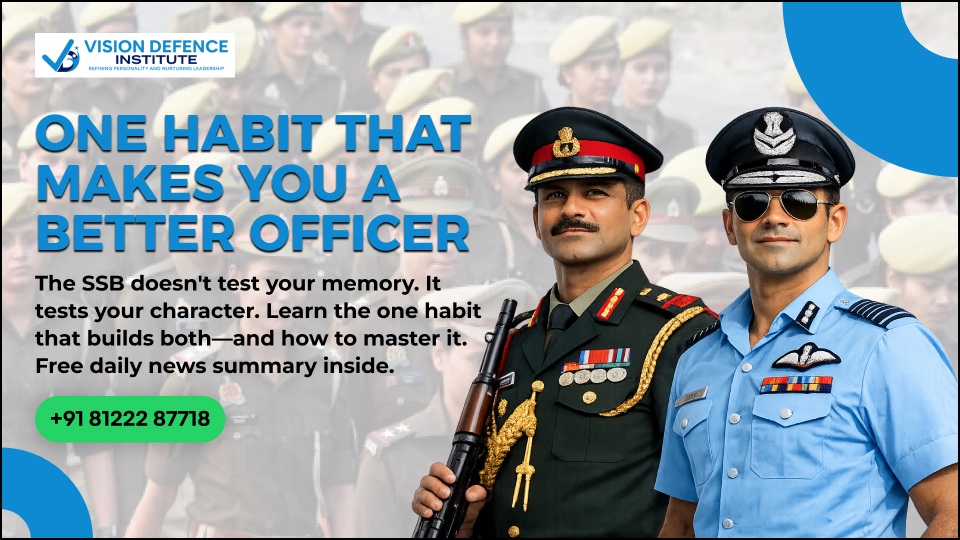
Here’s the truth they don’t tell you in textbooks: The SSB doesn’t test your memory. It tests your character.
And character isn’t built by memorizing formulas or practicing multiple-choice questions. It’s built by a habit so simple, so accessible, that most aspirants ignore it entirely.
The habit is reading.
Not scrolling. Not scanning. Not memorizing headlines. But deep, thoughtful, intentional reading of current affairs—with one specific goal: to form an opinion.
At Vision Defence Institute, located at 2ND STOP, S ALANGULAM, Kulamangalam Main Rd, Madurai, we’ve seen this habit transform students. Shy students become confident speakers. Confused students become clear thinkers. Average students become officers.
Today, I’m going to show you:
-
Why reading (the right way) is the ultimate officer-building habit
-
How to read, not just what to read
-
How to move from “knowing facts” to “having opinions”
-
And how to make this habit stick—even if you hate reading
Plus, we’re offering something special: a free “Daily Defence News Summary” to get you started.
The Problem: Why “Studying” Isn’t Enough
Let’s understand why so many brilliant students fail the SSB.
The Written Exam Mentality
For years, you’ve been trained to:
-
Memorize facts
-
Recall them quickly
-
Select the right option
-
Move to the next question
This works for the NDA written exam. It works for CDS and AFCAT. It works for every multiple-choice test you’ll ever take.
But the SSB is not a multiple-choice test.
What the SSB Actually Tests
The SSB assesses 15 Officer Like Qualities (OLQs) . Among them:
| OLQ | What It Means |
|---|---|
| Effective Intelligence | Ability to analyze situations |
| Reasoning Ability | Logical thinking |
| Self-Confidence | Trust in your own judgment |
| Initiative | Acting without being told |
| Cooperation | Working with others |
| Social Adaptability | Understanding the world around you |
Notice something? None of these require memorizing formulas. They require understanding people, situations, and the world.
And that understanding comes from one place: reading deeply about what’s happening in the world.
Why Reading Builds Character
Let me explain the connection.
Reading Builds Knowledge
Obviously. You learn facts. You know what’s happening. But that’s just the starting point.
Reading Builds Perspective
When you read multiple sources about the same event, you realize: There’s always another side. This builds intellectual humility—the understanding that you don’t know everything, and that other perspectives exist.
Officers need this. In the Armed Forces, you’ll deal with complex situations where there’s no “right answer.” You’ll need to weigh multiple perspectives and make the best decision with the information you have .
Reading Builds Empathy
When you read about people in different situations—different countries, different struggles, different lives—you develop empathy. You understand that soldiers aren’t just “assets”; they’re humans with families, fears, and dreams.
The SSB tests this through situations in the SRT (Situation Reaction Test) and discussions in the GD (Group Discussion) . If you can’t understand people, you can’t lead them.
Reading Builds Opinions
This is the big one.
When you read deeply, you start to think: Do I agree with this? What would I do differently? Why?
These questions force you to form opinions. And opinions—backed by reasoning—are exactly what the Interviewing Officer is looking for .
How to Read: The VDI Method
Most students read wrong. They scan headlines. They memorize dates. They treat current affairs like a syllabus to be “covered.”
Here’s the right way.
Step 1: Choose Your Sources Wisely
You don’t need to read everything. You need to read the right things.
Essential Sources:
| Source | Why |
|---|---|
| The Hindu | Best for national news, editorial quality |
| Indian Express | Great for analysis, defence coverage |
| PIB (Press Information Bureau) | Official government releases |
| IDSA (Institute for Defence Studies) | Defence-specific analysis |
| Vision Defence Daily Summary | Curated for aspirants (free—details below) |
What to avoid:
-
TV news debates (too noisy, too polarized)
-
Social media news (too shallow, often unreliable)
-
Memorizing facts without context
Step 2: Read with a Question in Mind
Don’t just read. Ask:
-
Why did this happen?
-
What are the different perspectives?
-
Who benefits? Who loses?
-
What would I do if I were in charge?
This turns passive reading into active thinking.
Step 3: Take Notes Your Way
Everyone’s note-taking style is different. Find what works for you.
Option A: The Summary Method
-
Read one article
-
Write a 3-line summary in your own words
-
Add your opinion (1-2 lines)
Option B: The Question Method
-
Write down 3 questions the article raises
-
Try to answer them yourself
-
Discuss with friends
Option C: The Connect-the-Dots Method
-
How does this connect to something else you’ve read?
-
How does it connect to history? Geography? Defence?
Step 4: Discuss Everything
Reading alone is good. Reading + discussing is better.
Find 2-3 friends who are also preparing. Meet weekly (or daily on WhatsApp) and discuss one news topic. Explain your opinion. Listen to theirs. Refine your thinking.
This mirrors the Group Discussion in the SSB exactly .
Step 5: Form an Opinion—and Defend It
After reading and discussing, you should have an opinion.
Write it down. Then ask: Why do I believe this? What evidence supports it? What would someone who disagrees say?
If you can answer these questions, you’re ready for the Interviewing Officer.
What to Read: The VDI Priority List
Not all news is equally important for defence aspirants.
Priority 1: Defence and National Security (Daily)
| Topic | Why |
|---|---|
| Military exercises (India + foreign) | GD topics, Interview questions |
| Defence acquisitions (new weapons, technology) | Shows interest in Armed Forces |
| Border situations | Directly relevant |
| Appointments (new CDS, Army Chief, etc.) | General awareness |
| Defence policy (Agneepath, etc.) | Opinion-forming |
Priority 2: National News (Daily)
| Topic | Why |
|---|---|
| Politics (elections, policies) | GD topics |
| Economy (budget, inflation) | Shows awareness |
| Social issues (education, health, caste) | Builds empathy |
| Science and technology (ISRO, etc.) | General awareness |
Priority 3: International News (Weekly)
| Topic | Why |
|---|---|
| India’s neighbors (China, Pakistan, Bangladesh) | Directly relevant |
| Global conflicts (Ukraine, Middle East) | Strategic awareness |
| Major global events (G20, UN, etc.) | Shows world view |
Priority 4: Editorials and Opinions (Weekly)
This is where opinions are formed. Read editorials from different newspapers. See how different people view the same event.
The 30-Day Reading Challenge
Want to build this habit? Take the 30-day challenge.
Week 1: The Foundation
| Day | Task |
|---|---|
| 1-7 | Read one editorial daily. Write a 3-line summary. |
Week 2: Add Opinion
| Day | Task |
|---|---|
| 8-14 | Read one editorial. Write summary + your opinion (2 lines). |
Week 3: Add Discussion
| Day | Task |
|---|---|
| 15-21 | Read one editorial. Discuss with a friend. Write notes from discussion. |
Week 4: Add Defense Focus
| Day | Task |
|---|---|
| 22-28 | Focus on defence news. Read, summarize, opine, discuss. |
Day 30: Reflect
Ask yourself:
-
Am I more aware of current events than 30 days ago?
-
Do I have opinions on major issues?
-
Can I defend those opinions?
-
Am I more confident in discussions?
If yes, you’ve built the habit.
Success Stories: Reading Changed Everything
Let me share two real examples.
Story #1: Senthil’s Transformation
Senthil joined our SSB interview coaching program with a problem: he was painfully shy. In group discussions, he barely spoke. When he did, he just repeated what others said.
We put him on our reading program. Every day, he read one editorial and wrote his opinion. Every week, he discussed with his group.
Six months later, Senthil was leading GDs. Not because he was loud, but because he had something to say. He had formed opinions. He had thought through issues. When he spoke, people listened.
Result: Cleared SSB. Now an officer.
Story #2: Priya’s Edge
Priya was preparing for AFCAT. Her English was good, her technical knowledge strong. But she was average in GDs—until she started reading deeply.
She focused on defence news. She read about military exercises, border situations, defence technology. In one GD, the topic was “India’s defence preparedness.” Priya spoke about specific exercises with China, recent acquisitions, and doctrinal changes.
The assessor noted: “Deep knowledge. Clear opinions. Confident presentation.”
Result: Recommended.
Why Vision Defence Institute?
At Vision Defence Institute, we don’t just teach subjects. We build habits.
What We Offer
| Program | Focus |
|---|---|
| SSB Interview Coaching | Psychology, GTO, Interview |
| NDA Coaching Madurai | Written + SSB integrated |
| CDS Coaching Madurai | For graduates |
| AFCAT Coaching Madurai | For Air Force aspirants |
| Current Affairs Program | Daily news, weekly discussions |
The VDI Advantage
-
Ex-defence faculty: Trainers who’ve been on the other side
-
Integrated approach: Written + SSB from Day 1
-
Discussion groups: Weekly GD practice
-
Daily news summaries: Curated for aspirants
-
Bilingual support: Tamil + English for local students
Visit Us
📍 Address: 2ND STOP, S ALANGULAM, Kulamangalam Main Rd, Madurai, Tamil Nadu 625017
📞 WhatsApp: +91 81222 87718
📧 Email: visiondefencemduofficial@gmail.com
🌐 Social: Facebook | Instagram | YouTube
Your Free Resource: Daily Defence News Summary
We know that building a reading habit is hard. Newspapers are long. You don’t know what to focus on. You get overwhelmed and give up.
That’s why we created the “Daily Defence News Summary” —a free WhatsApp service that sends you:
What You Get
| Day | Content |
|---|---|
| Monday-Friday | 5 key defence news items with summaries |
| Saturday | Weekly quiz to test your knowledge |
| Sunday | One editorial summary with discussion questions |
What’s Inside Each Summary
-
The Headline: What happened
-
The Context: Why it matters
-
The Connection: How it relates to defence exams
-
The Question: One question to think about/discuss
How to Subscribe
It’s completely free. No strings attached.
WhatsApp “NEWS” to +91 81222 87718
That’s it. You’ll start receiving daily summaries immediately.
Conclusion: The Habit That Keeps Giving
Let me end where I began.
Vikram had facts. He had memory. He had preparation. But he didn’t have opinions. And without opinions, he couldn’t convince the assessors that he was officer material.
The one habit that would have saved him? Reading deeply. Forming views. Thinking critically.
The SSB doesn’t test your memory. It tests your character.
And character is built one article, one opinion, one discussion at a time.
Start today. Read one editorial. Write your opinion. Discuss with a friend. Repeat tomorrow.
And if you want a head start, subscribe to our Daily Defence News Summary. Let us do the curating while you do the thinking.
Subscribe to our ‘Daily Defence News Summary’ (It’s free).
WhatsApp “NEWS” to +91 81222 87718
Your journey to becoming an officer starts with a single habit. Build it now.
Jai Hind.