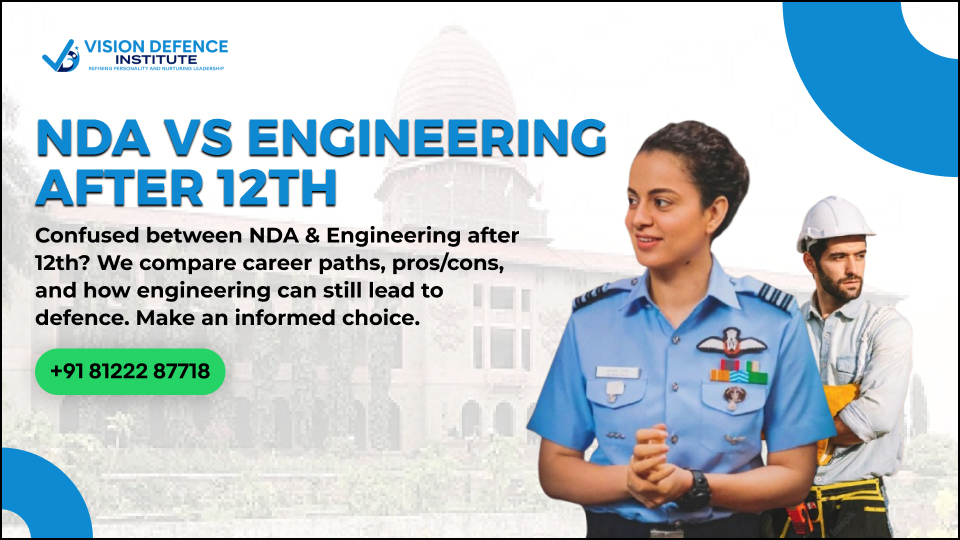
NDA or Engineering? The Ultimate Crossroads for a Defence Aspirant
You’re a bright student in Class 11 or 12, having chosen the Science stream with your sights set on a future of impact and service. The board exams are approaching, but a bigger question looms: What next? For countless students across Tamil Nadu, especially in cities like Madurai, Coimbatore, and Chennai, this moment presents two powerful, yet seemingly divergent paths: the prestigious National Defence Academy (NDA) or the conventional engineering degree. It feels like a choice between passion and practicality, between serving the nation immediately and building a “safe” technical career. This confusion is the single biggest career dilemma for a science student with a defence dream.
I recall counselling Aditya, a top-tier PCM student from a renowned school in Madurai. His father, an engineer, had mapped out his BTech at a premier institute. Aditya, however, spent his evenings reading about fighter jets and military history. “I feel like I’m being pulled in two directions,” he confessed. “One path feels like my duty, the other feels like my family’s expectation for a ‘secure’ career.” Aditya’s story is universal. The perceived conflict between NDA or engineering creates unnecessary stress, often leading to a choice made under pressure rather than one based on clarity.
This guide is here to dispel that myth of conflict. We will analyze NDA and engineering not as opposing choices, but as two potent pathways that can, in fact, converge. We will break down the decision into clear parameters—timeline, career structure, skill development, and long-term goals—so you can make an informed, confident choice for your future.
Understanding the Two Pathways: A Side-by-Side View
Before we delve deeper, let’s establish a clear, high-level comparison of these two prestigious options.
| Aspect | National Defence Academy (NDA) | Engineering (BTech/BE) |
|---|---|---|
| Primary Focus | Integrated military training and graduation. Becomes an officer first, with a degree as part of training. | Specialized technical education. Becomes an engineer first, with options to join defence later. |
| Entry Point | After Class 12, via the UPSC NDA exam. | After Class 12, via national/state engineering entrance exams (JEE, TNEA, etc.). |
| Duration & Structure | 4 years: 3 years at NDA (B.Tech/BA/B.Sc) + 1 year at pre-commissioning academy (IMA, AFA, INA). | 4 years: Dedicated focus on an engineering discipline (Mechanical, CS, Electronics, etc.) at a university. |
| Core Outcome | Commissioned as a Lieutenant (or equivalent) in the Indian Armed Forces. A guaranteed career as an officer. | Graduate with a Bachelor of Technology/Engineering degree. A gateway to corporate, higher studies, or defence sectors. |
| Career Security | Extremely high. Permanent Commission with a structured career, pension, and lifelong benefits. | Market-dependent. Security is tied to individual skill, college brand, and industry demand. |
| Skill Development | Holistic leadership: Military strategy, men-management, decision-making under pressure, physical endurance. | Specialized technical: Deep expertise in a chosen engineering field, problem-solving, research & development. |
The Deep Dive: Making Your Choice Based on Your Priorities
The right choice depends entirely on what you value most at this stage of your life. Let’s break it down.
Choose the NDA Path if your answer is “YES” to most of these:
-
Your primary, burning desire is to serve in the uniform. The idea of leading soldiers, sailors, or airmen is your core motivation.
-
You want a structured, disciplined life with clear progression. You thrive in environments with clear rules, ranks, and a defined path for growth.
-
You value holistic leadership development over deep technical specialization. You want to be a leader of people and projects, not just an expert in circuits or code.
-
You are physically fit and mentally prepared for the rigours of military training and life.
-
Long-term financial security and benefits (like pension) are a significant priority for you and your family.
The NDA Advantage: It offers the earliest possible entry into the forces as an officer. You start your professional life at 21-22 as a commissioned officer, building seniority early. The life, while challenging, is filled with unparalleled adventure, respect, and purpose.
Choose the Engineering Path if your answer is “YES” to most of these:
-
Your passion lies deeply in a specific branch of engineering (e.g., Artificial Intelligence, Aerospace, Computer Science).
-
You want to keep multiple career options open—corporate sector, entrepreneurship, higher studies (MS/MBA), or government jobs like ISRO, DRDO.
-
The flexibility of the civilian workforce and potentially higher variable income (especially in IT/tech) appeals to you.
-
You prefer to first acquire a strong, specialized technical skill set that you can later apply in various domains, including defence.
-
You or your family have concerns about the risks and lifestyle constraints (frequent transfers, remote postings) associated with military service.
The Engineering Advantage: It keeps your options wide open. An engineering degree is a powerful, versatile asset. It also opens a second gateway to defence through the Technical Branches of the Air Force (AFCAT), Navy, or the Army’s Technical Entry Scheme (TES), where your engineering knowledge is directly utilized.
The Convergence Point: Engineering as a Gateway to Defence
This is a critical insight that dissolves the dilemma. Choosing engineering does NOT mean abandoning your defence dream. In fact, it can make you a more valuable candidate for specific roles.
-
Technical Entries Post-Engineering:
-
Indian Air Force: The AFCAT exam for the Technical Branch (Ground Duty) actively seeks engineering graduates in Mechanical, Computer Science, and Electronics streams.
-
Indian Navy & Army: They have specific entries for engineering graduates, valuing their technical expertise for maintaining and operating complex warfare systems.
-
-
Higher Studies & Defence Research: A BTech degree allows you to pursue an MTech or PhD and enter premier defence research organizations like DRDO (Defence Research and Development Organisation), where you contribute to cutting-edge military technology as a scientist.
-
The “Engineer-Officer” Profile: Officers with an engineering background often have an edge in understanding modern, technology-intensive warfare. They are well-suited for branches like the Army’s Corps of Engineers, Signals, or the Navy’s Engineering Branch.
The Long-Term Perspective: Where Can Each Path Lead?
Think 15-20 years ahead.
-
An NDA Officer’s Trajectory: Progresses through military ranks (Captain, Major, Colonel). Could command a battalion, lead strategic staff appointments, or serve as a military attaché abroad. Post-retirement (often in early 50s), options include corporate security, government advisory roles, or entrepreneurship, backed by immense leadership experience.
-
An Engineer’s Trajectory: Could rise to a top technical role (Principal Engineer, CTO) in the corporate world, become a successful entrepreneur, or ascend to leadership in a PSU or defence PSU (like HAL, BEL). If entering the forces later, they become specialist technical officers.
Actionable Steps for Class 11/12 Students
-
Do Not Delay Your Preparation: This is the most crucial advice. The syllabus for JEE/State Engineering Entrances and the NDA exam has significant overlap in Physics, Chemistry, and Mathematics.
-
Follow a Dual-Prep Strategy: For the next 1-2 years, your core focus should be mastering PCM. Use the same strong foundation to apply for both NDA and engineering entrance exams. They are not mutually exclusive at the preparation stage.
-
Take the NDA Exam Seriously: Even if you are leaning towards engineering, appear for the NDA exam in Class 12. Clearing it gives you a powerful option. You can always choose to forgo it if you get a premier engineering college.
-
Seek First-Hand Guidance: Talk to serving defence officers (especially those who are engineers) and engineers working in different sectors. Understand their daily lives, challenges, and rewards.
Conclusion: It’s About Alignment, Not Sacrifice
The decision between NDA or engineering is not about choosing one dream over another. It’s about deciding which platform you want your dream to launch from.
-
If your dream is the uniform, the brotherhood, and the command, then NDA is your most direct and fulfilling route.
-
If your dream is mastery over technology with the armed forces as one of several potential applications, then engineering offers a broader base with a deferred, specialized entry into defence.
Both are honourable, challenging, and impactful paths. At Vision Defence Institute, Madurai, we guide students through this very decision. Our integrated coaching strengthens your PCM foundation for all competitive exams, while our mentorship helps you align your academic choices with your long-term career goals.
Your future is not a single track; it’s a network of possibilities. Choose the node that best aligns with who you are and who you aspire to become.
Ready to build a strategy that keeps both prestigious paths open?
📍 Visit Us: 2ND STOP, S ALANGULAM, Kulamangalam Main Rd, Madurai, Tamil Nadu 625017
📞 Call/WhatsApp for Career Counselling: +91 81222 87718
🌐 Connect for Guidance: Vision Defence Institute Facebook | Vision Defence Institute YouTube