
Your Ultimate Guide to CGCAT: Launch Your Career as a Coast Guard Officer
Have you ever stood at a coastline, mesmerised by the endless horizon, and felt a calling that was deeper than the ocean itself? For many young Indians, especially in the coastal states of Tamil Nadu, the call is to the Indian Coast Guard (ICG) – the nation’s maritime guardian. Yet, the path to becoming an Assistant Commandant (General Duty) often begins in confusion. Unlike the more familiar NDA or CDS, the Coast Guard Combined Admission Test (CGCAT) and its selection process remain a mystery to countless aspirants. They ask, “Is it the same as the Navy? How do I prepare? Is there specialized CGCAT coaching?” This lack of clear, structured information is the first wave that washes away many dreams before they even set sail.
I remember a conversation with a bright graduate from Chennai, let’s call him Karthik, who had cleared his CDS written exam. “I want to join the Coast Guard,” he said, “but I have no idea where to start. Everyone talks about NDA and AFCAT, but the Coast Guard path seems hidden.” Karthik’s struggle is not unique. Aspiring officers often treat CGCAT as an afterthought or mistakenly prepare for it using Navy exam strategies, not realising it demands a unique blend of maritime awareness, mental agility, and specific physical standards.
This guide is your navigational chart. We will demystify the entire journey to becoming an Assistant Commandant in the Indian Coast Guard. We’ll break down the CGCAT exam pattern, the crucial stages of the selection process, and provide a strategic preparation plan, including insights on effective CGCAT coaching and the all-important FSSB (Final Selection Board) interview.
Why the Indian Coast Guard? A Unique Vocation of Service
Before we dive into the “how,” let’s solidify the “why.” The Indian Coast Guard is not a branch of the Navy; it is an independent armed force with a distinct, vital mandate: maritime defence, search and rescue, marine pollution response, and law enforcement in our territorial waters. As an Assistant Commandant (GD), you won’t just be an officer; you’ll be a guardian of our blue frontiers, leading crews on daring missions that save lives and protect our national interests at sea. It’s a career that blends adventure, technology, and profound service.
Charting the Course: The Complete CGCAT Selection Process
The journey to the Coast Guard is a multi-stage voyage. Understanding each checkpoint is critical.
Stage 1: The Preliminary Selection
This is an initial screening of your application based on your academic percentage. Only candidates who meet the cut-off (which varies each year) proceed to the next stage.
Stage 2: The Coast Guard Combined Admission Test (CGCAT)
This is your first major hurdle. The CGCAT is a written examination designed to test your intellectual potential.
-
Mode: Computer-Based Test (Online)
-
Sections & Focus:
-
Mental Ability & Reasoning: Tests your logical and analytical thinking. Expect questions on series, analogies, coding-decoding, and puzzles.
-
General Awareness & Current Affairs: This is heavily weighted. Focus on national and international news (especially maritime), sports, awards, government schemes, and basic science.
-
English Language: Tests grammar, vocabulary, comprehension, and sentence correction.
-
Numerical Ability & Mathematics: Questions are of Class 10-12 level, focusing on speed and accuracy in topics like percentage, profit-loss, time-speed-distance, and basic algebra.
-
Stage 3: The Final Selection Board (FSSB) Interview
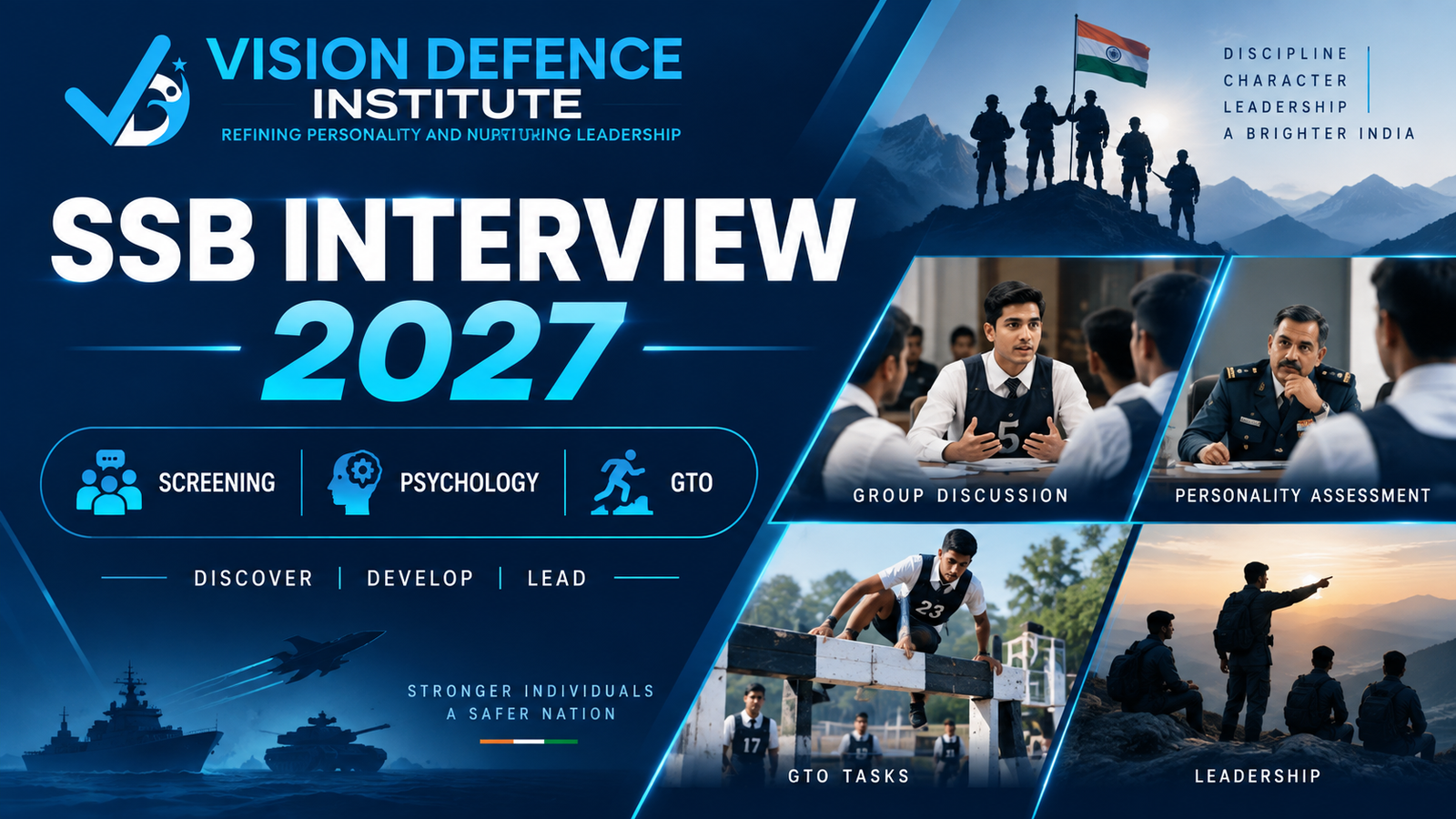
Clearing CGCAT qualifies you for the FSSB interview, a comprehensive personality assessment similar to the SSB but with a distinct Coast Guard flavour.
-
Psychologist Tests: Includes written projective tests like the Picture Perception Test, Thematic Apperception Test (TAT), and Word Association Test (WAT).
-
Group Testing Officer (GTO) Tasks: A series of indoor and outdoor group activities to assess leadership, teamwork, communication, and problem-solving skills.
-
Personal Interview: A one-on-one interview delving deep into your personality, motivation for the Coast Guard, and awareness of maritime affairs.
-
CPSS (Computerised Pilot Selection System): For candidates applying for the Naval Aviator (Pilot) entry, this is a mandatory, one-time test to assess your inherent aptitude for flying.
Stage 4: Medical Examination & Final Merit List
The final stage is a rigorous medical examination as per ICG standards. The final merit list is prepared based on your combined performance in CGCAT and the FSSB interview.
The CGCAT Advantage: Why Specialised Coaching Makes a Difference
While self-study is possible, structured CGCAT coaching offers a decisive edge. Here’s why:
-
Tailored Curriculum: Generic defence coaching often misses the specific maritime focus of the CGCAT’s General Awareness section. Specialised coaching zeroes in on ICG history, vessels, operations, and current maritime geopolitics.
-
Mastering the CBT Format: The online, computer-based test requires a different strategy than pen-and-paper exams. Coaching institutes provide simulated CBT platforms to build familiarity and speed.
-
Decoding the FSSB: The FSSB is as important as the written exam. Good coaching provides mock FSSB series, including psychologist tests, group tasks, and personalised interview preparation, which is invaluable for first-timers.
-
Time Management & Strategy: A structured program provides a realistic study plan, prioritises high-yield topics, and teaches time-saving tricks for the Mental Ability and Mathematics sections.
Your CGCAT Preparation Blueprint: A 6-Month Plan
Follow this phased approach to ensure comprehensive coverage and peak performance.
| Phase | Duration | Key Actions |
|---|---|---|
| Phase 1: Foundation (Months 1-2) | 8 Weeks | Build core concepts in Reasoning, Mathematics, and English Grammar. Start a daily habit of reading a newspaper and a monthly current affairs magazine. |
| Phase 2: Intensive Learning (Months 3-4) | 8 Weeks | Dive deep into subject-wise study. Solve topic-wise questions. Start a dedicated maritime GK diary. Begin practising previous years’ CGCAT question papers. |
| Phase 3: Practice & Testing (Month 5) | 4 Weeks | Shift to full-length mock tests. Take at least 2-3 tests per week under timed conditions. Analyse each test to identify weak areas. |
| Phase 4: Revision & FSSB Prep (Month 6) | 4 Weeks | Focus only on revision notes and high-frequency topics. Intensify mock FSSB practice. Work on physical fitness and outdoor group activities. |
Key Pillars of Your CGCAT Success Strategy
Beyond the plan, internalise these principles:
-
Maritime GK is Non-Negotiable: Don’t just read the news; connect it to the maritime domain. Follow the Indian Coast Guard’s official social media handles and website.
-
Practice Online: Get comfortable with solving questions on a screen. Use online test series extensively.
-
Start FSSB Prep Early: Work on your communication skills, participate in group discussions, and practice speaking about your motivation for the Coast Guard. Physical fitness is a must.
-
Be Authentic: In the FSSB, honesty and consistency in your personality are paramount. The board is trained to spot pretense.
Your Call to Action: Set Sail for Your Dream
The path to the Indian Coast Guard is challenging, selective, and incredibly rewarding. It demands a candidate who is not just academically sound but also possesses leadership potential, physical robustness, and a genuine passion for maritime defence.
By understanding the unique contours of the CGCAT and FSSB process, and by undertaking a disciplined, focused preparation journey—potentially augmented by specialised CGCAT coaching—you transform a distant dream into a navigable course.
Ready to embark on this structured voyage with expert guidance?
For aspirants in South India, particularly in Tamil Nadu, institutes like Vision Defence Institute offer specialised programs tailored for the CGCAT. Such coaching can provide the targeted strategy, maritime-focused material, and realistic FSSB simulation needed to stand out in this prestigious selection.
Your watch on the high seas begins with your preparation on land. Start today.
📍 Visit Us: 2ND STOP, S ALANGULAM, Kulamangalam Main Rd, Madurai, Tamil Nadu 625017
📞 Call/WhatsApp: +91 81222 87718
🌐 Connect: Vision Defence Institute Facebook | Vision Defence Institute YouTube