Online vs Offline Defence Coaching: Best Choice?

Online vs Offline Defence Coaching: Which One Gives Better Results? Let me tell you about two students. Same town. Same dream. Different choices. Rahul lived in a small village near Madurai. His parents couldn’t afford to send him to a city for coaching. He opted for online defence coaching from a popular platform. Cheap. Convenient. No travel. Priya lived just 10 km away. She joined Vision Defence Institute (offline) in Madurai. She woke up at 5 AM. She traveled 45 minutes each way. She paid more money. After 6 months of preparation, who cleared the NDA written exam? Both. But only one cleared the SSB interview. Priya did. Rahul didn’t. Why? Because online coaching taught Rahul how to answer questions. Offline coaching taught Priya how to become an officer. If you are searching “online vs offline defence coaching” , you are probably confused. Your parents want you to join a “real coaching center.” Your friends say “everything is available online for free.” Your budget is limited. Let me settle this debate once and for all. In this guide, I will compare online vs offline defence coaching across every parameter that matters for NDA, CDS, and AFCAT: Cost (fees + hidden costs) Discipline and routine SSB and GTO preparation (the real differentiator) Peer group and competition Doubt clearing Success rates and results Who should choose what (based on your profile) Let me be honest upfront: I run an offline coaching center (Vision Defence Institute in Madurai). So you might think I am biased. That’s fair. But I will give you the unvarnished truth. Online coaching works for some people. Offline coaching works for most people. Let me tell you why. The Problem: Online Feels Easier. Offline Feels Harder. Both Can Fail. Here is what aspirants don’t realize. Online defence coaching feels good in the beginning. You wake up at 9 AM. You open your laptop in your pajamas. You watch a recorded lecture at 1.5x speed. You feel productive. You are not. Offline defence coaching feels hard. You have to wake up early. You have to travel. You have to sit in a classroom with 30 other students. You cannot pause the teacher. You cannot rewind. You have to pay attention. But here is the truth: Discomfort is where growth happens. Online Coaching Offline Coaching Comfortable Uncomfortable (initially) Flexible Rigid schedule No travel Travel required Cheaper More expensive Easy to skip lectures Hard to skip (you are there) Low accountability High accountability No peer pressure Healthy competition At Vision Defence Institute, we have seen students switch from online to offline after failing for 1-2 years. They all say the same thing: “I wish I had joined offline from the beginning.” Now, let me break down every parameter. Round 1: Cost Comparison (Online vs Offline Defence Coaching) Let’s start with the elephant in the room: money. Online Defence Coaching Costs Type Cost (Approx) Free YouTube resources ₹0 (but scattered, no structure) Recorded courses (Unacademy, Khan Global, etc.) ₹5,000 – ₹15,000 per year Live online batches ₹15,000 – ₹35,000 per year Premium 1-on-1 online coaching ₹50,000+ per year Hidden costs of online coaching: Good internet connection (₹500-1000/month) Laptop/tablet (₹25,000+ one-time) Printer for study material (₹10,000+) Distraction management (priceless) No SSB GTO ground access Offline Defence Coaching Costs Type Cost (Approx) Local coaching center ₹30,000 – ₹60,000 per year Premium academy (like VDI Madurai) ₹45,000 – ₹75,000 per year (all inclusive) Hostel facility (if from outstation) ₹60,000 – ₹1,00,000 extra per year What offline coaching includes (that online doesn’t): Physical classroom infrastructure Library and study spaces GTO ground (obstacles, 400m track) Peer group and competition Faculty interaction face-to-face SSB psychology labs (group settings) Weekly physical training sessions Verdict on cost: Online is cheaper. Offline is more expensive but includes more. But here is the question: What is the cost of wasting 1-2 years trying to crack the exam alone? That lost time has value too. At defence coaching in Madurai (VDI), we offer EMI options. Many students pay in monthly installments. Do not let cost alone decide. Let value decide. Round 2: Discipline & Routine (Where Online Fails) This is the biggest difference between online vs offline defence coaching. The Online Discipline Problem You tell yourself: “I will wake up at 6 AM and study.” Your alarm goes off. It’s cold outside your blanket. You think: “I can watch the recorded lecture later.” You go back to sleep. This happens to 90% of online students. Online coaching has no external accountability. No one knows if you watched the lecture. No one knows if you did your PT. No one knows if you are struggling. The result: You fall behind. You feel guilty. You try to catch up. You fall further behind. You give up. The Offline Discipline Advantage At an Army coaching centre like VDI: Your faculty knows if you are absent. Your batchmates know if you missed a class. You have a fixed time to be at the center. If you don’t show up, someone calls you. The result: You show up. Even on days you don’t feel like it. Especially on those days. The data: VDI’s offline batch has a 92% attendance rate. Online courses typically have 40-60% completion rates. Verdict on discipline: Offline wins by a massive margin. Round 3: SSB & GTO Preparation (The Real Differentiator) Here is the secret that online coaching platforms don’t want you to know. You cannot prepare for the SSB interview fully online. Why? Because the SSB tests group dynamics, physical leadership, and real-time reactions. Online SSB Preparation (What’s Possible) Component Can be done online? PPDT story writing ✅ Yes TAT story writing ✅ Yes WAT word practice ✅ Yes SRT situation practice ✅ Yes Personal interview mocks 🟡 Partially (video call) Online SSB Preparation (What’s IMPOSSIBLE) Component Can be done online? Why Group Discussion (GD) ❌ No Real GD requires real people, real interruptions, real pressure Progressive Group Task (PGT) ❌ No Requires physical obstacles, planks, ropes, a team Group Obstacle Race ❌ No Requires a ground, a 400m track, physical competition Command Task ❌ No Requires 3 followers, a physical problem to solve Lecturette to a real audience ❌ No Speaking to a screen is NOT the same as speaking to 20 people Offline SSB
Life After NDA or CDS Selection: Complete Guide

Life After Selection: What Happens After You Clear NDA or CDS? Let me tell you about a phone call I will never forget. It was 8:30 PM on a Tuesday. My phone rang. It was Vikram—a student who had joined Vision Defence Institute two years ago. He was quiet. He was average. He struggled with English. His parents had almost given up on his defence dream. I picked up the call. He didn’t say hello. He just said one sentence, his voice cracking: “Sir. I got recommended. CDS. I’m going to the Academy.” I cried. He cried. His mother in the background was sobbing. That night, Vikram wasn’t thinking about the written exam or the SSB or the medicals. He was thinking about one thing: What happens now? If you are preparing for NDA or CDS, you have probably asked the same question. You have seen the videos of passes-out parades. You have seen officers in uniform. But you don’t know what actually happens after the recommendation letter. In this guide, I will take you through life after clearing NDA or CDS : The day you get recommended (what to do immediately) Medical examination (the final hurdle) Merit list and joining instructions Training at NDA vs IMA/OTA/AFA (what happens inside) Daily routine at the academy (hour by hour) Salary, allowances, and career progression Life as a commissioned officer Let me show you what is waiting for you on the other side of your hard work. The Problem: You Are Preparing for the Exam, Not the Life Here is the truth. Most aspirants spend 100% of their energy on cracking the written exam and SSB. They never think about what comes after. Then, when they get recommended, they are completely lost. “What medical tests will I face?” “How long is the training?” “Will I get a salary during training?” “What if I get injured during training?” Life after clearing NDA or CDS is not just “congratulations and a uniform.” It is a structured, challenging, transformative journey. And if you are not mentally prepared for it, the training can break you. At Vision Defence Institute, we don’t just prepare you for the exam. We prepare you for the life of an officer. Our ex-defence faculty—who have lived through NDA, IMA, and active service—tell you exactly what to expect. Now, let me walk you through every step after that magical phone call. Step 1: The Day You Get “Recommended” – What Happens Immediately? You have just finished Day 5 of the SSB. The President calls your name. You walk in. He says: “You are recommended.” Here is what happens next, hour by hour: Time Event 12:00 PM Recommendation letter handed to you. Your photo is taken. 12:30 PM You are asked to sign multiple documents. (Read them carefully.) 1:00 PM You are given a medical appointment letter for the next 2-3 days. 1:30 PM You call your parents. (Try not to cry. Or cry. Both are fine.) 2:00 PM – 5:00 PM Paperwork. Verification of documents. Multiple forms. Evening You are taken to a medical board hostel. You do NOT go home yet. Important: Being “recommended” does NOT mean you are selected. You still have to clear the medical examination. Many recommended candidates get rejected at the medical stage. What to pack for the medicals: All original documents (10th, 12th, degree certificates) 10 passport-size photographs Your recommendation letter A tracksuit and sports shoes (for physical medical tests) At defence coaching in Madurai (VDI), we give every student a “Post-SSB Medical Checklist” before they even go for their SSB. Forewarned is forearmed. Step 2: The Medical Examination – The Final Hurdle Life after clearing NDA or CDS depends entirely on passing this 2-3 day medical marathon. Day 1 of Medicals: Preliminary Tests Test What They Check Height Minimum: NDA (157 cm male, 152 cm female), CDS (157.5 cm) Weight Proportionate to height Chest expansion Minimum 5 cm expansion Vision 6/6 in each eye (for flying branch, stricter) Hearing Whispered speech test Dental Jaw alignment, cavities, gum health Color vision Ishihara plates (color blindness test) The most common rejection reasons at this stage: ❌ Vision issues (correctable with LASIK? Yes, but specific rules apply) ❌ Flat foot (Yes, this is a real rejection reason) ❌ Piles or hernia (Temporary rejection – treatable) ❌ High blood pressure ❌ Past medical history (asthma, epilepsy, fractures) Day 2 of Medicals: Detailed Examination X-rays (chest, spine, limbs) Blood tests (HIV, hepatitis, blood sugar) Urine tests ECG (heart function) Consultations (physician, surgeon, ophthalmologist, ENT specialist) Day 3 of Medicals: Specialty Tests (If Needed) Medical board review of borderline cases Specialist opinions Final medical report prepared What is a “temporary rejection”? You are not permanently disqualified. You have a correctable condition (e.g., hemorrhoids, low BMI). You get 42 days to fix it and report back for re-examination. What is a “permanent rejection”? You cannot join. Conditions like HIV, uncontrolled diabetes, major spinal issues, severe flat foot, color blindness (for certain branches). VDI Tip: We recommend a pre-SSB medical checkup at a civilian hospital. Find out your issues before you reach the SSB medical board. Fix what you can. Then go. Step 3: Merit List & Joining Instructions – The Waiting Game You have cleared the medicals. Now you wait. The SSB sends your recommendation to UPSC (for NDA/CDS) or IAF (for AFCAT). A merit list is prepared based on: Your written exam score (50% weightage) Your SSB recommendation (50% weightage) Your medical fitness category Timeline: Event Typical Time After Recommendation Merit list published 4-8 weeks Joining instructions sent 6-10 weeks Report to academy 8-12 weeks What you do during this waiting period: Maintain your physical fitness (do NOT stop PT) Get any pending dental or minor medical work done Start reading about the academy (what to pack, what to expect) Meet with ex-officers (VDI arranges this for our selected students) Emotional reality check: The waiting is harder than the preparation. You will check the UPSC website 50 times a day. You will panic if you don’t see your name. This is normal. Breathe. Step 4: Training Academy – What Happens Inside? Life after clearing NDA or CDS now takes you to the academy. The training duration varies by entry and academy. For NDA Candidates (National Defence
Complete AFCAT Guide for Beginners
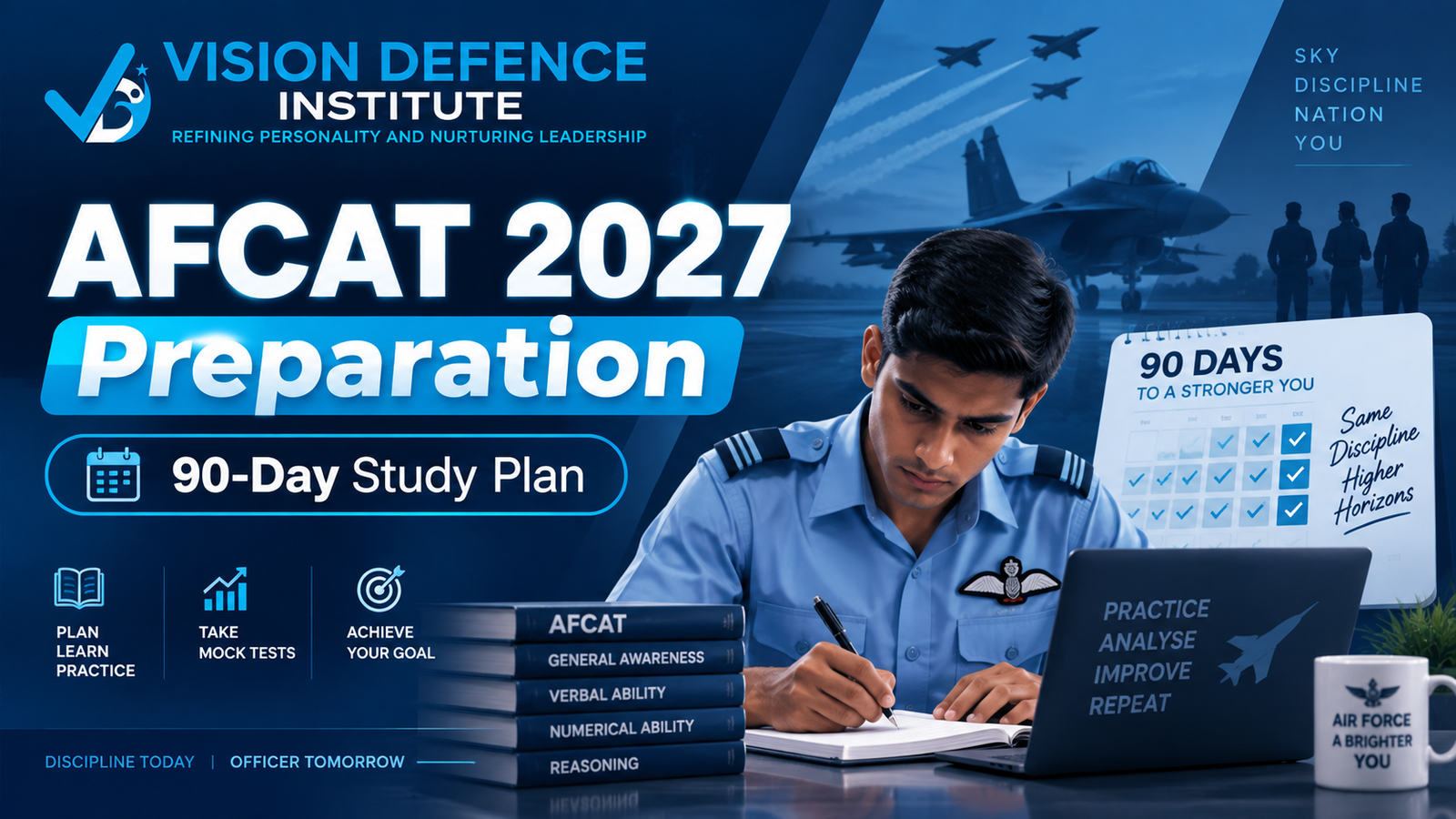
Complete Guide to AFCAT Exam Preparation for Beginners Let me tell you about a student named Divya. Divya was in her final year of college. Her brother was in the Army. But she wanted something different. She wanted to fly. She wanted the blue uniform. She wanted the Air Force. But she knew nothing about AFCAT exam preparation. She didn’t even know what AFCAT stood for. (It’s Air Force Common Admission Test, by the way.) She searched YouTube. She got confused by 50 different videos. Some said “AFCAT is easy.” Some said “Only engineers can clear AFCAT.” Some said “You need 6 months of preparation.” Divya was paralyzed. She almost gave up before starting. Then someone told her about Vision Defence Institute in Madurai. She came for a free demo class. Within one hour, an ex-Air Force officer explained the entire AFCAT exam preparation journey—from eligibility to study plan to SSB. Today, Divya is preparing for her AFCAT 2026 attempt. She is confident. Not because she is a genius. Because she finally has a roadmap. If you are a beginner—someone who just heard about AFCAT and wants to understand it from zero—this guide is for you. In this complete guide to AFCAT exam preparation for beginners, I will cover: What is AFCAT? (Simple explanation, no jargon) Who can apply? (Eligibility broken down) Exam pattern & syllabus (What to study) Step-by-step study plan for 6 months How to prepare for the Air Force SSB (Different from Army/Navy) Why AFCAT coaching matters (And why VDI Madurai is your best bet) Let’s start from the absolute beginning. The Problem: AFCAT Looks Scary from the Outside Here is what a beginner feels when they first hear about AFCAT: “I don’t have a technical background. Can I still apply?” “What is the Air Force SSB? Is it different from the Army one?” “Do I need to be a pilot to write AFCAT?” “How many months do I need to prepare?” Let me answer the biggest fear first: You do NOT need to be an engineer to clear AFCAT. AFCAT has two branches: Flying Branch (Pilot) – Requires Physics and Maths at Class 12 level Ground Duty Branch (Administration, Logistics, Accounts, Education) – ANY graduate can apply So if you are a Commerce or Arts graduate, you are eligible for Ground Duty. The Indian Air Force needs officers on the ground too—managing operations, logistics, finance, and personnel. At Vision Defence Institute, we have helped students from all backgrounds—BA, BCom, BSc, BTech—crack AFCAT exam preparation successfully. Now, let me break down everything you need to know. What is AFCAT? (The Simple Explanation) AFCAT = Air Force Common Admission Test. It is the written exam conducted by the Indian Air Force (IAF) twice a year (February and August) to select officers for: Entry What It Is Flying Branch Pilot. You will fly fighter jets, transport aircraft, or helicopters. Ground Duty (Technical) Engineering roles. Maintain aircraft, radar, and weapons systems. Ground Duty (Non-Technical) Administration, Logistics, Accounts, Education, Meteorology. The process is: Apply online (UPSC or AFCAT portal depending on entry) Take AFCAT written exam (2 hours, 100 questions) Shortlisted → Air Force SSB interview (5 days) Medical examination Merit list → Training at Air Force Academy (AFA), Dundigal Important: For Flying Branch, you also have to pass a CPSS (Computerized Pilot Selection System) test after the SSB. This tests your hand-eye coordination, multitasking, and spatial awareness. Now, let’s answer the most common beginner question. Who Can Apply for AFCAT? (Eligibility Breakdown) AFCAT exam preparation starts with checking if you are eligible. For Flying Branch (Pilot) Criterion Requirement Age 20 to 24 years Education Any degree (3 years) with Physics and Maths at Class 12 level Minimum Marks 60% aggregate in degree Gender Male and Female Marital Status Unmarried For Ground Duty (Technical) Criterion Requirement Age 20 to 26 years Education B.Tech/BE in any engineering discipline Minimum Marks 60% aggregate Gender Male and Female Marital Status Unmarried For Ground Duty (Non-Technical) – Most Beginners Qualify Here Stream Eligible Degrees Administration Any degree (BA, BCom, BSc, BBA, etc.) Logistics Any degree Accounts BCom, MCom, CA, ICWA Education MA/MSc in English, Physics, Maths, Chemistry, Psychology, or Computer Science Meteorology MSc in Physics, Maths, Geography, or Meteorology Criterion Requirement Age 20 to 26 years Minimum Marks 60% aggregate in degree Gender Male and Female Marital Status Unmarried Good news for beginners: If you have ANY bachelor’s degree with 60% marks and you are between 20-26 years old, you are eligible for Ground Duty (Non-Technical). No Physics, no Maths, no engineering required. At AFCAT coaching Madurai (VDI), nearly 40% of our students are from BCom and BA backgrounds. They clear AFCAT regularly. AFCAT Exam Pattern: What You Will Face Understanding the exam pattern is the first step in AFCAT exam preparation. Feature Details Duration 2 hours Total Questions 100 Total Marks 300 Negative Marking Yes (1 mark deducted per wrong answer) Sections 4 (General Awareness, Verbal Ability, Numerical Ability, Reasoning) Section-wise Breakdown Section Questions Marks What is Tested General Awareness 25 75 Current affairs, Defence news, History, Geography, Polity, Basic Science Verbal Ability in English 30 90 Grammar, Vocabulary, Comprehension, Sentence correction Numerical Ability 20 60 Class 10 level Maths (Percentages, Averages, Ratios, Simple Interest, etc.) Reasoning & Military Aptitude 25 75 Verbal and non-verbal reasoning, pattern recognition, spatial ability Total: 100 questions, 300 marks Cutoff: Varies every year. Typically around 150-165 marks out of 300 for general category. For beginners: The Maths is Class 10 level. Not Class 12 like NDA. This is a huge advantage for non-maths students. AFCAT Syllabus: What Exactly to Study Here is the complete syllabus for AFCAT exam preparation. General Awareness (25 questions) Topic Priority Current Affairs (last 6 months) High Defence news (exercises, missiles, appointments) Very High History (Modern India only) High Geography (Physical geography) Medium Polity (President, Parliament, Fundamental Rights) High Basic Physics (Class 10 level) Low Basic Chemistry (Class 10 level) Low Sports awards Low Verbal Ability in English (30 questions) – Most Scoring Topic Description Comprehension One passage with 5-6 questions Sentence correction Spot the error Fill in the blanks Prepositions, articles, conjunctions Vocabulary Synonyms, antonyms, idioms Para jumbles Arrange sentences in logical
Mock Tests: Secret Weapon for NDA, CDS & AFCAT
Why Mock Tests Are the Secret Weapon for NDA, CDS & AFCAT Success Let me tell you about two students. Same batch. Same coaching. Same starting point. Student A: He studied 8 hours daily. He read every book. He made perfect notes. He never took a mock test because “syllabus complete nahi hua.” Student B: She studied 5 hours daily. She skipped many topics. But she took one mock test every Sunday without fail. Even when her syllabus was incomplete. Even when she scored poorly. Guess who cleared NDA written? Student B. By a margin of 80 marks. Student A failed. He called me crying: “I knew everything. I don’t understand what happened.” I told him the truth: “You knew everything on paper. You never practiced under exam pressure. Mock tests are the secret weapon—and you never picked it up.” If you are preparing for NDA, CDS, or AFCAT, let me save you from Student A’s fate. Mock tests are the secret weapon that separates recommended officers from “almost there” aspirants. In this guide, I will show you: Why mock tests matter more than studying (the science behind it) How to take mock tests the right way (most people do it wrong) The exact analysis method that improves your score by 50+ marks Weekly mock test schedule for NDA, CDS, and AFCAT At Vision Defence Institute, we have seen average students outscore toppers simply because they took mocks seriously. Let me show you how. The Problem: You Are Studying in a Bubble Here is what most aspirants do. They sit in their room. Comfortable chair. No clock. No pressure. They read a chapter. Then they solve a few practice questions. If they get stuck, they look at the solution immediately. This is not preparation. This is a fantasy. The real exam is NOTHING like this. Your Study Bubble The Real Exam Hall No time limit Strict 2.5 hours per paper No negative marking pressure 0.33 marks deducted per wrong answer Can look at solutions No help. Just you and the paper Comfortable, familiar environment Strangers, strict invigilators, anxiety You choose easy questions first Random order. No control. Mock tests are the secret weapon because they destroy your study bubble. They simulate the real exam. They show you exactly where you will fail—before you actually fail. At Vision Defence Institute, we force every student to take their first mock test within 15 days of joining. Even if they know nothing. The shock of scoring 120 marks out of 900 is the best motivation we have ever seen. Now, let me give you the complete blueprint. Why Mock Tests Are the Secret Weapon: 5 Undeniable Reasons Reason #1: They Kill Your “Overconfidence” You think you know a topic until you are asked a question under a ticking clock. Example: Study mode: You read “Quadratic equations have two roots.” Easy. Mock test mode: “If one root of 2x² + kx + 4 = 0 is 2, find k.” Suddenly your brain freezes. The truth: Knowing about a topic is not the same as being able to apply it under pressure. Mock tests expose this gap brutally. Reason #2: They Train Your “Exam Stamina” Sitting and concentrating for 2.5 hours straight is a skill. Most students cannot do it. The science: After 45 minutes, your focus drops by 30%. After 90 minutes, your error rate doubles. After 120 minutes, you start making “silly mistakes.” Mock tests train your brain to stay alert for the full duration. By your 10th mock test, 2.5 hours will feel normal. Reason #3: They Teach You Time Management (The #1 Failure Reason) Here is what happens in the real exam: 2.5 hours = 150 minutes. NDA Maths: 120 questions. That’s 1.25 minutes per question. You cannot solve every question. You cannot even read every question carefully. Mock tests teach you: Which questions to attempt first (your strong topics) Which questions to skip instantly (your weak topics) When to stop trying a hard question (30-second rule) Without mock tests, you will run out of time. I have seen students leave 40 questions unattempted because they spent 10 minutes on one tough problem. Reason #4: They Destroy Exam Fear and Anxiety Your first mock test will feel terrible. You will panic. Your heart will race. You will forget simple formulas. Good. That is the point. By your 20th mock test, your body will be desensitized to exam pressure. When you walk into the real UPSC exam hall, it will feel like just another Sunday mock test. The research: Elite athletes visualize and simulate competition conditions. Mock tests are your visualization. You cannot “think” your way out of exam fear. You must practice your way out. Reason #5: They Reveal Your “Mistake Patterns” Most students think their mistakes are random. “Oh, I made a silly calculation error.” But when you analyze 10 mock tests, patterns emerge: Mistake Type Frequency Root Cause Misread the question 40% Rushing. Not highlighting keywords. Formula forgotten 25% Weak memory. Need flashcards. Time pressure 20% Spent too long on hard questions. Concept gap 15% Didn’t really understand the topic. Mock tests are the secret weapon because they turn vague “I need to study more” into specific “I need to practice reading questions carefully.” At NDA coaching Madurai (VDI), we maintain a “Mistake Notebook” for every student. We track patterns across 20+ mock tests. By the end, students know exactly what to fix. How to Take Mock Tests: The Right Way (90% Do It Wrong) Most students take a mock test like this: Sit down. Start answering. Look at the score at the end. Feel bad or good. Move to the next topic. This is useless. You are wasting the mock test. Here is the VDI 4-Step Mock Test Method that adds 50+ marks to your score. Step 1: Before the Mock Test (15 minutes) Sleep well the night before. No late-night cramming. Eat a light meal 1 hour before. Not heavy (no food coma). Not empty (no hunger distraction). Use the washroom before sitting down. Sounds small. You will thank me. Keep water, pencil, rough paper ready. No getting up during the test. Step 2: During the Mock Test (Simulate Reality) Set
Can Average Students Crack NDA? Yes, Here’s How

Can Average Students Crack NDA? Real Preparation Strategy That Works Let me tell you about a student named Pranav. Pranav came from a small town near Madurai. His Class 10 score? 62%. Class 11? He failed in Mathematics once. His teachers told him, “Beta, NDA is not for you. Focus on something easier.” His own father said, “Only toppers crack NDA. You are an average student. Be realistic.” Pranav almost believed them. Then he walked into Vision Defence Institute one rainy evening. He asked the counselor a question that was breaking his heart: “Can average students crack NDA? Or am I just wasting my time?” That counselor—a retired Army officer—laughed. Not at Pranav. At the question. He said: “Son, some of the best officers I served with were ‘average students.’ The NDA doesn’t want a bookworm. It wants a leader. And leadership has nothing to do with your Class 12 percentage.” Today, Pranav is in his second term at the National Defence Academy. If you are searching “can average students crack NDA” at 1 AM, let me give you the answer you desperately need: YES. Absolutely yes. But not with the strategy that toppers use. In this guide, I will give you the real preparation strategy for average students: Why average students actually have an advantage over toppers The 80/20 rule for NDA syllabus (what to study, what to skip) How to compensate for weak Maths without crying The secret weapon that toppers ignore (and you must exploit) Let me show you exactly how. The Problem: Average Students Are Using the Wrong Role Model Here is the painful truth. Most “average students” look at the school topper and try to copy them. The topper studies 10 hours a day. The topper reads every reference book. The topper solves every single problem. Then the average student tries to do the same. They burn out in 2 weeks. They feel stupid. They conclude, “I am not NDA material.” But here is the secret the topper won’t tell you: The NDA is NOT a school exam. School Exam NDA Exam Rewards memorization Rewards concepts and speed Needs 90%+ for “success” Needs 40-50% to pass (cutoff varies) Deep knowledge of few topics Wide knowledge of many topics Penalizes mistakes heavily Negative marking exists, but you can skip The topper’s strength (deep diving into one topic) is actually a weakness for NDA. The NDA needs a generalist, not a specialist. Can average students crack NDA? Yes, because the NDA is perfectly designed for the student who is decent at many things rather than excellent at one thing. At Vision Defence Institute, we have seen hundreds of “average” students (60-70% in school) crack NDA while toppers failed. Why? Because we stopped forcing them to study like toppers. The Mindset Shift: From “Average” to “NDA-Ready” Before we talk about strategy, let’s fix your brain. Three beliefs you must kill right now: Wrong Belief Truth “I need 90% in school to crack NDA” NDA cutoff is usually 35-45% in written exam. School marks don’t matter. “I am bad at Maths, so I cannot crack NDA” Maths is 300 marks. GAT is 600 marks. Focus on GAT. “Toppers have some secret I don’t” The secret is discipline, not intelligence. Discipline can be learned. Three beliefs you must adopt: “I don’t need to be brilliant. I need to be consistent.” “My ‘average’ means I am balanced. The NDA loves balanced.” “Every topper I compete against is also nervous. We start from the same line.” At NDA coaching Madurai (VDI), our first month is dedicated to unlearning school exam mentality. We don’t care about your past marks. We care about your present effort. Now, let me give you the exact strategy that works for average students. Strategy #1: The 80/20 Rule for NDA Syllabus You cannot study everything. Accept it. Move on. The 80/20 Rule: 20% of the syllabus gives you 80% of the marks. Find that 20%. Master it. Ignore the rest. For NDA Maths (300 marks) Topic Weight Effort Needed Strategy for Average Student Algebra High Medium Learn basics. Solve PYQs. Skip tough proofs. Calculus Very High High Focus on differentiation only. Integration? Just basics. Trigonometry Medium Medium Memorize identities. Practice heights & distances. Matrices Medium Low Easy marks. Do not skip. Probability Low Low Do only very basic questions. Statistics Low Low Skip if short on time. 3D Geometry Low High Skip. Too time-consuming. The average student’s Maths plan: Target: 70-80 marks out of 300 (not 150+) How? Algebra + Trigonometry basics + Matrices + easy Calculus What to skip? Complex integration, 3D geometry, tough probability VDI Tip: Our defence coaching in Madurai has a “Maths for Non-Maths Students” batch. We teach you ONLY what is necessary. Nothing extra. For NDA GAT (600 marks – The Gold Mine) This is where average students WIN. Section Marks Your Strategy English 200 Must score 120+. Grammar rules are learnable. Practice daily. Physics 100 Class 10 level. Read NCERT twice. Don’t solve numericals—focus on theory. Chemistry 60 Memorize periodic table trends. Organic chemistry? Skip complex reactions. Biology 40 NCERT diagrams + functions. Easy marks if you read. History 80 Spectrum book. Only Modern India (1857-1947). Skip Ancient & Medieval. Geography 60 Physical geography (rivers, mountains, climate). Skip economic geography. Current Affairs 60 Last 6 months only. Defence news priority. The average student’s GAT plan: Target: 250-300 marks out of 600 Focus: English + History (Modern) + Geography (Physical) + Biology Skip: Complex Physics numericals, Organic Chemistry, Ancient History Total written exam target for average student: Maths: 70 marks GAT: 270 marks Total: 340 marks (well above cutoff – typically 300-320) “I scored only 45 in Maths. But I scored 310 in GAT because I focused on English and GK. I cleared NDA in my first attempt.” – Priya S., VDI Student Strategy #2: How to Handle Weak Maths (Without Crying) The number one fear for the question “can average students crack NDA” is Maths. Let me address this head-on. You do NOT need to be good at Maths to crack NDA. You need to be smart at Maths. The 3-Step Maths Survival Plan for Average Students: Step 1: Identify Your “Free Marks” Topics These
Top 10 OLQs Every SSB Candidate Must Develop

Top 10 Officer Like Qualities (OLQs) Every SSB Candidate Must Develop Let me tell you about a student named Kavin. Kavin was brilliant. He had scored 450+ in his NDA written exam. He was fit. He spoke good English. He walked into the SSB interview confident that he would get recommended. He came back home in 5 days. Not recommended. Why? Because he had never heard of Officer Like Qualities (OLQs) . He thought the SSB was a “personality test.” He thought if he just “behaved well” and “answered politely,” he would pass. He was wrong. The SSB does NOT look for a “nice person.” The SSB looks for a leader. And leaders are defined by 15 specific Officer Like Qualities (OLQs). You need to demonstrate at least 10 of them consistently across 5 days to get recommended. At Vision Defence Institute, our ex-defence officers don’t just teach you the syllabus. They obsess over your OLQs. Every group discussion, every psychology story, every personal interview answer is designed to showcase these qualities. In this guide, I will break down the top 10 Officer Like Qualities that matter most for SSB success: What each OLQ means (simple language, no jargon) Why the SSB assessor cares about it Daily habits to develop each quality Common mistakes that hide your OLQs Let’s decode what the SSB is actually looking for. The Problem: You Have OLQs, But You Hide Them Here is the painful truth. Every single candidate has at least 4-5 Officer Like Qualities naturally. You might be a good listener (Cooperation). You might be good at solving problems (Effective Intelligence). You might be honest (Integrity). Then why do 97% fail? Because under SSB pressure, you hide your OLQs. You become nervous. You give politically correct answers. You try to be “perfect.” And perfection looks fake. Fake looks like a liar. And the SSB rejects liars. Example: Your natural self: You once resolved a fight between two friends by listening to both sides and finding a middle ground. (OLQ: Cooperation + Social Adaptability) Your SSB answer: “I am a natural leader. I always take charge.” (Fake, vague, no evidence. The assessor sees right through it.) At Vision Defence Institute, we run weekly SSB interview coaching mocks. We catch your fake answers. We pull out your real stories. And then we help you present them authentically. Now, let me introduce you to the 10 most critical Officer Like Qualities. OLQ #1: Effective Intelligence (Not Book Smarts) What it means in simple language: You can solve real-world problems. You don’t freeze under pressure. You see multiple solutions and pick the best one. Why the SSB cares: On the battlefield, there is no textbook. A bridge is blown up. You have 30 seconds to decide the next route. Effective intelligence is survival. How the SSB tests it: OIR (Officer Intelligence Rating) on Day 1 GTO planning exercises Command task solutions Daily habit to develop Effective Intelligence: Every morning, look at a news headline. Ask yourself: “If I was the officer in charge here, what three things would I do?” Play chess or Sudoku for 15 minutes daily. At VDI, we conduct weekly command task simulations on our GTO ground. Sign you lack this OLQ: You memorize answers instead of thinking on your feet. You say “I don’t know” without attempting a logical guess. OLQ #2: Reasoning Ability (Connecting the Dots) What it means: You can go from A to C even when B is missing. You see patterns. You spot inconsistencies. Why the SSB cares: An officer receives incomplete information constantly. You must deduce the missing pieces. How the SSB tests it: OIR non-verbal reasoning questions TAT story themes (does your plot make logical sense?) Group discussion contributions Daily habit to develop Reasoning Ability: Read a mystery novel or watch a crime documentary. Pause halfway. Write down who you think did it and why. Practice 10 reasoning questions daily from any competitive exam book. Discuss current events with friends and ask: “What is the hidden cause behind this?” OLQ #3: Organizing Ability (Chaos into Order) What it means: You can take a messy situation—people, resources, time—and create a plan that works. Why the SSB cares: A platoon is chaos. 120 soldiers, weapons, rations, movement orders. An officer organizes. How the SSB tests it: Group Planning Exercise (GPE) Progressive Group Task (PGT) Your personal story narration during the interview Daily habit to develop Organizing Ability: Every Sunday, plan your entire week in a notebook. Time-block every hour. Organize a small event at home (a family dinner, a study group meetup). Be the coordinator. At VDI, we make students lead the PT session rotationally. You organize warm-ups, drills, and cool-downs. Sign you lack this OLQ: Your room is messy. You miss deadlines. Your study plan exists only in your head. OLQ #4: Power of Expression (Say It Clearly) What it means: You can speak and write in a way that others understand easily. You don’t use fancy words. You use effective words. Why the SSB cares: An officer gives orders. If your order is confusing, soldiers die. If your SSB story is confusing, you fail. How the SSB tests it: Lecturette (3 minutes on a random topic) Group Discussion (clarity and fluency) TAT and WAT written responses Daily habit to develop Power of Expression: Every evening, pick one random topic (e.g., “Why I like rain”). Speak about it for 2 minutes into your phone’s voice recorder. Listen back. Did you make sense? Write one paragraph daily (100 words) on anything. Read it aloud. Cut unnecessary words. Join VDI’s weekly debate club every Saturday. We force you to speak. Sign you lack this OLQ: You say “um,” “like,” and “actually” constantly. Your written stories are confusing or grammatically broken. OLQ #5: Social Adaptability (Fit Anywhere) What it means: You can work with anyone—the rich, the poor, the educated, the illiterate, the friendly, the rude. You don’t get offended easily. You find common ground. Why the SSB cares: In the Army, you will lead soldiers from 20 different states. You cannot be picky about who you talk to. How the SSB tests it: Group Discussion (how do you handle someone who disagrees with you?) Group Obstacle Race (do you
Best Daily Routine for NDA & CDS Aspirants
Best Daily Routine for Defence Aspirants Preparing for NDA & CDS Let me tell you about a student named Dinesh. Dinesh came to Vision Defence Institute last year. He was passionate. He watched war movies. He dreamed of wearing the olive green uniform. But he had one massive problem: his daily routine was a disaster. He woke up at 10 AM. He studied for 2 hours, scrolled Instagram for 4 hours. He ate junk food. He slept at 2 AM. He wondered why he wasn’t cracking the NDA. Sound familiar? Here’s the truth that no one tells you: Your timetable decides your commission, not your intelligence. Dinesh changed his best daily routine for defence aspirants after joining VDI. Within 4 months, he went from failing mock tests to scoring 420+ in GAT. His SSB psychology stories improved. His running time dropped from 15 minutes to 9 minutes for 1.6 km. Today, Dinesh is training at the National Defence Academy. If you are serious about how to crack NDA or CDS, stop romanticizing “hard work.” Start respecting routine. In this guide, I am going to give you the best daily routine for defence aspirants—hour by hour, from the moment your alarm rings to the moment you close your eyes. We will cover: Why 5 AM is non-negotiable The 3-hour study block method Physical training schedule (what to do each day) Diet and sleep for mental stamina How to integrate SSB preparation into your daily life Let’s build a routine that builds an officer. The Problem: Why Most Aspirants Fail Before the Exam Let me be brutally honest. You can join the best defence coaching in Madurai (like VDI). You can have the best faculty. You can have all the books. But if your daily habits are chaotic, you will fail. The typical bad routine looks like this: Time Activity (Bad) Problem 8:00 AM Wake up (late) Misses morning PT window 9:00 AM Phone scrolling 1 hour wasted 10:00 AM Study Maths Half-asleep, low retention 1:00 PM Heavy lunch + nap Food coma, loses 2 hours 4:00 PM Study GK Tired, distracted 8:00 PM Dinner + TV series No evening revision 12:00 AM Late-night cramming Poor sleep, next day ruined This is not a routine. This is a slow path to “Not Recommended.” At Vision Defence Institute, we have tracked our successful students (the ones who got recommended). Every single one followed a structured best daily routine for defence aspirants. Let me show you exactly what that looks like. The VDI Gold Standard: Hour-by-Hour Daily Routine This routine works for both NDA coaching Madurai students and CDS coaching Madurai students. Adjust timings based on your coaching class schedule (VDI batches run morning and evening). 5:00 AM – Wake Up (The Officer’s Hour) Why 5 AM? The Indian Armed Forces operate early. Your body clock must align. What to do: No snooze. Get up immediately. Drink 2 glasses of water (room temperature). Freshen up. Make your bed (non-negotiable—this is a discipline test). 5 minutes of deep breathing or light stretching. VDI Tip: Keep your phone in a different room at night. The first 30 minutes of your day should be phone-free. 5:30 AM to 6:30 AM – Physical Training (PT) You cannot crack NDA or CDS sitting on a chair. Physical fitness is not optional. Weekly PT Schedule (VDI standard): Day PT Activity Duration Monday 2.4 km run + Push-ups (3 sets of 15) 45 min Tuesday Interval sprints (100m x 10) + Sit-ups (3×20) 45 min Wednesday Obstacle course practice (if available) 1 hour Thursday Cross-training (Burpees, jumping jacks, planks) 45 min Friday 3 km slow run + Pull-ups (attempt 5) 45 min Saturday Beep test + Team sports (football/volleyball) 1 hour Sunday Active rest (brisk walk or yoga) 30 min If you don’t have a ground: Join an Army coaching centre like VDI with an in-house 400m track. We have one. Use it. 6:30 AM to 7:30 AM – Bath, Breakfast, News What to do: Shower. Wear neat casual clothes (not pajamas). Breakfast: 3 eggs (or paneer), 2 slices of brown bread, 1 fruit, 1 glass milk. Read The Hindu or Indian Express for 20 minutes. Note down 5 important defence news items. Why this matters: Current affairs for GAT and SSB group discussions come from newspapers. You cannot cram GK one month before the exam. 7:30 AM to 9:30 AM – Study Block 1 (Maths – 2 hours) Your brain is freshest in the morning. Use this for Maths (NDA) or Elementary Maths (CDS). What to study: Day 1: Algebra (Quadratic equations, Matrices) Day 2: Calculus (Differentiation, Integration basics) Day 3: Trigonometry (Identities, Heights & Distances) Day 4: Coordinate Geometry Day 5: Probability & Statistics Day 6: Mock test + error analysis Day 7: Revision of weak topics The 50-10 Rule: Study for 50 minutes. Take a 10-minute break (walk, stretch, no phone). 9:30 AM to 10:00 AM – Short Break Snack: 1 banana + 5 almonds. Hydrate. 10:00 AM to 12:00 PM – Coaching Class (or Self-Study GAT) If you are enrolled at Vision Defence Institute: This is your classroom time. Our ex-servicemen faculty will cover: English (grammar, comprehension) General Knowledge (History, Geography, Polity) Physics/Chemistry (Class 10-12 level) If self-studying: Use this block for GAT. Monday/Wednesday/Friday: English (30 mins grammar + 30 mins vocabulary + 30 mins comprehension) Tuesday/Thursday/Saturday: GK (Spectrum for History + Lucent for General Science) 12:00 PM to 12:30 PM – Quick Revision Review what you studied in the last 3 hours. Close your books. Recall from memory. This is called active recall—the most effective study method. 12:30 PM to 1:30 PM – Lunch & Rest Lunch plate (Officer’s meal): 2 whole wheat chapatis 1 bowl dal or chicken/fish (if non-veg) 1 bowl green vegetables 1 bowl curd (for digestion and muscle recovery) No afternoon nap longer than 15 minutes. A long nap disrupts your sleep cycle. If you’re tired, put your head on the desk for 15 minutes max. 1:30 PM to 2:30 PM – Light GK or Newspaper Revision Your brain will be slightly slower after lunch. Use this for low-intensity work: Revise your morning newspaper notes Read a few pages of Lucent GK Watch a defence-related YouTube video (VDI’s YouTube channel has daily updates) 2:30 PM to 4:30 PM – Study Block 2
Inside SSB Interview: 5-Day Process Explained
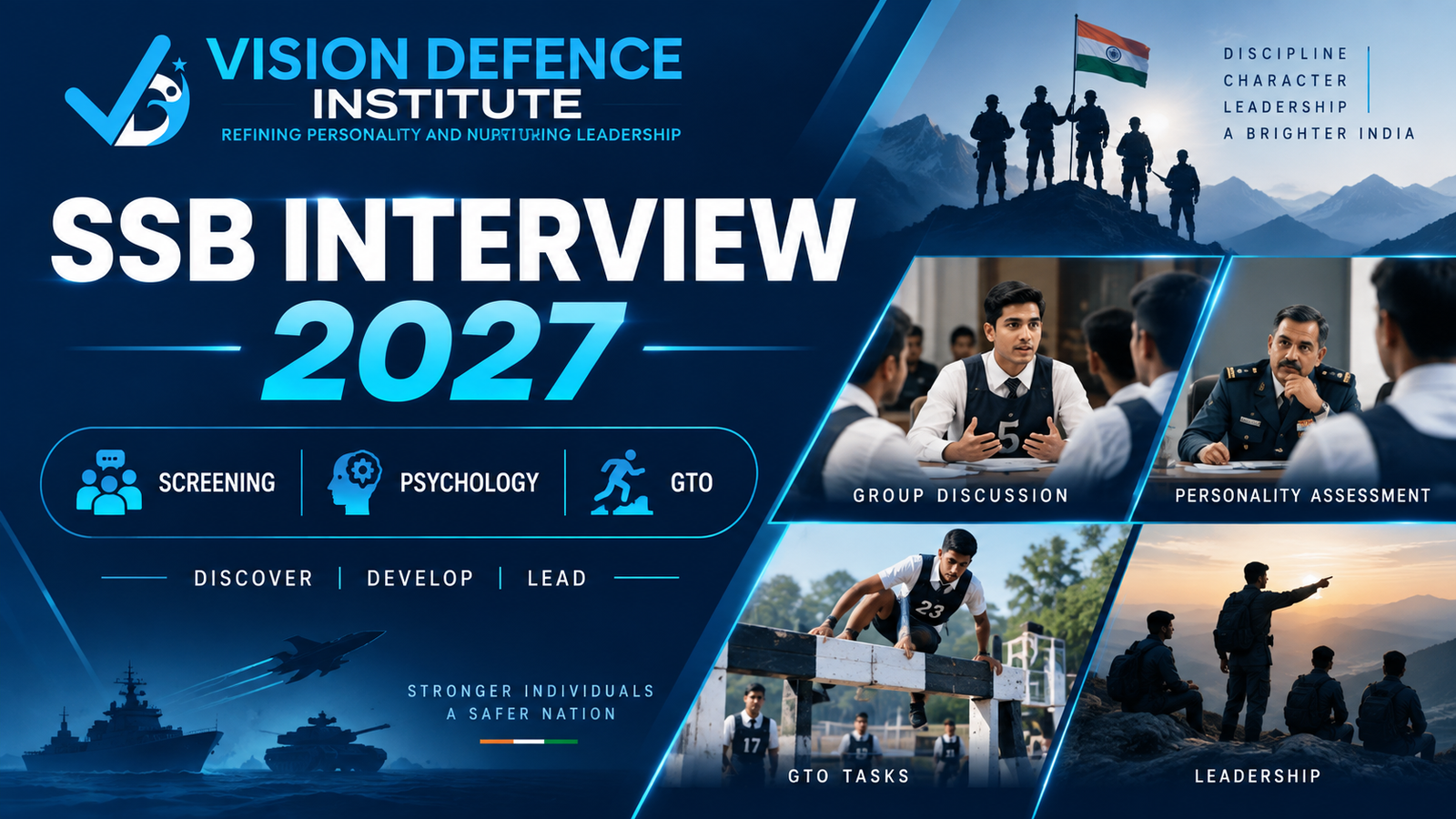
Inside the SSB Interview: 5-Day Process Explained by Defence Experts Let me tell you about a boy named Senthil from Madurai. Senthil had cleared his NDA written exam. He was smart. He was fit. He walked into the SSB center with confidence. Day 1? He was screened out within 8 hours. He never even got to Day 2. Why? Because nobody had told him what the SSB interview actually looks like from the inside. He thought it was a “normal job interview.” He wore a formal shirt, smiled a lot, and gave politically correct answers. The assessors saw through him in 15 minutes. If you are searching for “SSB interview process” or “how to clear psychology tests,” you are probably scared. And that’s okay. Fear comes from the unknown. Today, I am going to make the unknown known. At Vision Defence Institute, we have ex-defence officers who have sat on the other side of the table. They have been assessors. They have screened out thousands. And they have recommended hundreds. In this guide, I will take you inside the SSB interview—Day 1 to Day 5: What happens every single day (hour by hour) Why 70% of candidates fail on Day 1 itself Exactly how to prepare for the SSB psychological test Real GTO tasks you will face (with examples) By the end, you will never walk into an SSB center blind again. Let’s decode the monster. The Problem: Why 97% of Candidates Fail SSB Interview Let me give you a hard statistic. Every year, approximately 4.5 lakh candidates appear for various defence exams (NDA, CDS, AFCAT). Only about 15,000 reach the SSB interview. And out of those? Only around 400-500 get recommended. That is a 97% rejection rate at the SSB stage alone. Why? Not because you aren’t smart. Not because you aren’t patriotic. Because you don’t understand what the SSB is looking for. The SSB interview does NOT test: How many current affairs facts you remember How many push-ups you can do (that’s the medical) How expensive your suit is The SSB interview DOES test: Your Officer Like Qualities (OLQs) : Effective intelligence, reasoning ability, organizing ability, social adaptability, cooperation, self-confidence. Your honesty (consistency across all 5 days) Your reaction under pressure (not your prepared answers) “The SSB is the only interview in India where a village boy with no English can get recommended, and an IIT graduate can be rejected. It’s not about knowledge. It’s about character.” – Retired Colonel, VDI Faculty At Vision Defence Institute, we don’t teach you to “fake” being an officer. We help you become one. Our SSB interview coaching wing is run entirely by ex-servicemen who have conducted real SSBs. Now, let me walk you through the 5 days. Spoiler alert: Day 1 is the killer. Day 1: The Screening (The 70% Elimination Day) This is the day that eats your dreams. Timeline: 8:00 AM to 5:00 PM (approx.) What happens on Day 1 of SSB interview? Two tests. Two chances. Fail either, and you are sent home the same evening. Test 1: Officer Intelligence Rating (OIR) What it is: A series of verbal and non-verbal reasoning questions. Format: Approximately 50-60 multiple-choice questions. Time: 30-40 minutes. Difficulty: Moderate (Class 10 level reasoning). Example questions: *If 1 = 3, 2 = 6, 3 = 9, then 5 = ?* (Answer: 15) Find the odd one out: Apple, Mango, Orange, Car (Answer: Car) VDI Tip: Practice at least 100 OIR questions before you go. Speed matters. Our defence coaching in Madurai includes OIR mock drills every Saturday. Test 2: Picture Perception & Discussion Test (PPDT) This is where 70% of candidates get screened out. Step-by-step: You are shown a blurry, black-and-white picture for 30 seconds. You must write a story based on that picture in 3 minutes. You then discuss your story in a group of 10-12 candidates for 15 minutes. The biggest mistake aspirants make: Writing a violent or action-hero story. Example: Picture shows one man standing and four people sitting. Bad story: “The man is a terrorist. He will bomb the building.” → Screened out. Bad story: “The man is the boss ordering tea.” → Screened out. Good story: “The man is a project leader. He is motivating his team to finish a deadline. They discuss, agree on a plan, and succeed together.” → Selected. Why? The SSB wants to see if you see positive, constructive, leadership-oriented scenarios. Violent stories indicate an unstable mind. Passive stories indicate a follower, not a leader. VDI Hack: At Vision Defence Institute, we conduct weekly PPDT drills with actual SSB pictures. You will write, discuss, and get feedback from ex-defence officers before your real SSB. If you clear Day 1 screening: You stay for 4 more days. Congratulations. You are now in the top 30%. If you don’t: Go home. Prepare better. Come back. Many great officers cleared SSB on their 3rd or 4th attempt. Day 2: Psychology Test (The Mind Probe) Day 2 of the SSB interview is often called “The Day of Truth.” There is no right or wrong answer. But there is consistency. Three tests on Day 2: 1. Thematic Apperception Test (TAT) What it is: 12 pictures (11 ambiguous + 1 blank). You write a story for each. Time: 4 minutes per picture (3 minutes writing + 1 minute viewing) What they assess: Your thought process, values, problem-solving ability. The blank picture is the most revealing. You can write any story. What you write shows your deepest driving force. Example blank picture story: Candidate A: “Rohan is studying for UPSC. He feels lonely but keeps going. He clears it. He feels proud.” → Shows perseverance but isolation. Candidate B: “Rohan is leading a team for a college festival. There is a crisis. He gathers his team, delegates tasks, solves the problem. They celebrate together.” → Shows leadership and teamwork. (This candidate is more likely to be recommended.) 2. Word Association Test (WAT) What it is: 60 words flashed one by one (13-15 seconds per word). You write: The first thought/sentence that comes to mind. What they assess: Your spontaneous reactions, positivity vs. negativity. Examples: Word Positive Response (Good) Negative Response (Bad) Fight “Fight for justice” “Fight with friend” Failure “Failure teaches lessons” “Failure is depressing” Alone “Alone time to plan” “Feeling lonely and sad” VDI Tip: Never write violent or victim-hood responses. Always show an active, positive, solution-oriented mindset. 3. Situation Reaction Test (SRT) What it is: 60 situations. You write
NDA vs CDS vs AFCAT: Which Exam to Pick?
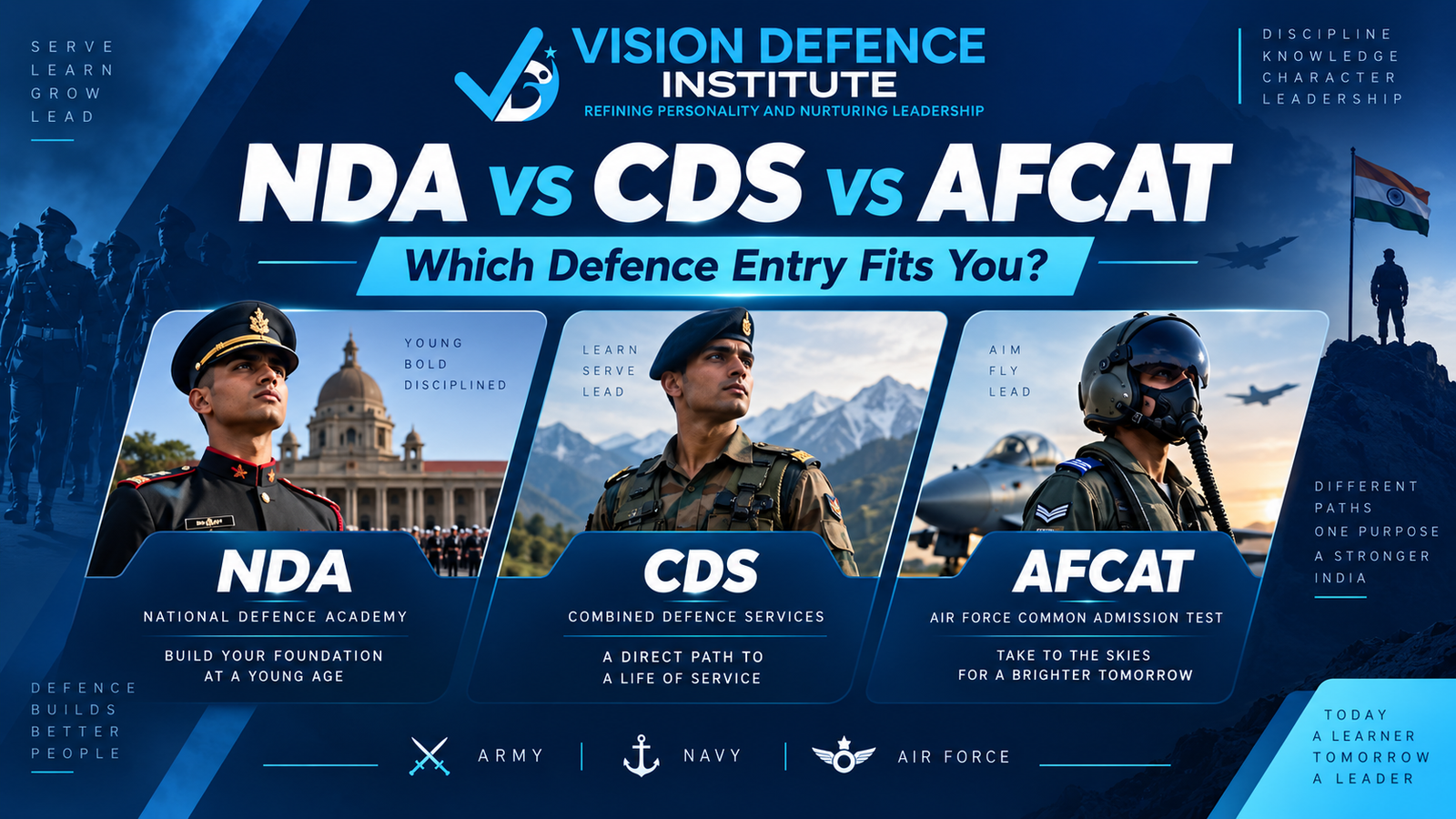
NDA vs CDS vs AFCAT: Which Defence Exam is Right for You? Let me tell you about a confused 18-year-old named Arjun. Arjun had just finished his Class 12 exams. His father wanted him to write the NDA. His uncle, an Army veteran, said, “Finish graduation first, then try CDS.” Meanwhile, his friend was preparing for AFCAT to join the Air Force. Arjun was paralyzed. He didn’t know which path to take. Sound familiar? If you are searching NDA vs CDS vs AFCAT on Google at 2 AM, you are exactly where Arjun was six months ago. The good news? He finally chose the right exam—and he’s now training at Vision Defence Institute in Madurai, preparing to crack it on his first attempt. Here’s the raw truth: There is no “best” exam. There is only the exam that fits your age, education, and personality. In this guide, I will break down NDA vs CDS vs AFCAT across every possible parameter: Eligibility (Age, education, marital status) Exam pattern (What you need to study) Training duration (How long before you wear that uniform) Career progression (Which rank you enter with) By the end, you will know exactly which exam to target. And if you’re in Madurai, you’ll know exactly where to prepare. Let’s settle this debate once and for all. The Big Picture: Why This Comparison Matters Most aspirants fail not because they aren’t smart, but because they prepare for the wrong exam. A 12th-pass student preparing for CDS? Wasted effort. You need a degree first. A graduate preparing for NDA? Too old. NDA age limit is 19.5 years. Someone who hates math preparing for AFCAT? Painful. AFCAT has a numerical ability section. At Vision Defence Institute, we see this confusion daily. That’s why we offer specialized NDA coaching Madurai, CDS coaching Madurai, and AFCAT coaching Madurai under one roof. Our ex-servicemen faculty helps you choose based on your profile, not someone else’s. Now, let’s dive deep into NDA vs CDS vs AFCAT. Round 1: Eligibility Criteria (Who Can Apply?) This is the first filter. If you don’t match these numbers, stop overthinking and move to the next option. National Defence Academy (NDA) Criterion Details Age 16.5 to 19.5 years Education Class 12 pass or appearing Marital Status Unmarried only Gender Male & now Female (Army, Navy, Air Force) VDI Note: This is the only entry for students right after school. If you are in Class 11 or 12, this is your golden window. Combined Defence Services (CDS) Criterion Details Age 19 to 24 years (varies by academy) Education Graduate (Any discipline) Marital Status Unmarried Gender Male & Female (IMA/OTA/AFA/INA) VDI Note: CDS is for graduates. You can appear in your final year of college. Air Force Common Admission Test (AFCAT) Criterion Details Age 20 to 24 years Education Graduate (60% aggregate in Maths/Physics at 10+2 level for Technical) Marital Status Unmarried Gender Male & Female (Flying & Ground Duty) Quick Verdict on NDA vs CDS vs AFCAT (Eligibility): Are you in Class 12? → NDA is your only option. Are you a graduate? → Choose between CDS and AFCAT. Do you want a flying branch? → AFCAT or CDS (Air Force Academy). Round 2: Exam Pattern & Syllabus (What to Study?) This is where most students get overwhelmed. Let me simplify NDA vs CDS vs AFCAT based on what you actually need to open a book for. NDA Exam Pattern (UPSC Conducted) Total Marks: 900 (Maths 300 + GAT 600) Duration: 2.5 hours per paper Negative Marking: Yes (0.33 marks deducted) Subjects: Maths (Class 11-12 level) GAT: English, Physics, Chemistry, Biology, History, Geography, Current Affairs VDI Hack: NDA GAT has Science weightage. Arts students need extra help here. Our defence coaching in Madurai includes bridge courses for non-science students. CDS Exam Pattern (UPSC Conducted) Total Marks: 300 (English) + 100 (GK) + 100 (Elementary Maths) Duration: 2 hours each paper Negative Marking: Yes Subjects: English (Grammar, Vocabulary, Comprehension) General Knowledge (Current Affairs + Static GK) Elementary Maths (Class 10 level) VDI Hack: CDS English is tougher than NDA. You need strong vocabulary and sentence correction skills. AFCAT Exam Pattern (Indian Air Force Conducted) Total Marks: 300 (100 questions) Duration: 2 hours Negative Marking: Yes (1 mark deducted per wrong answer) Subjects: General Awareness Verbal Ability in English Numerical Ability Reasoning & Military Aptitude Quick Verdict on NDA vs CDS vs AFCAT (Difficulty): Easiest Syllabus: AFCAT (Class 10 level math, moderate English) Toughest Competition: NDA (Over 4 lakh applicants for 400 seats) Balanced Option: CDS (Good for graduates who are weak in Science) Round 3: SSB Interview & Training (The Real Filter) Here’s a secret that 90% of articles on NDA vs CDS vs AFCAT won’t tell you: The SSB is the same for everyone. Whether you clear NDA written or CDS written, you will face the same 5-day Services Selection Board process: Screening Test (PPDT + OIR) Psychology Test (TAT, WAT, SRT, SD) GTO Tasks (Group Discussions, Lectures, Obstacles) Personal Interview Conference The Difference? The benchmark changes. NDA Entry: You are 17-18 years old. The SSB looks for raw potential, not polished leadership. CDS Entry: You are 21-23 years old. The SSB expects maturity, experience, and decision-making. AFCAT Entry: Air Force SSB is more technical. They test your coordination, quick thinking, and flying aptitude (CPSS test). VDI Suggestion: At Vision Defence Institute, we have a dedicated SSB interview coaching wing with an in-house GTO ground. Whether you are preparing for NDA, CDS, or AFCAT, you will practice the same obstacles, the same group discussions, and the same psychology tests with our ex-defence officers. Round 4: Career Progression (Where Will You Be in 10 Years?) Let’s talk about the long game. NDA vs CDS vs AFCAT decisions affect your entire service life. Parameter NDA Entry CDS Entry (IMA/OTA) AFCAT Entry Training Duration 3 years (Academy) + 1 year (Pre-commission) 1.5 years (IMA) / 1 year (OTA) 74 weeks (AFA) Entry Rank Lieutenant (No seniority benefits) Lieutenant Flying Officer Pension Same for all Same for all Same for all Promotion Speed Same as CDS after commission Same as NDA Same as NDA Retirement Benefits Identical Identical Identical The Truth: Once you are commissioned, your entry mode does not affect promotions. A CDS officer and an NDA officer of the same batch get promoted together. So why choose NDA then? Because you start living the army life 3 years earlier. You get more service years, a better alumni network, and early leadership exposure. Round 5: Coaching & Preparation (Where to Go?) Now,
How to Crack NDA Exam First Try
How to Crack NDA Exam in First Attempt: Complete Strategy for 2026 Aspirants Do you want to know how to crack NDA exam in your very first shot? I want to tell you a short story. Meet Karthik, a 17-year-old from Madurai. He wasn’t a genius. He wasn’t a topper. But six months ago, he got his recommendation letter for the National Defence Academy (NDA). How? He didn’t just “study hard.” He stopped making the mistakes that 90% of aspirants make. Most students treat the NDA like a school exam. They memorize formulas, read GK facts, and hope for the best. Then they wonder why they fail the SSB interview or why their score is stuck below the cutoff. If you want to know how to crack NDA exam 2026 without wasting years on attempts, you need a system, not just hard work. You need strategy, discipline, and the right guidance. At Vision Defence Institute, we don’t just teach you the syllabus. We transform civilians into officer material. In this complete guide, I’m going to give you the exact blueprint to crack NDA in first attempt, covering: The 6-month study roadmap Subject-specific hacks for Maths and GAT How to start SSB prep before the written exam Why physical training matters (and most ignore it) Let’s get started. Serving the nation starts with serving your ambition. The Harsh Reality: Why Most Aspirants Fail NDA Before we talk about solutions, let’s diagnose the problem. You cannot learn how to crack NDA exam if you keep falling into these traps. Mistake #1: Ignoring the GAT (General Ability Test). Students spend 80% of their time on Maths because they fear it, but GAT is worth 600 marks—double the weight of Maths. Mistake #2: Studying for the written exam only. The SSB interview eliminates more candidates than the written paper. Yet, most start SSB prep after the results. Mistake #3: No physical fitness. If you cannot run 2.4 km in under 10 minutes, the Indian Armed Forces doesn’t want you. Period. Mistake #4: Isolation. Studying in your room with distractions (phone, TV, family) kills your discipline. Karthik, the student from Madurai, used to make these mistakes. Then he joined Vision Defence Institute, one of the best defence coaching in Madurai, and everything changed. He got structure, mentorship, and a peer group that pushed him. Now, let’s look at the blueprint that works. Timeline to Glory: The 6-Month Study Plan for NDA 2026 Assuming you are starting today (or within the next month), here is the month-by-month breakdown of how to crack NDA exam 2026 . Month 1-2: The Foundation (NCERT is King) Don’t buy expensive reference books yet. Your best friends are your NCERT textbooks (Class 10 to 12). Maths: Solve every example and exercise of Class 11 and 12 NCERT. GAT (Science): Stick to Class 10 NCERT for Physics, Chem, and Bio. English: Start reading The Hindu newspaper daily . Pro Tip from VDI: Arts and Commerce students often struggle with Maths. Join a structured NDA coaching Madurai batch to bridge this gap quickly. Month 3-4: The Practice (MCQs & PYQs) Now you shift from learning to applying. Maths: Move to MCQ books. Start solving Previous Year Questions (PYQs). GAT: This is where History, Geography, and Polity come in. Use Spectrum for History and Lucent for GK. Daily Routine: Wake up at 5:30 AM for PT. “A healthy mind needs a healthy body”—the SSB looks for stamina . Month 5: The Simulation (Mock Tests) Take a full-length mock test every Sunday. Analyze every wrong answer. Did you make a silly mistake? Or don’t you know the concept? VDI Advantage: At our SSB interview coaching, we integrate psychological tests into these mocks . Month 6: The Final Sprint (Revision) No new topics. Only revision. Solve at least 10 previous year papers. Focus on time management. “The difference between a good score and a great score isn’t knowledge—it’s speed.” – Faculty, Vision Defence Institute. The Academic Blueprint: Subject-Wise Strategy Here is the proven formula to crack NDA in first attempt regarding the written syllabus. How to Approach NDA Maths (300 Marks) Maths is a scoring opportunity, but it requires daily practice. Strategy: Prioritize Topics: Calculus, Algebra, Matrices, and Trigonometry carry the highest weight. The VDI Iterative Cycle: Do not just read. Follow this loop: NCERT → MCQ Book → PYQs . Speed: You have roughly 2 minutes per question. If you don’t solve a problem in 60 seconds, skip it. How to Approach General Ability Test (600 Marks – GAT) GAT is divided into two parts: English and General Knowledge. English (200 Marks): The Reading Hack: Instead of memorizing 100 grammar rules, read novels and newspapers. This subconsciously improves sentence correction and comprehension . Vocabulary: Maintain a notebook. Write down 5 new words daily. General Knowledge (400 Marks): Physics & Chemistry: 90% of questions are from Class 10 level NCERT. Current Affairs: Focus on defense news, new appointments, missile tests, and exercises. (e.g., “Exercise Milan”). History: Focus on the Freedom Struggle and Modern India. VDI Tip: Our UPSC coaching Madurai module overlaps heavily with the NDA GK syllabus. You get the benefit of UPSC-level faculty for your NDA prep. The Game Changer: Cracking the SSB Interview Before the Written Here is the secret that 99% of “How to crack NDA exam” guides won’t tell you: The SSB starts Day 1 of your prep. The SSB (Services Selection Board) doesn’t just test your knowledge. It tests your Officer Like Qualities (OLQs) : Effective Intelligence, Reasoning, Social Adaptability, and Cooperation . How to prepare for SSB while studying for the written: Watch the news analytically. Don’t just read the headline. Think: “If I were the GTO (Group Testing Officer), what would I ask about this current event?” Start Group Discussions (GDs) now. Gather 4-5 friends. Take a random topic. Speak for 1 minute. The Picture Perception Test (PPDT): Look at a random image online. Write a story in 3 minutes. Check if your story is “Mature” or “Childish.” At Vision Defence Institute (VDI), we have a dedicated SSB interview coaching wing run by Ex-Defence Officers. We have an in-house GTO ground—the only best defence academy in Tamil Nadu with a 400m track and obstacle course . You cannot “read” about leadership. You must practice it on the ground. Why Madurai is the New Hub for Defence Coaching Most parents think they need to send