Tamil-Medium Defence Coaching for NDA/CDS | VDI Madurai
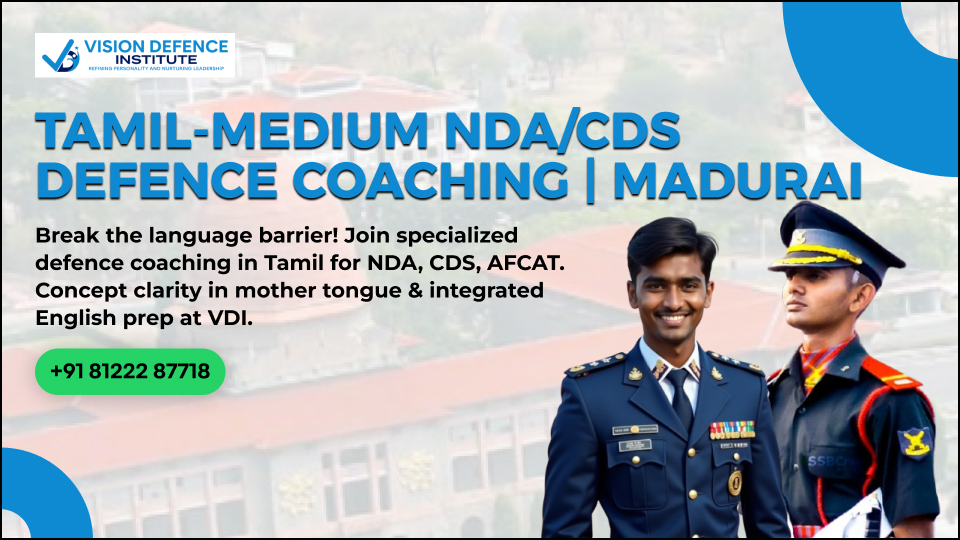
Breaking the Language Barrier: How Tamil-Medium Coaching at Vision Defence Paves the Path to the Armed Forces Have you ever had a brilliant idea, a deep understanding of a concept, but struggled to express it in a language that isn’t your own? For thousands of talented students across Tamil Nadu who have been educated in Tamil medium schools, this isn’t just a hypothetical—it’s the daily reality when they try to prepare for national-level defence exams like the NDA, CDS, and AFCAT. These exams, conducted in English, become not just a test of intelligence and aptitude, but an additional, exhausting test of language proficiency. The problem isn’t a lack of potential; it’s a formidable language barrier that forces students to fight on two fronts: mastering complex concepts and translating their understanding into a second language. I remember a student, Saravanan from a small town near Madurai, who scored 95% in his Class 12 state board exams but was struggling with basic grammar in his NDA English preparation. “I understand the Physics principle in Tamil,” he said with frustration, “but when the question is in English, I spend half my time decoding the sentence, not solving the problem.” His story is heartbreakingly common. Students like him are often advised to simply “improve their English,” which is like telling a soldier to learn a new weapon while already in battle. This approach overlooks their inherent analytical strength and puts them at a severe, unfair disadvantage. This is why Vision Defence Institute (VDI) took a revolutionary step: offering specialised, high-quality defence coaching in Tamil. Our mission is simple: to remove the language barrier as an obstacle so that talented, patriotic students from Tamil medium backgrounds can compete on a level playing field. Their intellect, not their English vocabulary, should determine their success in serving the nation. This article explores how our Tamil-medium coaching program is breaking down walls and building confident future officers. The “Two-Front War”: Why Tamil-Medium Students Need Specialised Coaching The challenge for a Tamil medium student preparing for defence exams is unique and multifaceted: The Conceptual Hurdle: Advanced topics in Mathematics (Calculus, Trigonometry), Physics (Optics, Mechanics), and General Science are difficult enough in one’s mother tongue. Learning them for the first time in English creates a cognitive overload, where the focus shifts from understanding the concept to deciphering the English terminology. The Exam-Day Disadvantage: In a time-bound, high-pressure exam, every second counts. A student who has to mentally translate questions from English to Tamil, solve them, and then translate the answer back is operating at a significant speed disadvantage. The SSB Interview Anxiety: The SSB interview is an interactive, spontaneous process. Even if a candidate clears the written exam, expressing nuanced thoughts, showcasing leadership qualities, and debating current affairs in English under extreme pressure can be overwhelmingly stressful, masking their true potential. The Vision Defence Solution: Our Tamil-Medium Coaching Framework Our Tamil-medium defence coaching program is not a translated version of our English course. It is a thoughtfully designed educational model built from the ground up to leverage the student’s strength—their cognitive ability in Tamil. 1. Concept Clarity in the Mother Tongue: Building a Rock-Solid Foundation This is the cornerstone of our program. We teach the entire NDA, CDS, and AFCAT syllabus—from Quadratic Equations to Newton’s Laws, from Indian History to the Indian Constitution—in clear, academic Tamil. How it works: Our bilingual faculty, experts in both the subject and language, explain complex theories in Tamil first, ensuring deep concept clarity. Once the concept is firmly grasped, we introduce the standard English terminology and definitions. The Result: Students build a strong, intuitive understanding. They learn that “கோண அளவீடு” is “Trigonometry,” and “விசையியல்” is “Mechanics.” This method builds confidence from the very first class. 2. Bridging the Gap: Parallel Language Development While concepts are taught in Tamil, we run a powerful, integrated English language development program. Focus on Functional Exam English: We don’t teach literature; we teach the specific English needed for the exam: comprehension skills, grammar for error spotting, and the military/technical vocabulary that frequently appears. Contextual Learning: New English words are taught in the context of the subject matter, making retention easier and more practical. 3. Bilingual Study Material: Your Dual-Language Toolkit We provide uniquely crafted study material that supports this learning model: Tamil Explanatory Texts: Core theory and solved examples are presented in Tamil for clarity. Bilingual Practice Questions: Practice sets and previous years’ papers are presented with questions in both English and Tamil, allowing students to verify their understanding. Glossaries & Term Lists: Comprehensive lists of key English terms with their Tamil equivalents for every subject. The VDI Advantage: More Than Just Language Translation Choosing defence coaching in Tamil at VDI means accessing a complete ecosystem designed for your success. Expert Faculty Who Understand the Struggle: Our Tamil-medium faculty aren’t just translators; they are passionate educators who have either come from similar backgrounds or have dedicated their careers to bridging this gap. They teach with empathy and a proven methodology. Holistic SSB Interview Preparation in a Supportive Environment: We conduct group discussions and lecturettes in both English and Tamil initially, allowing students to develop their ideas and confidence in their mother tongue before transitioning to English. Our mock personal interview sessions are conducted with patience, focusing on helping candidates articulate their thoughts clearly. A Community of Peers: Students find themselves in a classroom with others who share similar backgrounds and aspirations. This creates a powerful, supportive community where they motivate each other, eliminating the isolation they might feel in a purely English-medium environment. Who Should Join Our Tamil-Medium Defence Coaching Program? This program is ideal for: State Board (Tamil Medium) Toppers who aspire for the NDA or CDS but feel held back by English. Students from Rural and Semi-Urban Tamil Nadu with limited exposure to English-medium education. Repeat aspirants who have cleared written exams but face a barrier at the SSB interview stage due to language anxiety. Any student who believes they can perform exponentially better if they could first learn in the language they think in. Success Stories: From Tamil Classroom to National Academy Our greatest validation comes from our students. We have guided numerous Tamil medium students who, after building their foundation with us, have gone on to: Clear the NDA written exam with high scores, as their conceptual doubts were
SSB Coaching by Ex-Defence Officers | VDI Madurai
The Unbeatable Edge: Why SSB Coaching by Ex-Defence Officers Changes Everything Let’s be honest. You can buy the best books, memorize the entire syllabus, and watch a hundred YouTube videos on the SSB interview. You might even join a generic coaching class. But there’s one question that haunts every serious defence aspirant: “Will I ever truly understand what goes on inside the mind of an SSB assessor?” This gap in understanding is the single biggest reason why brilliant candidates fail to get recommended. They prepare for what they think the SSB is, not for what it actually is—a sophisticated, scientific personality assessment designed by psychologists and executed by seasoned military officers. A student, let’s call him Arun, came to us after his third “Not Recommended.” He was demoralised and confused. “I did everything the books said,” he told us. “I initiated group discussions, I wrote positive stories in the psychology tests, I spoke confidently. What more do they want?” When our faculty—comprising ex-defence officers who have served on selection boards—spoke with him for 30 minutes, the problem became crystal clear. “You were performing a checklist,” one of our mentors explained. “Your actions looked right, but your motivation was transparently tactical, not authentic. The board doesn’t select actors; they select leaders.” Arun’s story is a classic case of preparing with theory, not insight. This is the core of the VDI advantage. Our SSB coaching isn’t delivered by generic trainers; it’s guided by a faculty of ex-defence officers, psychologists, and GTOs who have been on the other side of the table. They don’t just teach you about the SSB; they decode its very DNA, giving you an insider’s perspective that is simply unavailable anywhere else. The Chasm Between Theory and Reality in SSB Prep Most coaching institutes operate in the realm of theory. They teach you: “Write a story with a positive ending for TAT.” “Take initiative in the Group Discussion.” “Be confident in the interview.” This is basic, generic advice. The real SSB exists in the realm of nuance and authenticity, which only those who have lived it can teach: “What is the subtle difference between ‘initiative’ and ‘domination’ that a GTO observes in the first 30 seconds of a task?” “How does the Psychologist spot inconsistency between your written WAT response and your body language during the personal interview?” “What specific phrasing in your interview answer about ‘motivation for the Army’ sounds genuine versus rehearsed?” This depth of understanding transforms preparation from a guessing game into a strategic mission. The Pillars of the VDI Advantage in SSB Coaching Our strength lies in the lived experience and continued ethos of our core faculty. Here’s how this translates into an unbeatable training environment. 1. Faculty with Real SSB Experience: The Insider’s Lens This is our foundational pillar. Our mentors include: Former SSB Interviewing Officers (IOs) who have conducted hundreds of personal interviews and know exactly how questions are framed to probe your character. Ex-Group Testing Officers (GTOs) who have designed and observed countless group tasks. They understand the subtext of every command, every obstacle, and every group dynamic. Retired Defence Psychologists who have evaluated the TAT, WAT, and SRT booklets of real candidates and can teach you the art of projecting, not fabricating, your personality. Serving/Retired Officers from the Army, Navy, and Air Force who provide branch-specific insights and realities of service life, making your motivation authentic and informed. 2. Personalized Mentorship Rooted in Military Ethos At VDI, mentorship isn’t a monthly meeting; it’s a continuous process. Our ex-defence officers don’t just teach a class and leave. They embody the mentorship model of the armed forces. They See What Others Miss: A seasoned GTO can watch a 10-minute group planning exercise and pinpoint exactly which candidate took charge constructively versus who just shouted orders. This feedback is gold. They Build Authenticity: They help you dig into your own life experiences to find genuine examples of leadership, courage, and teamwork, rather than feeding you clichéd stories. They Provide Unfiltered Reality Checks: They will tell you, with brutal honesty born of concern, if your personality projection is inconsistent or if your officer-like qualities need more ground-level development. 3. Training That Mirrors Reality: Beyond Mock Tests Anyone can conduct a mock interview. We recreate the authentic SSB environment. Realistic GTO Ground: Our outdoor tasks are supervised by ex-GTOs who observe, not just for completion, but for the unspoken leadership and teamwork that emerges under stress. Psychology Test Analysis with a Psychologist’s Eye: Your practice TAT and WAT are not just checked for “positive words”; they are analysed for narrative consistency, underlying values, and the projection of the 15 Officer Like Qualities (OLQs). Interview Simulation with Former IOs: Your mock personal interview is conducted by an ex-Interviewing Officer. They will ask the probing, follow-up questions you will actually face, helping you build depth and clarity in your responses. The Tangible Impact: How This Advantage Translates to Your Success What does this mean for you, the aspirant? The difference is profound and practical. You Learn the “Why,” Not Just the “What”: Instead of memorizing that you should “be a leader,” you learn how leadership is demonstrated differently in a Group Discussion versus a Command Task versus a Personal Interview, as per the military’s definition. You Develop a Coherent Personality Narrative: Our experts ensure your performance is consistent across all three assessors (Psychologist, GTO, IO). Inconsistency is the fastest route to being not recommended. You Gain Unshakeable Confidence: Walking into the SSB centre knowing that your preparation was guided by those who have actually recommended candidates eliminates a huge layer of anxiety. You are not walking into the unknown. You Receive Tailored, Not Generic, Feedback: Your feedback will be specific: “In the PGT, when you suggested using the rope, your idea was good, but you didn’t ensure the team understood it. A leader ensures comprehension.” Beyond the 5 Days: Instilling a Lasting Officer-Like Mindset The ultimate goal of SSB coaching by ex-defence officers is not just to get you recommended for 5 days, but to instil a mindset that will carry you through the academies and your career. Ethos and Values: You absorb the core values of integrity, duty, and camaraderie by being around those who have lived them. Real-World Context: Your understanding of current
Best Residential Defence Coaching for NDA in Tamil Nadu
The Transformational Power of Our Residential Defence Coaching Program Imagine you’re a student in Madurai, or perhaps from a smaller town in Tamil Nadu. You have the talent and the drive to join the National Defence Academy (NDA). You study diligently for a few hours each day. But between school, family distractions, social media, and the lack of a competitive peer group, your preparation feels scattered. You’re trying to build a warrior’s discipline in an environment filled with civilian distractions. This is the silent struggle of thousands of defence aspirants—fighting not just the vast syllabus, but also their own inconsistent routines and isolation. Now, picture a different scene. You wake up at 5:30 AM to the sound of a wake-up call, not your phone’s social media notifications. Your day is a structured blend of academic classes, physical training, group discussions, and supervised study—all alongside peers who share your singular goal. Your mentors are available round the clock. This isn’t a fantasy; it’s the daily reality within our residential defence coaching program. This controlled, immersive environment isn’t a luxury; for many, it’s the decisive factor that transforms potential into a successful NDA recommendation. Let’s talk about Rohan, who joined us from a town near Trichy. At home, despite his best intentions, his study hours were erratic, and he had no one to discuss complex physics problems or current affairs with. Within two months of joining our residential program, his focus sharpened, his physical stamina improved, and he found his “battle buddies”—a group of friends who pushed each other to excel. Rohan’s story illustrates a simple truth: you cannot prepare for a military life in a civilian environment. Our residential program is designed to bridge that gap, creating a microcosm of the disciplined, focused world you aspire to join. The Core Philosophy: Building More Than Just Academic Proficiency The goal of our residential defence coaching is holistic transformation. We aim to cultivate the complete Officer Like Qualities (OLQs) that the SSB interview seeks: leadership, discipline, effective intelligence, and unshakable physical and mental stamina. A typical day is engineered to build these qualities layer by layer. A Day in the Life: Discipline by Design Here’s what a structured day looks like for our residential cadets: Time Activity Skills & Qualities Cultivated 5:30 AM Wake-up & Morning PT/Drills Discipline, Physical Stamina, Team Spirit 7:00 AM Breakfast & Personal Time Time Management, Personal Hygiene 8:30 AM – 1:30 PM Core Academic Sessions (Maths, English, GK, Science) Conceptual Clarity, Focus, Academic Excellence 1:30 PM – 2:30 PM Lunch & Rest Nutrition, Scheduled Downtime 2:30 PM – 4:30 PM Specialized Classes (Current Affairs, Reasoning, Doubt Sessions) Awareness, Analytical Thinking, Clarification 4:30 PM – 6:00 PM Sports / Outdoor Activities Teamwork, Leadership, Stress Relief, Fitness 6:00 PM – 8:00 PM Supervised Self-Study / Library Time Self-Discipline, Revision, Goal-Oriented Work 8:00 PM – 9:00 PM Dinner & Informal Interaction Social Adaptability, Peer Learning 9:00 PM – 10:30 PM Group Activities (GD, Lecturette Practice) Communication, Confidence, Critical Thinking 10:30 PM Lights Out Discipline, Adequate Rest for Optimal Performance This regimented schedule does more than just fill hours; it instills military-grade time discipline, ensuring every aspect of preparation—academic, physical, and psychological—receives dedicated attention. The Pillars of Our Residential Program’s Success 1. The 24/7 Conducive Environment: Eliminating Distractions The residential campus is a controlled ecosystem designed for success. Academic Focus: The hostel facility and classrooms are designed for study. With a dedicated library and study halls, the environment constantly nudges you towards your books. Digital Discipline: We implement sensible restrictions on mobile phone and internet usage during study and sleep hours, helping cadets break free from the biggest source of distraction. Positive Peer Pressure: Living with like-minded, high-aspiring peers creates a powerful culture of hard work. You’re not the “weird one” studying on a Saturday; you’re part of a team striving for a common goal. 2. Unmatched 24/7 Mentorship and Guidance This is arguably the most valuable feature. Unlike day scholars who have access to teachers only during class, our residential cadets benefit from round-the-clock mentorship. Academic Doubt Resolution: Stuck on a calculus problem at 8 PM? A faculty member is available in the academic block for doubt-clearing sessions. Personal Counselling: The pressures of preparation are real. Our mentors, many of whom are ex-servicemen or seasoned educators, provide constant emotional and motivational support, helping cadets navigate stress and maintain a positive mindset. SSB Preparation Integration: SSB interview coaching isn’t a separate module; it’s woven into daily life. Mentors observe cadets during group activities, meals, and sports, providing informal feedback on their leadership and communication skills in real-time. 3. Holistic Development Beyond the Books We prepare the complete individual, not just a test-taker. Structured Physical Training (PT): Daily PT and sports are mandatory. We build the physical fitness required not just to pass the SSB medicals, but to thrive in the gruelling NDA training ahead. Personality Development Sessions: Regular group discussions, debates, and lecturette practices are conducted in the evenings. This constant practice eradicates the fear of public speaking and sharpens articulation. Community Living: Sharing a room, adhering to mess timings, and maintaining cleanliness teach responsibility, cooperation, and social adaptability—key OLQs assessed at the SSB. Who is the Ideal Candidate for Residential Defence Coaching? This program is a powerful tool, but it’s not for everyone. It is ideally suited for: Aspirants from Towns/Villages with limited access to quality offline coaching infrastructure and peer groups. Students who struggle with self-discipline and need an external structure to maximize their potential. Those preparing for their first attempt and wanting to build a rock-solid foundation in a compressed timeframe. Candidates who have faced SSB setbacks and need an immersive environment to rebuild their personality projection and strategy. Addressing Common Concerns “Will my child be isolated from family?” We encourage healthy communication and scheduled family calls. The focus is on minimizing distracting influences, not family bonds. Periodic visiting days are also planned. “Is it only for NDA?” While we are a premier NDA coaching institute, our residential program is equally beneficial for aspirants of CDS, AFCAT, and SSB interviews, as the core development of discipline and OLQs is universal. “How do we ensure safety and well-being?” The campus has 24/7 security, a dedicated warden, and tie-ups with nearby medical facilities. The health and
Best Defence Academy in Tamil Nadu | VDI Madurai
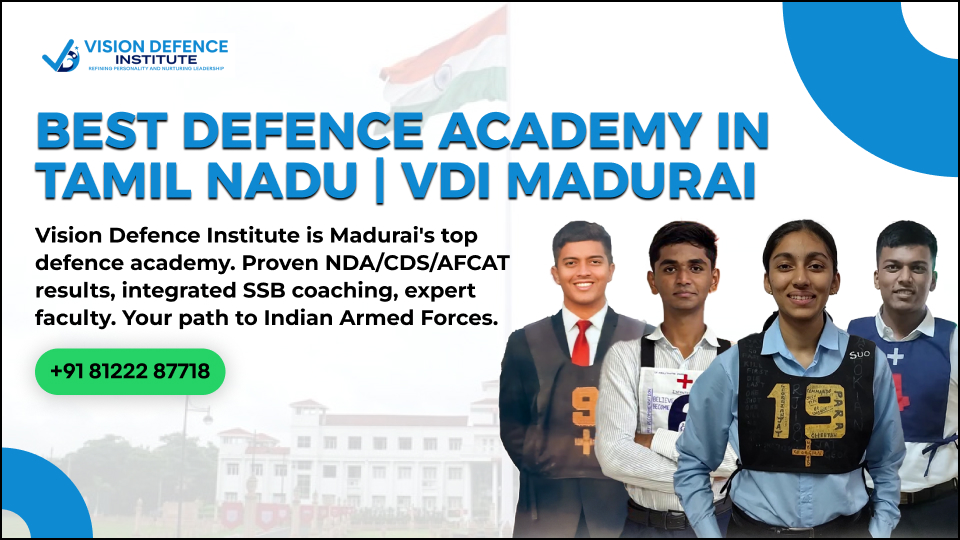
Why Vision Defence Institute is the Premier Choice for Defence Aspirants in Tamil Nadu Let’s be honest. When you decide to pursue a career in the Indian Armed Forces, you’re not just choosing a career; you’re embarking on a life-altering mission. The path is paved with intense competition, vast syllabi for exams like NDA, CDS, and AFCAT, and the daunting challenge of the SSB interview. In Madurai and across Tamil Nadu, countless young dreamers stand at this crossroads, asking a critical question: “Which coaching institute can truly guide me to success?” The wrong choice can mean wasted time, misdirected effort, and a fading dream. The right choice becomes your strategic partner in this campaign. I recall a conversation with the parent of an aspirant from Trichy. They had sent their son to a large, generic coaching chain in Chennai. “He was studying 10 hours a day but his mock test scores weren’t improving,” they shared. “The coaching was treating the NDA like any other competitive exam. There was no focus on building his personality or SSB skills.” This is the core flaw of many institutes—they prepare you for a written test, not for the holistic transformation into an officer. This gap between academic coaching and military readiness is precisely where Vision Defence Institute (VDI) in Madurai has carved its reputation as the best defence academy in Tamil Nadu. Our philosophy is simple: We don’t just train students to clear exams; we mentor future officers. This article will walk you through the distinct pillars that make VDI not just another coaching centre, but the proven launchpad for defence aspirants across South India. Pillar 1: A Legacy of Tangible Results – Our Success Stories Speak In the world of defence coaching, results are the only currency that matters. At VDI, our legacy is written by our cadets. We don’t just claim to be the top NDA institute; our achievers demonstrate it. All India Rank 17 in NDA/NA: Our cadet, S. Sabari, secured this elite national rank, a testament to the academic excellence and strategic preparation ingrained at VDI. His journey from a focused student in Tamil Nadu to an NDA topper is a blueprint we replicate. Consistent Recommendations from SSB/AFSB: Our walls are adorned with the faces of cadets who have earned the coveted “Recommended” stamp from SSB and AFSB boards across the country. We have a proven track record of guiding students through the intricate 5-day selection process. Pan-India Reach from a Madurai Base: While we are proudly based in Madurai, our cadets come from every corner of Tamil Nadu—from Chennai and Coimbatore to smaller towns like Dindigul and Ramanathapuram—and even from other states, drawn by our reputation as the best defence academy in Tamil Nadu. These are not just numbers; they are individual stories of transformation, each one affirming our methodology. Pillar 2: The VDI Methodology – Holistic Preparation, Inside and Out Anyone can teach from a syllabus. At VDI, we engineer success through a dual-track, holistic methodology that most generic coaching centres overlook. Track 1: Academic Mastery (The Written Exam Conquest) Our academic program is built on precision and depth. Expert Faculty: Our teachers are not just subject experts; they are specialists in the UPSC pattern for NDA, CDS, and AFCAT. They know the exact weightage, recurring themes, and trick areas. Structured, Evolving Curriculum: We don’t use static material. Our study plans are updated before every exam cycle to reflect syllabus changes, like the latest AFCAT 2024 pattern. We provide NDA preparation that is current and comprehensive. Rigorous Testing & Analysis: We believe “practice” is incomplete without “analysis.” Our relentless schedule of topic-wise tests, full-length mock exams, and SSB interview simulation tests is followed by detailed performance analytics. We identify not just what you got wrong, but why. Track 2: Personality Transformation (The SSB Interview Forge) This is where VDI separates itself as the best institute for SSB interview in Madurai. We understand that clearing the written exam is only 50% of the battle. Integrated SSB Training From Day One: While other institutes treat SSB as a post-exam crash course, we integrate it into daily training. From the first week, cadets practice Psychology Tests (TAT, WAT, SRT), Group Discussions (GD), Lecturettes, and participate in mock Personal Interview sessions. Live GTO Ground: We possess a dedicated, professional GTO Ground where cadets experience the exact outdoor and indoor tasks—Group Planning Exercise (GPE), Progressive Group Task (PGT), Command Task—under the observation of trained psychologists and GTOs. This realistic simulation is a game-changer. Building Officer-Like Qualities (OLQs): Our environment is designed to cultivate leadership, initiative, and communication—the core OLQs. We mentor cadets to be authentic leaders, not just candidates performing a role. Pillar 3: Beyond the Classroom – The VDI Ecosystem Choosing VDI means joining an ecosystem designed for success. Personalized Mentorship: Every cadet is assigned a mentor who tracks their academic and psychological progress, offering guidance and course correction. We believe in individual attention. Physical Training & Wellness: We incorporate structured physical fitness training, knowing that a fit body houses a resilient mind, crucial for both the SSB and a military career. Comprehensive Current Affairs Program: Our daily and weekly current affairs modules, with a special focus on defence news, ensure our cadets walk into exams and interviews with superior awareness. Parental Partnership: We keep parents informed and involved, creating a supportive home environment that understands the unique pressures of defence exam preparation. Pillar 4: Answering Your Practical Questions We understand you have practical concerns. Let’s address them clearly. “What about fees and batches?” We offer transparent fee structures for our various programs (NDA, CDS, AFCAT integrated courses). We run multiple batches to accommodate school/college schedules and offer free demo classes so you can experience our teaching firsthand before committing. “Do you offer online coaching?” Yes. For students who cannot relocate to Madurai, we offer a robust online coaching for CDS and NDA platform with live interactive classes, recorded lectures, digital study material, and online test series, bringing the VDI quality to your home. “How do I start?” The journey begins with a counseling session. Visit our campus at 2ND STOP, S ALANGULAM, Kulamangalam Main Rd, Madurai, or call us at +91 81222 87718 to speak with our counselors. We assess your profile, discuss your goals, and chart out the best course for you. Your Call to Action: From Aspiration to Achievement The journey to the Indian Armed
10 VDI Success Stories: Cadets Who Cracked NDA & SSB
From Dream to Reality: 10 Inspiring Defence Academy Success Stories Have you ever looked at the crisp uniform of an NDA cadet or a newly commissioned officer and wondered, “Could that ever be me?” That question is often followed by a wave of doubt. “The competition is insane.” “What if I’m not good enough?” “Can someone from a regular background in Madurai or a small town in Tamil Nadu really make it?” This gap between dream and doubt is where many defence aspirations fade away. But what if you could see, in clear detail, the journeys of ten young men and women who stood exactly where you stand today, harboured the same fears, and yet, through grit and the right guidance, turned their ‘what if’ into a definitive ‘I did.’ We are not just another defence coaching in Madurai. We are a launchpad where dreams are engineered into reality. The stories of our cadets are our most valuable testimony—real, relatable, and packed with actionable lessons. This article is a collection of ten such inspiring defence academy success stories. These are not just names on a board; they are narratives of struggle, strategy, and ultimate triumph in cracking the NDA and SSB. Their journeys prove that with the right defence academy success stories as your roadmap, your name can be next. 1. S. Sabari: The Scholar-Warrior Who Secured AIR 17 in NDA/NA Background: A focused Class 12 student from a humble background in Tamil Nadu. The Challenge: Mastering the vast NDA syllabus while maintaining stellar board exam performance. The pressure was immense. The VDI Strategy: Sabari enrolled in our integrated NDA coaching program early. His discipline was legendary. He followed a dual-track study plan that balanced school academics and NDA prep seamlessly, a core philosophy at our institute. The Breakthrough: He didn’t just clear the exam; he dominated it, achieving an All India Rank 17 in NDA/NA. His story is a masterclass in time management and foundational strength. His Message: “Don’t see board exams and NDA as separate battles. A strong foundation in NCERT for school is your strongest weapon for the NDA’s GAT section. Discipline is the bridge between goals and accomplishment.” 2. Captain R. Karthik (Army): The “Third-Time’s-The-Charm” Story Background: A determined graduate who faced two consecutive SSB recommendations but not a final call. The Challenge: The psychological blow of coming so close yet missing out. The risk of diminishing confidence. The VDI Strategy: Instead of repeating the same prep, Karthik joined our intensive SSB interview coaching program. We worked on a deep personality analysis, identified inconsistencies in his officer-like projection, and put him through relentless mock SSB series. The Breakthrough: In his third attempt, he walked into the SSB with polished authenticity, not a rehearsed act. He was recommended from the first board he attended post-coaching and is now a serving Captain. His Message: “Every ‘Not Recommended’ is feedback, not failure. My SSB recommendation came when I stopped trying to guess what they wanted and started being the best version of my true self.” 3. Flying Officer Priya R. (IAF): Shattering Stereotypes Background: A bright B.Tech graduate who dreamt of the skies but was surrounded by voices saying technical branches were “easier” for women. The Challenge: Preparing for the fiercely competitive AFCAT Flying Branch, which demands exceptional aptitude alongside written excellence. The VDI Strategy: Priya joined our AFCAT coaching program with a special focus on the Computerised Pilot Selection System (CPSS) and AFSB preparation. We provided technical aptitude training, aviation psychology sessions, and physical training to meet the rigorous standards. The Breakthrough: She aced the AFCAT, impressed the AFSB board with her technical clarity and calm demeanor, and earned her wings. Her story is a beacon for young women across India. Her Message: “Your gender does not define your capability. The sky is not the limit; it’s the destination. Prepare holistically—mind, body, and knowledge must all be in formation.” 4. Sub Lieutenant Arjun M. (Navy): From Coastal Town to Warship Background: Hailing from a coastal village in Tamil Nadu, Arjun’s dream was fueled by the sea but limited by a lack of metropolitan coaching resources. The Challenge: Access to structured preparation and understanding the specific requirements of the Indian Navy entry. The VDI Strategy: He utilized our comprehensive online coaching for defence exams, which gave him access to top-tier Navy-specific faculty and study material right in his hometown. Regular online doubt sessions and live current affairs classes kept him on par with city-based aspirants. The Breakthrough: He cleared the NDA exam and, with focused naval interview prep at our centre, secured a recommendation for the Navy. He now serves on an Indian warship. His Message: “Your location is not a barrier anymore. With determination and the right online guidance, you can reach any port you set your sights on.” 5. Lt. Ajay S. (Army): The “Non-Science” Warrior Background: A BA History graduate who was constantly told that the NDA/IMA was only for science students. The Challenge: Building confidence and a strategy to tackle the mathematics and science sections of the CDS exam from scratch. The Challenge: Building confidence and a strategy to tackle the mathematics and science sections of the CDS exam from scratch. The VDI Strategy: Ajay was put on a customised foundational program in our CDS coaching batch. We started his Maths and Science from Class 10 NCERT levels, building brick by brick. His strength in English and GK was leveraged to balance scores. The Breakthrough: His hard work paid off with a high score in the CDS written exam. At the SSB, his articulate communication and strong general awareness, honed by his arts background, made him stand out. He was recommended for IMA. His Message: “Your stream in graduation does not limit your service to the nation. The will to learn and adapt is the most important subject.” 6. Cadet Neha W. (OTA): The Power of Personality Background: A corporate professional with a secure job but an unfulfilled dream of joining the Indian Army. The Challenge: Transitioning from a corporate to a service mindset. She had the knowledge but needed to reshape her personality projection for the SSB. The VDI Strategy: Neha enrolled in our weekend SSB interview coaching program. We focused entirely on psychology test techniques, group dynamics, and personal interview narratives. We helped her translate her leadership at work into authentic military officer potential. The Breakthrough: She cracked the CDS (OTA) exam and,
Physical Fitness for SSB: Complete PFT & Training Guide
The Fitness Ultimatum: Your Body’s Battle for the SSB, AFSB, and Coast Guard Imagine this: You’ve conquered the written exam. The call letter for the SSB, AFSB, or Coast Guard FSB sits proudly on your table. You’ve prepped your interview answers, brushed up on current affairs, and feel mentally sharp. But then, a cold wave of doubt hits you: “Am I physically ready?” For countless defence aspirants, this moment of truth reveals a critical oversight. They treat physical fitness for SSB as a last-minute checklist item, not as the foundational pillar of an officer’s life. The result? Brilliant candidates stumble at the final hurdle, not because of a lack of knowledge, but because their bodies weren’t trained for the relentless demands of the selection process and military life. Let me share a story. Arjun, a bright engineering graduate from Madurai, aced his AFCAT written exam. He was articulate and confident for his AFSB interview. However, during the routine physical efficiency tests, he struggled to complete the 2.4 km run within the time limit. Exhausted and demoralized, his performance in the subsequent group tasks dipped. His dream of the flying branch was grounded, not by his mind, but by his physical preparation. Arjun’s story is a stark warning: in the world of officer selection, your physical stamina is not just tested; it’s the engine that powers your entire performance across the 4-5 days. This guide is your essential training manual. We will provide a complete, actionable checklist for the physical fitness standards required at the SSB (Army/Navy), AFSB (Air Force), and Coast Guard selections. Beyond just passing the Physical Fitness Test (PFT), you’ll learn how to build the endurance, strength, and resilience that will carry you confidently through every task, from the GTO ground to the personal interview room. Why Fitness is Your Silent Weapon at the Selection Board Before we jump into reps and run times, understand the philosophy. The boards are not looking for Olympic athletes. They are assessing your physical and mental robustness—a key Officer Like Quality (OLQ). They want to see: Stamina and Endurance: Can you sustain high performance over multiple demanding days? Determination and Willpower: Do you push through discomfort and fatigue? Discipline and Self-Improvement: Have you taken the initiative to prepare your body systematically? Foundation for Military Life: The tests are a baseline for the rigorous training that follows. Your fitness level directly impacts your performance in outdoor GTO tasks, your alertness during psychological testing, and your overall confidence. A fit body houses a resilient, focused mind. The Physical Fitness Test (PFT): The Universal Baseline While specific requirements can vary slightly, the core PFT for male candidates is standardized. Always check the latest official notification for your specific entry and gender, as standards for women candidates differ. Here is the standard benchmark you must aim to surpass: Test Standard Requirement (Men) What It Assesses Topper’s Target 1.6 km / 2.4 km Run 1.6 km in 6-7 minutes (varies). Often 2.4 km run is tested. Cardiovascular endurance, lung capacity, and mental grit. Complete 2.4 km in 8 minutes 30 seconds or less. Pull-Ups (Chin-Ups) Minimum 6-8 repetitions. Upper body strength (back, arms, shoulders) and relative strength. Aim for 12-15 clean, dead-hang pull-ups. Push-Ups 20-25 repetitions in 2 minutes. Chest, shoulder, and tricep strength, and muscular endurance. Complete 40-50 push-ups in 2 minutes. Sit-Ups / Crunches 30-40 repetitions in 2 minutes. Core strength and endurance, crucial for stability. Aim for 60-80 sit-ups in 2 minutes. Squats & 9-Feet Ditch Jump Ability to perform and clear the ditch. Lower body strength, explosive power, and coordination. Practice for ease and consistency. For Women Candidates: Standards differ, often including a 1.6 km run, bent-knee sit-ups, and push-ups (knees on ground). The Coast Guard and Air Force have their specific benchmarks, so verify from the official joinindiancoastguard.gov.in or careersindianairforce.cdac.in websites. The Medical Standards: The Non-Negotiable Filter Clearing the PFT gets you to the detailed medical examination. This is a stringent check conducted by military doctors. While a complete list is extensive, common grounds for rejection include: Poor Vision (Uncorrected): Myopia or hypermetropia beyond permitted limits. Specific standards apply for different branches (Flying, Technical, etc.). Hearing Impairment. Chronic Diseases: Such as asthma, heart conditions, or orthopedic issues that limit mobility. Surgical History: Certain past surgeries may be disqualifying. BMI (Body Mass Index): Being underweight or overweight beyond the prescribed range. Your Action: Get a preliminary check-up with a civilian doctor familiar with military standards before you appear for the SSB. Address any correctable issues like weight or minor deficiencies. Your 12-Week “SSB Fitness” Transformation Plan This is not about gym aesthetics; it’s about functional, military fitness. Start at least 3 months before your expected SSB date. Weeks 1-4: Foundation & Consistency Goal: Build the habit. Establish a running base and master exercise form. Running: Alternate between brisk walking and jogging. Aim for 3 runs/week, building up to 2 km comfortably. Strength: Practice push-ups, squats, and plank holds. Focus on perfect form. Try assisted pull-ups with a band. Schedule: Train 4 days a week, with a rest day in between. Weeks 5-8: Intensity & Progressive Overload Goal: Increase running speed and strength endurance. Running: Introduce interval training. Example: Jog 2 min, sprint 1 min (repeat 6-8 times). Aim for a 5 km long, slow run once a week. Strength: Increase reps and sets. Start strict pull-up training. Add variations like wide-grip push-ups. Schedule: Train 5 days a week. Incorporate one day of sports (football, basketball) for agility and fun. Weeks 9-12: Peak & Specificity Goal: Peak performance. Simulate test conditions. Running: Time your 2.4 km run every week. Aim to shave off seconds each time. Strength: Perform your push-ups and sit-ups in a 2-minute timed test format. Do pull-ups to failure. Mock PFT: Once a week, perform the entire PFT in sequence (run last) as you would at the board. Running Tips for Defence Aspirants: Conquer the Track The run is the ultimate test of will. Here’s how to own it: Footwear is Key: Invest in a good pair of running shoes to prevent injury. Pace Yourself: Don’t sprint the first lap. Find a steady, challenging pace you can maintain. Mental Tricks: Break the run into segments (e.g., “just to the next tree”). Use positive self-talk. Breathe: Develop a rhythmic breathing pattern (e.g., inhale for 2
Online vs Offline Defence Coaching: Choose Your Best Mode

Online vs. Offline Coaching: Choosing Your Path to Defence Success The dream of joining the Indian Armed Forces is clear. You’ve decided to take the plunge and prepare for the NDA, CDS, or AFCAT. But then comes a modern dilemma that your predecessors never faced: Should you join the bustling offline coaching class in your city, or embrace the new-age flexibility of online coaching for defence exams? This choice is no longer trivial; it’s a strategic decision that can shape the efficiency, cost, and outcome of your entire preparation journey. Many aspirants, especially those from smaller towns in Tamil Nadu or those balancing college, make this choice based on trends, not fit, leading to a mismatch in their best learning mode. Consider the story of Arvind, a bright student from a town near Madurai. Enthusiastic about the NDA, he enrolled in a renowned offline coaching centre in the city. The daily three-hour commute, rigid timings, and the exhaustion soon started eating into his self-study and revision time. He was physically present but mentally drained. Conversely, Priya, a CDS aspirant from Chennai, chose a popular online platform. While she loved the flexibility, she struggled with consistency, felt isolated, and missed the immediate doubt-solving that a classroom offers. Both were capable, but their chosen mode of preparation became an obstacle, not an accelerator. This guide is your decision-making framework. We will objectively compare online vs. offline coaching, not to declare a universal winner, but to help you identify which environment aligns with your personality, discipline, location, and learning style. The goal is to ensure your coaching mode amplifies your efforts, not hinders them. The Offline Classroom: The Traditional Powerhouse The classic model of defence coaching in Madurai and other cities is built on structure and immersion. The Key Advantages: Structured Discipline & Routine: A fixed timetable imposes external discipline. You have to be present at 8 AM, which builds a regimented routine akin to military life itself. Immediate Doubt Resolution & Peer Interaction: The ability to raise your hand and get an instant explanation is invaluable. Learning alongside peers fosters healthy competition, allows for group study, and provides a support system. Direct Mentor Access & Personal Touch: Building a rapport with a teacher who knows you by name can be highly motivating. They can notice your weak areas and offer personalised guidance. Simulated Exam Environment: Regular classroom tests under exam conditions build exam temperament. Institutes like Vision Defence Institute also provide mock SSB interview setups, which are difficult to replicate online. The Potential Drawbacks: Fixed Schedule & Commute Time: This is the biggest cost. Travel time is dead time that could be used for revision or rest. Pace is Set by the Batch: You cannot pause, rewind, or speed through a concept. If you miss a class, catching up is solely your responsibility. Generally Higher Cost: Offline programs often have higher fees due to infrastructure and logistics. The Online Classroom: The Flexible Frontier Online coaching for defence exams has evolved from a pandemic stopgap to a sophisticated, mainstream option. The Key Advantages: Ultimate Flexibility & Accessibility: This is the game-changer. You can learn from the best defence academy in Tamil Nadu or even Delhi, right from your home in Tirunelveli or Coimbatore. You control the schedule. Learn at Your Own Pace: Didn’t understand a concept? Rewind and watch the lecture again. Already know a topic? Fast-forward. This personalised pace is impossible offline. Cost-Effectiveness & Wider Choice: Online courses are often more affordable, and you have access to a national pool of top faculty, not just those in your city. Digital Library & Recorded Lectures: Study material is available 24/7. Missed a live session? Watch the recording at your convenience. The Potential Drawbacks: Requires High Self-Discipline: You are the master of your schedule. Without intrinsic motivation, it’s easy to procrastinate. There’s no teacher physically ensuring you attend. Limited Direct Interaction: While live sessions have chat features, the spontaneous Q&A of a physical classroom is reduced. You might have to wait for an email or forum response. Potential for Isolation & Distraction: Studying alone can feel isolating. The same device used for learning is also a gateway to social media and other distractions. No Ready-Made Peer Group: Building a study group requires extra initiative online. The Decision Matrix: Which Mode is Your Best Fit? The right choice depends entirely on your personal profile. Ask yourself these questions: Choose OFFLINE Coaching if you… Thrive on a fixed, external routine and lack self-imposed discipline. Learn best through direct interaction, group discussions, and immediate feedback. Have a good offline coaching centre with a proven track record (success rate of defence academies) accessible without a punishing commute. Are preparing for the SSB interview and value in-person mock GTO tasks and interview practice. Need the motivation of a competitive peer environment. Choose ONLINE Coaching for defence exams if you… Are highly self-motivated and can stick to a schedule you create. Live in a location with limited access to quality offline coaching (e.g., smaller towns). Are a college student or working professional needing flexible defence coaching hours. Prefer learning at your own pace, revisiting difficult topics multiple times. Are comfortable with technology and can create a dedicated, distraction-free study zone at home. The Hybrid Model: The Best of Both Worlds? A growing trend is the blended or hybrid model. Some institutes now offer a core online coaching program supplemented with periodic offline workshops—like intensive weekend doubt classes, mock test series conducted in-centre, or crash courses before the exam. This can be an ideal compromise for many. Maximizing Your Chosen Mode: Pro Tips for Success If You Choose Offline: Be More Than a Passive Attendee: Engage actively in class. Clarify doubts then and there. Leverage the Community: Form a solid study group with committed peers from your batch. Optimize Commute Time: Use travel time to listen to current affairs podcasts or revise flashcards. If You Choose Online: Create a Sacred Study Routine: Treat your online class like an offline one. Dress up, start on time, and have a dedicated space. Actively Participate in Live Sessions: Use the chat, ask questions. Don’t let it become a passive video-watching exercise. Build a Virtual Support System: Connect with fellow aspirants on the platform’s forum or create a small WhatsApp group for doubt-solving and motivation. Strictly Schedule
Master Current Affairs for Defence Exams: NDA, CDS, AFCAT

The Current Affairs Battlefield: Your Secret Weapon in Defence Exams Picture this: You’re in the exam hall for the NDA, CDS, or AFCAT. You’ve aced the mathematics, your English is sharp, and you’re breezing through the static GK. Then, you hit a wall of questions about a recent military exercise, a new government scheme, or a geopolitical development from six months ago. Your mind goes blank. This exact moment of panic is where the “static-only” preparation strategy fails countless defence aspirants. The problem isn’t a lack of hard work; it’s a fundamental misunderstanding of the importance of current affairs in the selection of future officers. Let’s talk about Rohan, a diligent student from Madurai who was a whiz at Physics and History. He dedicated months to mastering his NCERTs. When he took his CDS mock test, his score in the General Knowledge section was a shock. “I knew all the permanent facts,” he lamented, “but I didn’t know the name of the new aircraft carrier, the details of the latest Agnipath scheme, or the outcome of the recent G20 summit. It felt like I prepared for the wrong war.” Rohan’s story is not unique. It highlights the critical gap in preparation—treating current affairs for defence exams as an optional, last-minute ritual rather than the core, dynamic pillar it truly is. This guide will change your perspective. We will dive deep into why current affairs is the differentiator in NDA, CDS, and AFCAT, what specific areas you must cover, and how to build a simple, sustainable system to master this ever-changing subject. Consider this your tactical manual to conquer the GK section and impress the SSB interview board with your informed worldview. Why is Current Affairs the Ultimate Game-Changer? The Indian Armed Forces do not operate in a vacuum. An officer is expected to be a leader aware of the national and international context in which they serve. The exam patterns reflect this need perfectly. High Marks Weightage: In exams like AFCAT and the CDS, the General Knowledge/General Awareness section constitutes a massive portion of the written paper (often 33-50%). Within this, a significant percentage—anywhere from 40-60%—is dedicated to current affairs and recent events. Ignoring it means willingly surrendering a huge chunk of marks. The SSB Interview Killer App: Your written exam gets you the call letter, but your SSB interview decides your fate. Here, current affairs is not a section; it’s the air you breathe. The interview revolves around your awareness. Whether it’s a discussion on India’s border security, your opinion on a new defence policy, or questions about recent international treaties, your answers demonstrate your officer-like curiosity and intellectual depth. A candidate who is well-versed in defence news and national issues naturally stands out as more aware and responsible. Testing Analytical Ability: Modern exam questions don’t just ask “what.” They ask “why” and “how.” You might be asked about the implications of a new missile system or the significance of a joint military exercise. This tests your ability to connect facts and think strategically—a key quality for an officer. What Exactly to Study? Your Smart Current Affairs Filter The ocean of daily news is vast. You need a smart filter to focus only on what’s relevant for your GK preparation. Here is your categorized checklist: 1. National Affairs (Your Top Priority) Government Policies & Schemes: Major launches and updates (e.g., PM-Janman, PM-SHRI, Make in India in Defence). Defence & Security: This is non-negotiable. New inductions into Armed Forces (warships, aircraft, missiles). Defence deals and partnerships (with countries like US, Russia, France, Israel). Military Exercises (Names, participants, location – e.g., MALABAR, VARUNA). Important appointments (New Chiefs of Army, Navy, Air Force, CDS). Gallantry awards (Param Vir Chakra, Ashok Chakra winners). Science & Technology: ISRO missions (Chandrayaan, Aditya-L1), DRDO achievements, digital India initiatives. Reports & Indices: Important rankings like Global Hunger Index, Happiness Index, Ease of Doing Business (know India’s position). 2. International Affairs Major Global Events: G20, UNGA sessions, Climate Summits (COP). Geopolitical Hotspots: Ongoing conflicts, major diplomatic visits involving India. International Organizations: Key decisions or reports from UN, WHO, WTO, IMF. 3. Economy & Environment Union Budget & Economic Survey: Key highlights, defence allocation, new initiatives. Major Environmental Summits & Agreements. 4. Sports & Culture Major International Sports Events (Olympics, Asian Games, World Cups) and India’s medal tally. Important Awards: Padma Awards, Booker Prize, Nobel Prizes (especially Peace). Your Actionable 6-Month Current Affairs Preparation Plan A goal without a plan is just a wish. Here is how to systematically integrate current affairs for defence exams into your daily routine. Month Primary Focus Daily Action (30-45 mins) Weekly Action (60 mins) Months 1-3 Building the Habit & Foundation Read 1 national newspaper (The Hindu/Indian Express). Mark/note 5 key points. Compile weekly notes. Revise last month’s headlines. Solve a weekly current affairs quiz. Months 4-5 Deep Dive & Revision Continue daily reading. Start following 1-2 reputable defence news portals/YouTube channels. Focus on connecting events (e.g., a defence deal with its strategic importance). Begin revising notes from Month 1. Month 6 Consolidation & Mock Integration Shift to monthly compilations & revision notes. Reduce daily news intake to avoid last-minute overload. Take full-length GK/Current Affairs mock tests. Focus on recall and answer-writing speed. Proven Methods to Retain Current Affairs (No More Forgetting!) Reading is one thing; retaining is another. Use these active learning techniques: The “Notes & Revise” Method: Maintain a dedicated current affairs diary (digital or physical). Use the Cornell Note-taking System—write facts on one side, and your analysis/question on the other. Revise these notes every Sunday. Spaced repetition is the key to memory. The “Mind Map & Link” Method: Don’t study in isolation. Create mind maps for big topics like “Indo-Pacific Strategy” linking events, exercises, and diplomatic visits. Link static GK (e.g., location of Strait of Hormuz) with current events (tensions in the region). Leverage Technology Wisely: Use Apps: Install 1-2 reliable current affairs apps that provide daily quizzes and monthly digests. Watch Explained Videos: Follow channels that break down complex defence deals or geopolitical issues in simple terms. Listen to Podcasts: Use commute time to listen to daily news analysis podcasts. From Written Exam to SSB Interview: Making Current Affairs Work for You Your knowledge must be fluid and applicable. For the Written Exam: Practice Previous Years’ Questions (PYQs). See how questions are framed. You’ll notice a shift from
Crack NDA First Attempt: Ultimate 1-Year Study Plan

Your Definitive One-Year Plan to Crack the NDA in the First Attempt Let’s talk about a dream that feels both electrifying and intimidating: wearing the olive green, white, or blue uniform of the Indian Armed Forces. For a Class 12 student or a young graduate, the National Defence Academy (NDA) exam represents the ultimate gateway. Yet, the sheer scale of the challenge—a vast syllabus, fierce competition, and the daunting SSB interview—makes many wonder if cracking NDA on the first attempt is a realistic goal or just a hopeful fantasy. The secret isn’t just working hard; it’s working smart with a military-grade plan from day one. I remember Aditya, a bright student from Madurai who approached us with fire in his eyes but confusion in his strategy. “I study 6 hours a day,” he said, “but I feel like I’m running in circles. I do Maths one day, GK the next, but there’s no connection. The SSB feels like a distant monster.” Aditya’s story is the story of thousands. The problem isn’t effort; it’s the absence of a synergistic, long-term NDA study plan that harmonises academic prep with personality development. Without this blueprint, effort gets scattered, time gets wasted, and the dream of a first attempt success slips away. This guide is that master blueprint. We present a comprehensive, one-year action plan meticulously designed to help you crack the NDA in your first attempt. This isn’t just a study schedule; it’s a holistic transformation plan covering the written exam and the SSB interview, turning your overwhelming ambition into a series of achievable, daily victories. The NDA 2026 Battlefield: Know Your Enemy Before we deploy our troops, let’s reconnoiter. The NDA exam, conducted by the UPSC twice a year, is a two-stage war: The Written Exam: 900 marks (Mathematics 300, GAT 600). The SSB Interview: 900 marks. Your mission is to conquer both. The written exam tests your knowledge and speed; the SSB assesses your Officer Like Qualities (OLQs). A successful first attempt strategy requires you to train for both battlefronts simultaneously. The Core Philosophy: The Dual-Track Approach The biggest mistake aspirants make is treating the SSB as a “later” problem. Our one-year plan is built on a Dual-Track Approach: Track A (Academic): Systematic coverage of Maths and GAT syllabus. Track B (Personality & OLQs): Daily and weekly habits to build leadership, communication, and awareness alongside your studies. This ensures that by the time you clear the written exam, you are not a nervous rookie but a polished candidate ready for the SSB. Your Month-by-Month NDA Study Plan for 2026 This plan assumes you are starting in April/May for the NDA I exam the following year. Adjust accordingly if starting later. Phase 1: Foundation & Discipline (Months 1-3) Goal: Build unshakeable daily discipline and complete the first reading of the entire syllabus. Academics (Track A): Mathematics: Start with NCERT Class 11 textbooks. Complete Algebra, Trigonometry, and Calculus basics. Focus on concept clarity, not speed. General Ability Test (GAT): English: Begin with Wren & Martin for grammar. Start reading The Hindu editorials daily. Science (Physics, Chemistry, Bio): Revise NCERT Class 11-12 basics. History, Geography, Polity: Start with NCERT Class 9-12 for a broad understanding. Personality (Track B): Daily Habit: 45 minutes of physical exercise (running, sports). Weekly Habit: Read one biography of a military leader. Note down leadership lessons. Skill Build: Join a debating society or Toastmasters to improve spoken English. Phase 2: Intensification & Practice (Months 4-6) Goal: Transition from learning to application. Start solving problems. Academics (Track A): Mathematics: Move to advanced books (R.S. Aggarwal). Start topic-wise practice. Aim for accuracy. GAT: Begin solving previous years’ questions topic-wise. Start a Current Affairs diary (note 5 important points daily). Personality (Track B): Introduce Group Discussion (GD) practice with friends weekly on current topics. Start writing one TAT (Thematic Apperception Test) story daily from random pictures. Improve general awareness by watching documentaries on Indian Armed Forces. Phase 3: Consolidation & Mock Warfare (Months 7-9) Goal: Achieve exam readiness through simulated testing. Academics (Track A): Mathematics & GAT: Start full-length subject-wise tests (e.g., a 2.5-hour Maths paper on Sunday). Analysis is Key: After every test, spend double the time analyzing errors. Personality (Track B): Begin weekly mock SSB interviews (self or with a mentor). Practice Lecturette (3-minute impromptu speech) on random topics. Actively participate in outdoor team sports to demonstrate group cohesion. Phase 4: Revision & Final Assault (Months 10-12) Goal: Peak at the right time. Fine-tuning and confidence building. Academics (Track A): Full-Length Mocks: Take one complete NDA mock (Maths + GAT) every weekend under strict exam conditions. Revise Notes Only: No new topics. Revise formulas, current affairs notes, and error logs. Personality (Track B): Mock SSB Series: If possible, attend a 5-day mock SSB camp at a reputable institute. Final Polish: Work on interview answers, body language, and final revision of your Personal Information Questionnaire (PIQ). The Weekly Timetable: A Sample Framework Here’s how to structure a typical week during the Intensification Phase (Months 4-6): Day Morning (2.5 hrs) Afternoon (2.5 hrs) Evening (1.5 hrs) Monday Maths (Algebra) Physics & Chemistry Current Affairs Revision + GD Topic Tuesday English Practice History Physical Training + TAT Story Wednesday Maths (Calculus) Geography & Polity Newspaper Analysis Thursday Topic Test (Maths) Biology & GK Misc. Lecturette Practice Friday English Test Revision of Weak Topics Group Activity / Sports Saturday Full-Length GAT Mock Mock Test Analysis Leisure / Hobby Sunday Full-Length Maths Mock Mock Test Analysis Plan Next Week Essential Resources for Your Campaign Mathematics: NCERT Class 11-12, Quantitative Aptitude by R.S. Aggarwal. English: High School English Grammar by Wren & Martin, daily newspaper. General Knowledge: NCERTs (Class 6-12), Manorama Yearbook, a reliable monthly current affairs magazine. SSB: Let’s Crack SSB Interview by SSBCrack, The Pearson Guide to SSB Interview. The Mindset of a First-Attempt Topper Consistency is King: 5 hours daily with focus is better than 12 hours of distracted study once a week. Health is Tactical: Your brain functions on sleep, nutrition, and exercise. Neglect them at your peril. The SSB is Not an Afterthought: Your personality development is a 12-month project, not a 12-day crash course. Embrace the Process: There will be bad mock test scores and days of low motivation. The plan is your compass; trust it and keep moving. Conclusion: From Plan to Victory Cracking the NDA in your first attempt is a monumental achievement, but it is far from impossible. It is the logical outcome of a